You remember that first check after the well came online. It was substantial. Maybe enough to pay off a truck or put a serious dent in the mortgage. Naturally, you started budgeting around that number.
Then the next month came, and it was a little lighter. Six months later, you’re looking at the stub and realizing it’s half of what it used to be.
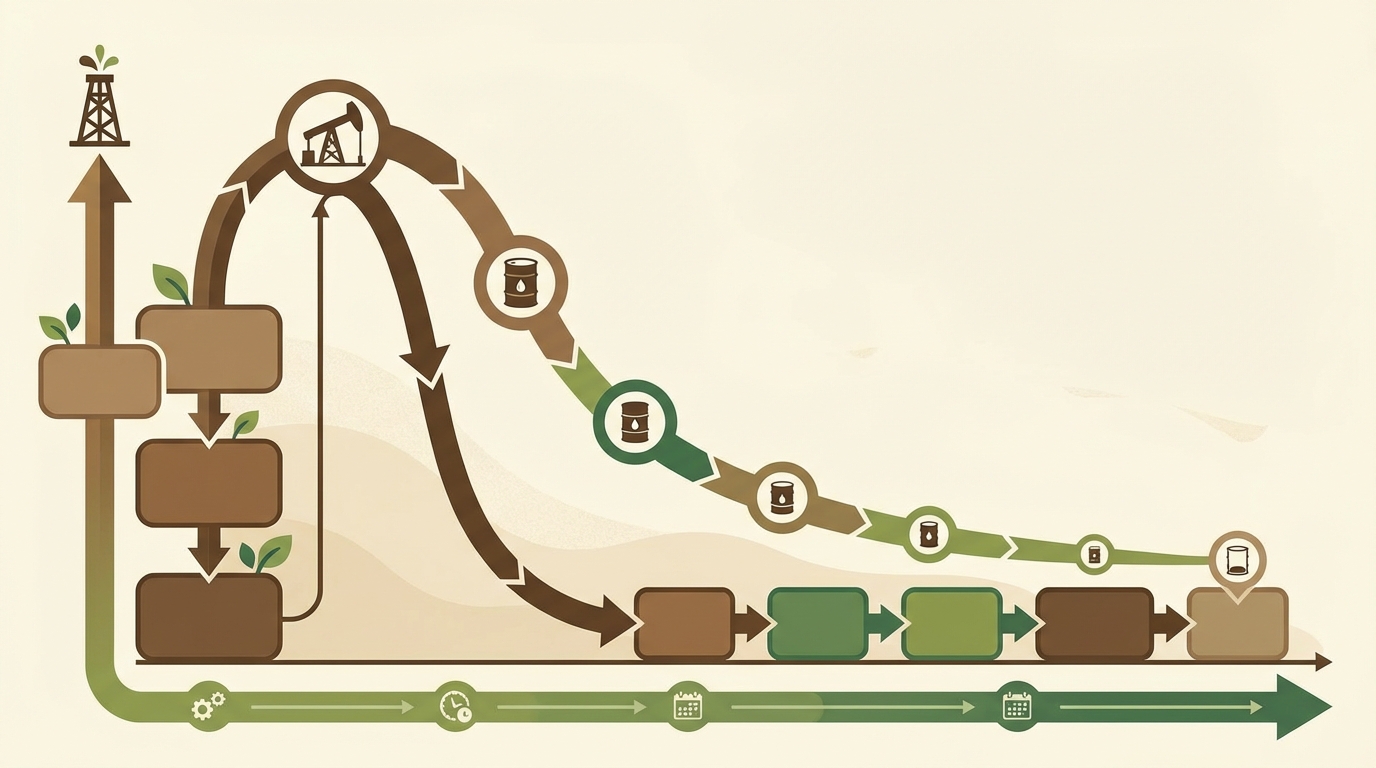
We get calls all the time from owners who are convinced the operator is skimming off the top or making accounting errors. While mistakes absolutely happen, the culprit is usually just physics. It’s called the :decline curve.
Think of a new oil well like a shaken soda can. When the operator first pops the tab, the underground pressure is immense. Production flows hard and fast. But once that initial pressure bleeds off, the flow slows down drastically. A typical horizontal well in Texas might produce 60% to 70% of its total lifetime oil in just the first few years.
After that initial flush, the well settles into a long, slow tail of production. It might pump for another twenty years, but at a fraction of that initial volume. This is known as :PDP, or Proved Developed Producing reserves. It’s steady, but it’s rarely exciting.
This matters because it changes how you look at your net worth. You aren’t necessarily losing money; you are just realizing that the “glory days” of that specific well are in the rearview mirror.
If you are holding out hoping those massive initial checks will return, you’re likely waiting for a train that already left the station. However, understanding this curve gives you clarity. You have to decide if you want the slow, predictable trickle of income over the next decade, or if it makes sense to pull that future value forward into a lump sum today. There isn’t a wrong answer, but you need the real math to make the choice.
:decline-curve
The rate at which an oil or gas well’s production falls over time. It is almost always steepest in the first 12 to 24 months before flattening out into a slow, steady decline.
:pdp
Short for “Proved Developed Producing.” This refers to oil and gas reserves that are currently coming out of the ground from existing wells. It’s the lowest-risk part of a mineral asset because the oil is already flowing.