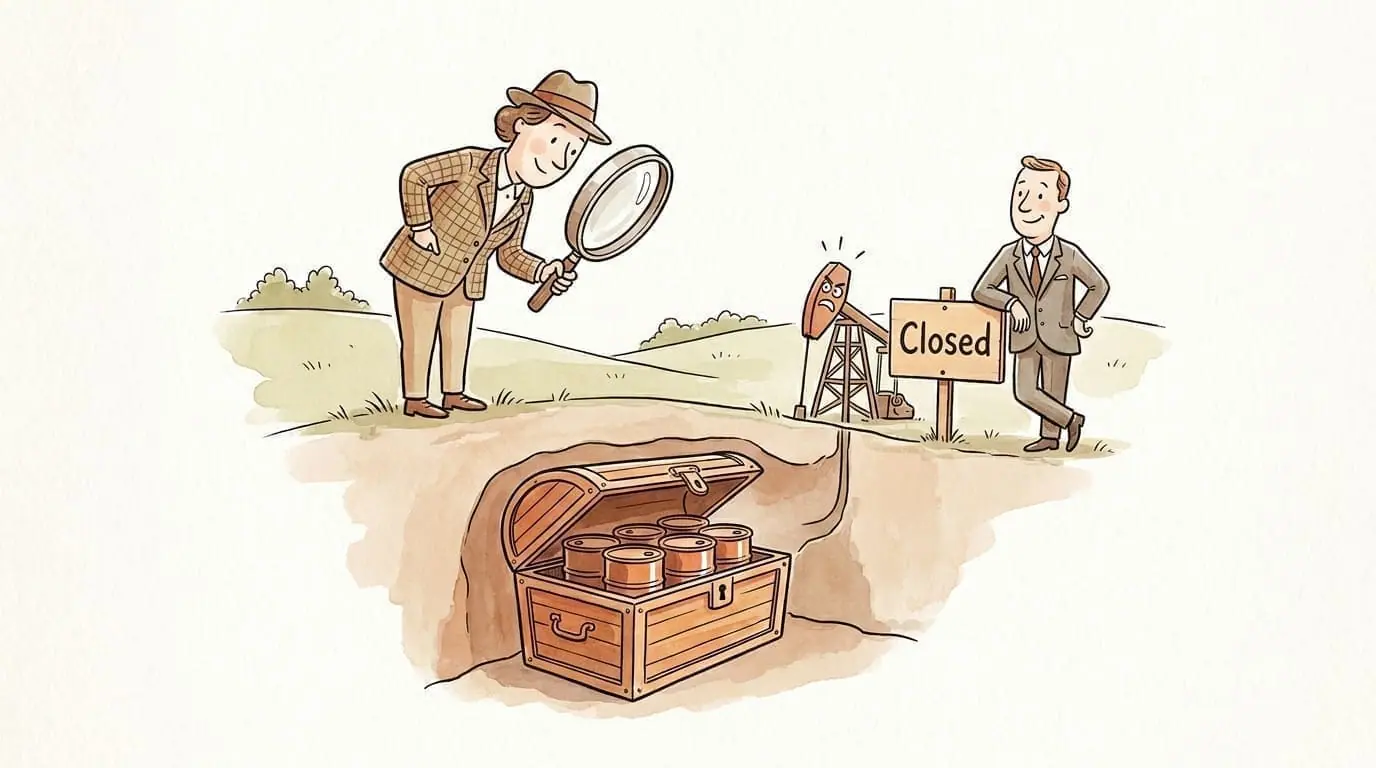
You own the rock. Your grandfather bought it decades ago, and the deed is sitting right there in your filing cabinet. The title is clear. The geology under your feet is proven, stacked with the kind of oil and gas reserves that built fortunes in the DJ Basin.
By all traditional measures of property law, you possess a highly valuable asset.
But in certain parts of Colorado right now, that piece of paper is effectively worthless. The state has not seized your title. No operator has drained your reserves. Yet, your asset is completely frozen.
We see this exact scenario play out constantly at our family office. We sit across the table from mineral owners who are confused and frustrated because they hold acreage in one of the most prolific oil basins in the country, but they cannot get a single operator to return their phone calls. The oil is down there. The operator wants to drill it. But a local city council has decided that neither of you is allowed to try.
This is the local control trap. It is a quiet, bureaucratic mechanism that creates :stranded minerals without ever requiring a town to write you a check for taking your property. And if your family owns minerals under the wrong Colorado municipality, you need to understand exactly how this invisible wall was built.
The Day the Rules Changed
To understand how we got here, we have to look back to 2019. That was the year the Colorado legislature passed Senate Bill 19-181, fundamentally rewriting the state’s relationship with energy production.
For more than half a century, American oil and gas law operated on a very specific mandate. The goal of state commissions was to conserve the resource. In the oil business, “conservation” does not mean leaving it in the ground. It means preventing physical waste and ensuring that operators extract as much of the resource as efficiently as possible. The mandate was to foster development.
SB 19-181 explicitly deleted that philosophy from Colorado law. The legislation changed the legal directive of the state commission. Their job was no longer to “foster” oil and gas development. Their new public interest mandate was to “regulate” the industry in order to “protect” public safety, health, welfare, and the environment.
The state completely restructured the commission itself to enforce this new reality. They reduced the number of industry representatives to just one single member. In their place, they brought in members with backgrounds in public health, environmental protection, and wildlife conservation.
But the most consequential part of the bill had nothing to hand to state regulators. It had to do with local politicians.
Handing the Keys to the Cities
Before 2019, local governments in Colorado had limited authority over oil and gas operations. If an operator met the state’s technical and environmental requirements, the state would issue a permit. Local towns could complain, but state law generally preempted local bans. The state understood that you cannot have a cohesive energy strategy if every single county and municipality writes its own conflicting rules.
SB 19-181 stripped away that limitation. It clarified that local governments now hold direct land use authority over the siting of oil and gas locations.
Suddenly, city councils and county commissioners had unprecedented power to regulate surface impacts. They were given the authority to impose heavy fines, levy new fees, and dictate exactly where an oil pad could be placed. Predictably, many municipalities along the Front Range used this new authority to essentially zone oil and gas out of existence within their borders.
The primary weapon of choice became the surface setback.
A setback is a rule dictating how far a drilling pad must be from buildings, homes, or schools. A town might pass a rule requiring a 2,000-foot setback for any new surface operations.
On paper, this sounds like a reasonable public health measure. But let us look at the geometry. A 2,000-foot setback requires a circle of clearance roughly 4,000 feet wide. If your minerals sit under a growing suburb in the DJ Basin, finding an empty 4,000-foot circle is physically impossible.
The Yale Law Journal recently highlighted this exact tension, noting that Weld County alone hosts over 23,000 wells in an area facing explosive residential population growth. As domestic fossil fuel development expands into populous areas, the clash between residential land use and drilling has become the defining feature of modern oil and gas governance.
When a town passes a massive setback rule, or enacts an indefinite moratorium on new permits while they “study the issue,” they do not have to ban drilling outright. They just make it impossible to execute.
You might think that because of horizontal drilling, an operator can just set up a pad outside the city limits and drill two miles sideways under the town. But those neighboring areas often have their own strict setbacks, or they simply refuse to grant the massive surface easements required for modern multi-well pads. The operator is boxed out. Your minerals are stranded.
The Regulatory Taking Debate
This brings us to one of the most fiercely debated legal concepts in property rights today.
If the government decides they need your family farm to build a new interstate highway, they have to pay you for it. The Fifth Amendment requires just compensation for the taking of private property.
But what happens when the government does not take your title, but simply passes a regulation that makes your property worthless? This is known as a :regulatory taking.
Mineral owners in Colorado are fighting this battle in the courts right now. They argue that when a municipality uses its :police power to pass a 2,000-foot setback, they are effectively stealing the underground asset. The rock has value solely because of the oil inside it. If the state grants local governments the power to permanently block access to that oil, the state has destroyed the asset’s economic viability.
The legal hurdles here are incredibly high. Courts are traditionally very deferential to local governments when it comes to public health and safety. The cities argue they are not taking your minerals. They argue they are simply regulating the surface impacts to protect their citizens from noise, traffic, and emissions. The fact that this regulation incidentally makes your subsurface property un-drillable is, in their eyes, just unfortunate collateral damage.
This leaves the mineral owner in a brutal limbo. You are holding a deed to an asset that could be worth millions of dollars if a drill bit could reach it. But since it cannot, you are left holding nothing but the obligation to pay property taxes and the faint hope of a future Supreme Court ruling.
The Operator’s Reality
To really understand why your minerals are stuck, you have to look at this through the eyes of an oil and gas exploration company.
Operators are highly rational allocators of capital. A modern horizontal well in the DJ Basin costs millions of dollars to drill and complete. Before an operator spends a dime on steel or frac sand, they have to spend massive amounts of money on legal fees, permitting, and planning.
If an operator looks at your acreage and sees that it sits inside a municipality with hostile local control, they do a very simple math equation. They weigh the potential oil recovery against the cost of fighting a hostile city council for three years.
They know that even if they manage to get a local permit, the city might impose such draconian conditions on noise, traffic routing, and pipeline construction that the well is no longer profitable. Or worse, the city might wait until the operator has spent millions in prep work, and then suddenly pass a new moratorium.
Capital flows to the path of least resistance. We operate out of Texas, and the contrast could not be sharper. Texas heavily restricts local control specifically to avoid this patchwork of municipal bans. Capital flows to West Texas and North Dakota because the regulatory environments are predictable. When an operator has a budget of fifty million dollars to deploy this year, they are not going to deploy it in a Colorado town that hates them. They are going to pack up their rigs and move to a jurisdiction that wants the tax revenue.
This means you are not just waiting on the law to change. You are waiting for operators to care again. And in the fast-moving world of energy finance, that wait can be permanent.
Navigating the Uncertainty
So what do you do when you own minerals trapped in this regulatory web?
The hardest part for most families is the uncertainty. It feels terrible to hold an asset that is slowly being regulated into oblivion. You might be dealing with the complex process of producing vs. non-producing minerals in your estate planning, and trying to assign a value to a blocked asset is a nightmare for your CPA.
Some families choose to hold. They believe that energy prices will eventually spike so high that state lawmakers will be forced to roll back local control and mandate production. They view their stranded minerals as a deep out-of-the-money call option. That is a perfectly valid strategy if you have the patience and you do not need the capital.
Other families look at the political trajectory of the Front Range and decide they want off the ride. They look at how Colorado turns silence into cost-recovery problems and they realize the regulatory environment is only getting tighter.
Valuing these assets is difficult, but it is not impossible. Buyers who understand political risk can model the probability of future development. The valuation will absolutely reflect a massive discount compared to drillable acreage in Texas or Wyoming. But a discounted value is often better than a permanent zero, especially if the capital can be deployed into something productive for your family today.
We know how frustrating this situation is. We talk to folks every week who feel like their family legacy is being slowly suffocated by city ordinances they never voted for.
You cannot control what the city council decides at their next zoning meeting. But you can control how you handle your own estate. Finding out if a mineral offer is actually fair in a stranded environment requires looking at cold, hard math rather than historical emotion.
The worst thing you can do is simply ignore the problem and hope the political winds shift. The rules of the game changed in 2019. The map was redrawn. If your minerals are sitting in one of these restricted zones, your first step is simply knowing what they are actually worth in today’s regulatory reality.
Having the facts gives you options. And having options gives you peace of mind. It is always worth a conversation just to find out where you stand.
:stranded-minerals
Mineral rights that are legally owned and geologically viable, but physically impossible to develop due to surface restrictions, local bans, or lack of operator access. The resource is trapped underground permanently unless regulations change.
:regulatory-taking
A situation where the government does not physically seize your property, but passes regulations so restrictive that they destroy the property’s economic value. Mineral owners often argue that drilling bans are regulatory takings that require financial compensation under the Fifth Amendment.
:police-power
The fundamental right of a government to make laws and regulations that protect the health, safety, and welfare of its citizens. Local towns frequently cite their police power as the legal justification for imposing strict drilling setbacks and noise ordinances.