If you own mineral rights in Texas, the rules are generally straightforward. You own the rock, you sign a lease, you get a check. It’s a contract between you and an oil company, governed by established state law.
Move across the border into New Mexico—specifically the Delaware Basin in Lea or Eddy Counties—and you enter a different world.
We see this confusion all the time. A family inherits a section of land near Carlsbad. They start getting checks. But the deductions are confusing, the pay schedules seem erratic, and the paperwork mentions entities that sound like government bureaus rather than oil companies.
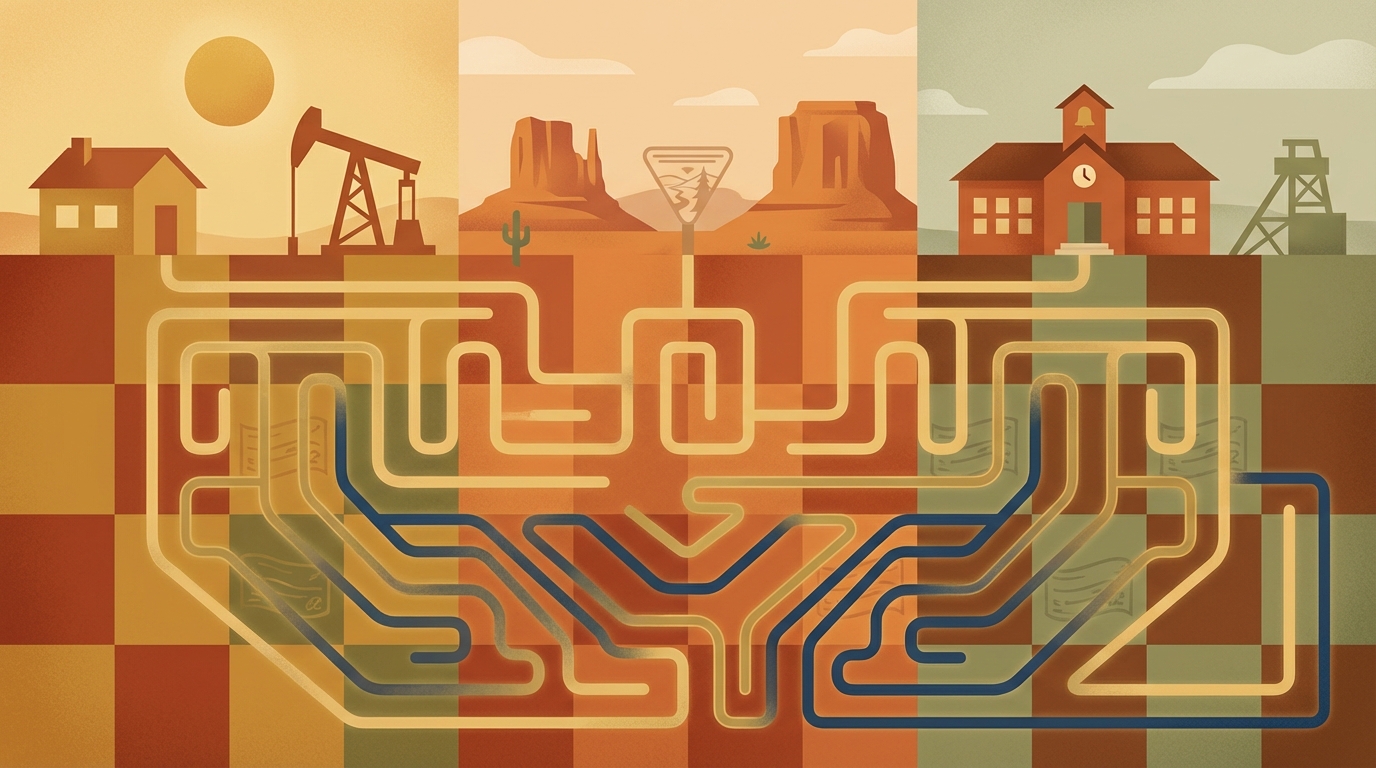
That’s because New Mexico isn’t just one jurisdiction. It’s a checkerboard of three distinct “regimes,” often sitting right next to each other—or sometimes, stacked on top of one another in the same well.
To understand your money in New Mexico, you have to answer one question: Who is the landlord?
Most owners assume the answer is “me.” But in New Mexico, that’s rarely the whole story. You are likely tangled in a three-way regulatory web involving Private Fee land, Federal (BLM) land, and the often-misunderstood “Third Regime”: State Trust Lands.
The Three Landlords
In the Permian Basin of New Mexico, three entities own the mineral estate. Your royalty check depends entirely on which of these three buckets your acreage falls into—or is pooled with.
1. Private Fee Minerals
This is what most people are familiar with. You (or your family) own the mineral rights. You signed a lease with an operator (like Devon, EOG, or Occidental). The terms of that lease dictate your royalty. Disputes are settled in court based on contract law.
2. Federal Minerals (The BLM)
The U.S. Government owns a massive amount of minerals in New Mexico. These are managed by the Bureau of Land Management (BLM) and the royalties are collected by the Office of Natural Resources Revenue (ONRR).
Federal minerals come with a thick book of regulations—specifically 30 CFR Part 1210 and others—that dictate exactly how oil must be valued. It’s bureaucratic, sure, but it’s standardized.
3. State Trust Lands (The Wildcard)
This is the one that trips people up. New Mexico was granted millions of acres of land at statehood specifically to fund public institutions (mostly public schools, universities, and hospitals). These are managed by the New Mexico State Land Office (NMSLO).
Here is the critical difference: The State Land Office is not just a regulator. They are a beneficiary with a constitutional mandate to make as much money as possible for the schools. They are aggressive, sophisticated, and they have their own set of rules that often override standard industry practices.
The ONGARD Machine
If your minerals are pooled with State Trust Lands, or if you are looking at data regarding a well on State land, you are entering the world of :ONGARD.
ONGARD (Oil and Natural Gas Administration and Revenue Database) is the central nervous system of New Mexico oil finance. According to the New Mexico State Land Office, this system “tracks oil and gas production, taxes, and royalties in a relational database” and is used to “audit oil and gas production volumes.”
Why does this matter to you?
Because unlike a private lease where the oil company does their own accounting and sends you a check, operators on State Trust Lands have to feed data into this massive state machine. The State uses ONGARD to aggressively audit volumes and values.
If the State Land Office disagrees with how an operator calculated a deduction or a volume, they don’t just send a angry letter. They can trigger audit adjustments that ripple through the operator’s accounting department.
For a mineral owner, this often manifests as:
- Prior Period Adjustments: You get a check that adds $500 for current production but subtracts $450 for “adjustments” from two years ago.
- Check Suspense: The operator freezes payment because they are in a dispute with the State regarding the “formatting” of the unit.
- Deduction Confusion: The State has strict rules on what can be deducted from their royalty. Operators sometimes apply these state-mandated formulas to your private interest if you are in the same unit, even if your lease prohibits it.
The “Communitization” Headache
The real headache starts when these regimes mix.
Modern horizontal wells are long—often two or three miles. In New Mexico, it is very common for a single wellbore to drill through:
- A tract of Federal land.
- A tract of State Trust land.
- A tract of your Private land.
To make this legal, the operator creates a Communitization Agreement (CA). This blends the royalties from all three tracts into one “community.”
We broke down how division orders work in a previous piece, but CAs in New Mexico are division orders on steroids.
The problem is the “Lowest Common Denominator” effect. The operator has to satisfy the strictest landlord. Usually, that’s the Federal government on environmental compliance, but it’s the State Land Office on revenue reporting.
We have seen cases where a family’s royalty payments were delayed for six months not because the well wasn’t producing, and not because the title wasn’t clear, but because the operator was waiting for the State Land Commissioner to sign off on the final Communitization Agreement. Until the State signs, the operator often won’t pay anyone.
The Audit Aggression
The New Mexico State Land Office is essentially a large, specialized accounting firm with police powers. Their job is to ensure the “beneficiaries” (schools) don’t get shorted a penny.
They publish specific guidance, like the “Royalty Filers Kit,” which tells oil companies exactly how to format their data. If an operator messes up a code, the system flags it.
Compare this to a private owner. If an operator underpays you by 2% on gas liquids, you will likely never know. You don’t have a team of auditors or a mainframe computer checking the volumes. But if that operator underpays the State in the same well, the State will catch it.
Sometimes, this benefits you. If the State forces an operator to recalculate volumes, that correction might flow through to your decimal interest too.
But more often, it creates friction. Operators are terrified of New Mexico compliance. They tend to be ultra-conservative with payouts in New Mexico compared to Texas. They hold money in suspense at the slightest hint of a paperwork issue because they know the State Land Office is watching.
The “Third Regime” Valuation Discount
When we look at buying minerals in New Mexico, we have to treat them differently than Texas minerals.
In Texas, we look at the geology and the price of oil. In New Mexico, we have to look at the regulatory risk.
If a property is heavily entangled with State Trust Lands, we know that:
- Administrative delays are likely. The paperwork burden on the operator is higher.
- Deductions are stickier. The fine print that eats your check is harder to fight when the operator claims they are just following state reporting guidelines.
- Political risk exists. The State Land Commissioner is an elected official. Policies on drilling permits, fresh water usage, and royalty audits can change with an election cycle.
This doesn’t mean New Mexico minerals aren’t valuable. The geology in the Delaware Basin is arguably the best in the world. The wells are massive. But the liquidity—the ease of getting that money out of the ground and into your bank account—is lower than in Texas.
Why We Are Different
Most buyers treat New Mexico deals just like Texas deals, then get surprised when the title work takes six months or the Communitization Agreement isn’t approved. They lock you into a contract and then stall.
We function as a family office. We understand that New Mexico is a different animal. We know how to read an ONGARD report. We know that a delay in a “Communitization Agreement” isn’t a reason to kill a deal—it’s just a Tuesday in Santa Fe.
If you are owning minerals in this “Third Regime,” you probably feel the complexity even if you can’t name it. You feel it in the erratic check sizes and the confusing statements.
It is worth knowing exactly what you own. Not just the acreage, but the regulatory environment it lives in. If you want to walk through the math, or just vent about the paperwork, reach out. We speak New Mexico.
:ongard
ONGARD (Oil and Natural Gas Administration and Revenue Database) Think of this as the “Master Brain” of New Mexico energy. It is a centralized database shared by the State Land Office and the Taxation and Revenue Department. Every barrel of oil and MCF of gas produced on state lands is reported here. It is used to generate tax bills and audit royalty payments. For mineral owners, it is a goldmine of public data, but it is notoriously difficult for non-professionals to navigate.
:communitization-agreement
Communitization Agreement (CA) A CA is a contract that pools federal or state lands with private lands to form a drilling unit. Because federal and state governments cannot simply be “pooled” like a private citizen, they require this specific agreement to share revenue. If you are in a well with a CA, your royalty checks are often dependent on the government approving this document.
:state-trust-lands
State Trust Lands These are not “public lands” in the sense of a national park you can camp on. They are lands granted to New Mexico by the federal government specifically to generate revenue for designated beneficiaries (primarily public schools). The State Land Office manages these lands with a fiduciary duty to maximize income, making them much more aggressive regarding royalties than the BLM or private owners.