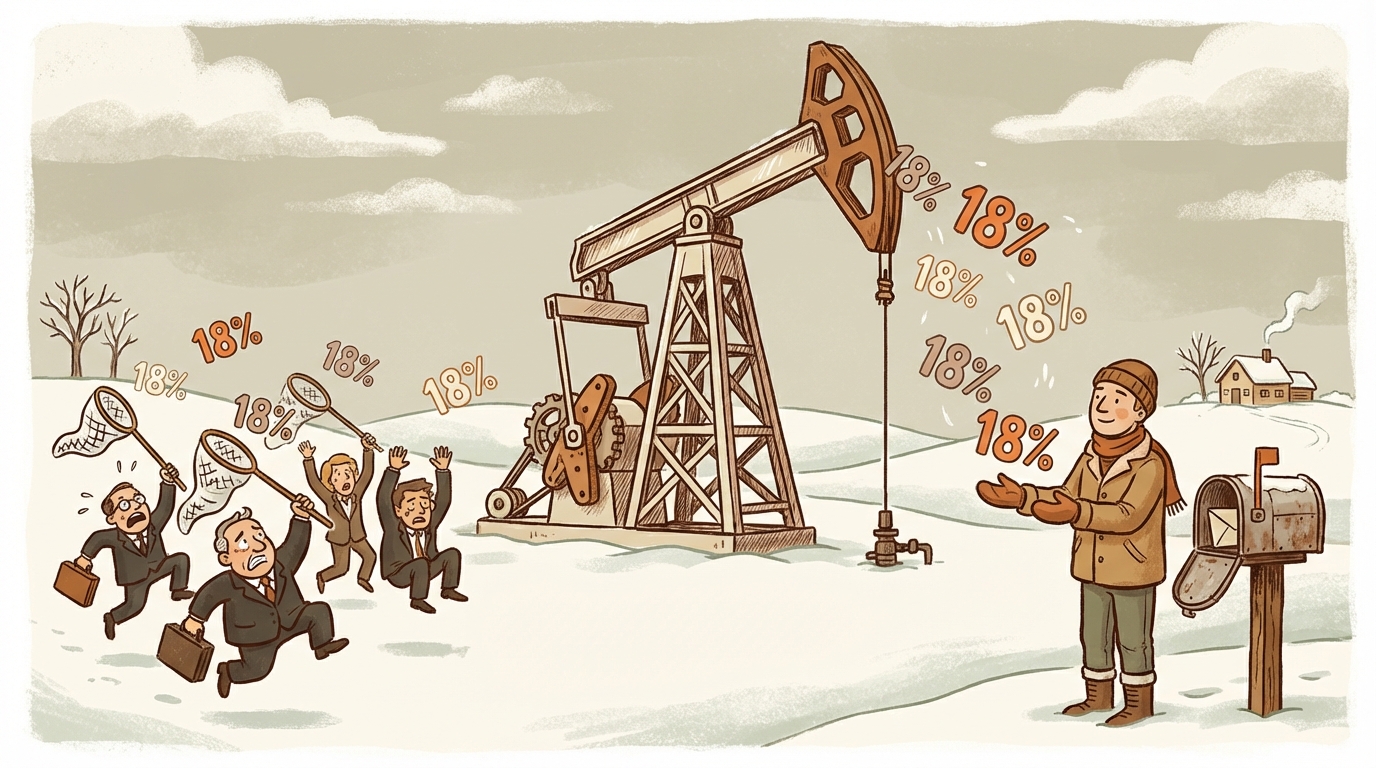
They owed one family over $750,000 in missing royalties. Then they owed them interest that looked like a high-limit credit card bill.
In most states, late royalties are just annoying. You call the operator. You leave voicemails. You wait. The operator eventually cuts a check for the exact amount they owed you months ago, and they keep the interest they earned by holding your money in their bank account.
North Dakota plays by different rules. In North Dakota, late royalties can become incredibly expensive for the oil company. The state has a mechanism known as the Suspense Statute. It requires operators to pay royalties within a set timeframe. If they fail, they can be hit with an 18 percent annual interest rate on the unpaid balance.
Operators are kings in this industry until the statute says otherwise. This law gives mineral owners serious leverage. But oil companies have massive legal departments. They know exactly how to use specific statutory escape hatches to avoid paying that 18 percent penalty. Owners often do not realize they have a statutory interest claim sitting there until the legal clock runs out and the claim disappears.
Let us look at how this statute actually works in the real world. We will cover when the operator owes you interest, how they use the “title dispute” excuse to get out of it, and what you can do to protect your bottom line.
The Law in Plain English
Under North Dakota Century Code § 47-16-39.1, the rule is simple on its face. The mineral developer must pay royalties within 150 days after oil or gas produced is marketed. After that initial period, they must pay you regularly. If they fail to pay you on time, the unpaid royalties bear interest at the rate of 18 percent per year.
Eighteen percent is a massive number. It is designed to be punitive. The state legislature wanted to stop operators from treating mineral owners like an interest-free line of credit.
But operators do not just hand over 18 percent interest voluntarily. They rely on a critical exception written right into the law. The statute says the penalty does not apply “in the event of a dispute of title existing that would affect distribution of royalty payments.”
Industry insiders call this the :Safe Harbor provision. If an operator can point to a title dispute, they can place your funds in :suspense and stop the 18 percent interest clock from ticking. Operators love the phrase “title dispute.” They use it constantly. They use it broadly. And courts have had to step in to define exactly what it means.
The Escape Hatch: Vic Christensen and the Title Dispute
To understand how operators use this safe harbor, we need to look at a specific legal fight. In 2022, the North Dakota Supreme Court issued a ruling in the Vic Christensen Mineral Trust v. Enerplus Resources case. The details tell you exactly what you are up against.
Enerplus was operating a well. They suspended royalty payments to several mineral owners, including the Vic Christensen Mineral Trust. The operator claimed there was a title defect identified in their drilling title opinion. This defect actually resulted in a lawsuit between the competing mineral owners.
Eventually, the mineral owners settled their disagreement. The Trust then turned around and sued Enerplus. The Trust argued that Enerplus “over-suspended” the payments. They claimed the operator should have only suspended the specific fraction of the money that was actively in dispute, and they demanded 18 percent interest on the rest.
The Supreme Court sided with the operator. You can read the breakdown of the decision from Fredrikson & Byron here. The court held that the safe harbor provision is not limited to just the specific percentage in dispute.
Think about the math on that. Suppose you own a lease with an 18 percent royalty rate on a tract of land. Let us say only 50 percent of your mineral interest has a title defect. Under this ruling, the operator can suspend your entire royalty payment for that tract. They do not just suspend the 50 percent that is messy. They freeze the whole thing, and the safe harbor protects them from paying you the 18 percent statutory interest on any of it.
This ruling was a massive win for operators. It means that any legitimate dispute found in a title opinion gives them a free pass to freeze your cash flow. We see this all the time. It is exactly why we previously wrote about The Title Opinion Shadow Market: Why You Can’t See the Document That Controls Your Pay. The operator holds the documents that dictate your suspense status, and you usually have to fight to even see them.
The Notice Trap: Powell v. Statoil
Operators might have won the Christensen case, but they do not have blanket immunity. A more recent case shows exactly how operators trap themselves through administrative laziness.
The case is Powell v. Statoil Oil & Gas LP, and it exposes a massive blind spot for oil companies. A woman named June Slagle owned a life estate mineral interest in McKenzie County. In 2010, Statoil’s predecessor leased the minerals. The lease was signed by June’s daughter, Fonda Powell, who held a power of attorney.
The operator had a copy of the power of attorney. But the document was never officially recorded in the county courthouse.
The well started producing in 2012. Statoil never paid June Slagle a dime during her lifetime. They placed the account in suspense because of the unrecorded power of attorney. But they never actually told June or Fonda about the problem. They just quietly held the money.
After June died, Statoil finally paid her trust about $750,000 for the suspended base royalties in 2017. The family sued for the 18 percent statutory interest. Statoil tried to hide behind the safe harbor provision. They argued that the unrecorded power of attorney created a legitimate “title dispute.”
The Supreme Court looked at a different part of the law. Under N.D.C.C. § 47-16-39.4, if there is a disagreement over ownership between the mineral owner and the operator, the operator must furnish the owner with a description of the conflict and a proposed resolution.
Statoil failed to do this. They never contacted June Slagle to tell her about the missing county record. Because they failed to give formal notice, the court ruled they could not use the safe harbor provision. Statoil owed the statutory interest. You can find more technical details on this ruling from Oliva Gibbs here.
The lesson here is profound. If the title dispute is between you and your cousin, the operator might not need to notify you before suspending your checks. But if the dispute is between you and the operator over their internal paperwork requirements, they cannot just ghost you. They must provide notice. If they stay silent, the 18 percent clock is ticking.
The Second Trap: The Statute of Limitations
This brings us to the most dangerous part of the North Dakota Suspense Statute. You cannot wait forever to claim your money.
In the Powell case, Statoil tried to argue that the 18 percent interest was technically a “penalty.” In North Dakota, lawsuits over penalties have a strict three-year statute of limitations. The oil company wanted the family’s claim thrown out because they waited too long to sue.
The court rejected this argument. They leaned on a previous 2016 case (Kittleson) and ruled that the obligation to pay royalties is a contract affecting title to real property. Therefore, a ten-year statute of limitations applies.
Ten years sounds like a long time. It is not.
We work with families every week who are trying to untangle estates from decades ago. Grandparents pass away. The estate goes through probate. The children inherit the assets but do not know exactly what wells they own. Years slip by while the family tries to figure out why the checks stopped. We covered this exact scenario in The Royalty Black Hole: Why Your Checks Stopped (But the Well Didn’t).
If an operator suspended your royalties in 2013 and never told you, and you finally figure it out in 2025, your claim for that 18 percent interest is likely dead. The operator keeps the windfall. The legal clock is unforgiving.
The Owner Playbook
So how do you actually use this information to protect your assets in North Dakota? You have to go on the offensive.
First, you must request a written reason for any suspense. Do not accept a verbal answer from a division order analyst over the phone. You want a formal email or letter stating exactly why your funds are being held. You need a paper trail to prove whether they actually gave you the notice required by law.
Second, force specificity. Operators will often send a generic letter saying “title dispute.” Write back and demand the specific title opinion requirement. Are two heirs fighting over a deed? Or did the operator just lose a copy of your W-9? Administrative missing paperwork is entirely different from a genuine legal dispute over title. Make them prove it is a real dispute.
Third, calculate the interest at stake. Use it as leverage. If an operator owes you $50,000 that has been suspended for four years without proper notice, the accrued 18 percent interest is massive. You can sometimes use the threat of a statutory interest lawsuit to force them to clear your title and release your base funds immediately.
The Rational Alternative
I will be completely honest with you. Policing operators is a heavy burden. It requires constant vigilance.
North Dakota is a fantastic state for oil and gas production. It generates serious wealth. We wrote about the state’s potential in North Dakota: Quiet Money in a Mature Basin. But getting that wealth out of the operator’s bank account and into yours takes work.
You have to audit your check stubs. You have to track missing payments. You have to hire specialized oil and gas attorneys to write demand letters. You have to monitor the ten-year statute of limitations to ensure your claims do not expire. You have to fight legal battles against corporations that have virtually unlimited budgets for litigation.
Many families eventually look at the math and realize the effort is just not worth the emotional toll. They do not want to spend their retirement tracking certified letters to oil companies or dealing with aggressive landmen.
Selling your mineral rights is one valid way to step off the treadmill. When you sell, the buyer takes on the legal fights. The buyer hires the attorneys to cure the title. The buyer assumes the risk of the operator trying to enforce a safe harbor provision. You walk away with a clean lump sum and absolute certainty.
We buy mineral rights across the country. We know how to navigate the North Dakota Suspense Statute. We have the legal resources to force operators to pay what they owe.
If you are tired of wondering why your checks stopped, or if you are staring at a suspense letter that makes no sense, you have options. You do not have to fight the operator alone. Sometimes the best financial decision is to let someone else take on the administrative headache.
It is always worth knowing what your property is actually worth on the open market. Get a valuation. See the real numbers. At the very least, you will have the peace of mind that comes from knowing exactly where you stand.
:safe-harbor
A legal provision that protects someone from a penalty if they meet certain conditions. In North Dakota mineral law, operators use the “title dispute” safe harbor to avoid paying 18% interest on late royalties. If they can prove ownership is genuinely unclear, the law gives them a pass on the penalty.
:suspense
A temporary holding status for royalty payments. When an operator cannot figure out exactly who to pay, or if they are missing critical paperwork, they place the money in a suspense account. The funds sit there, unpaid, until the underlying issue is resolved.