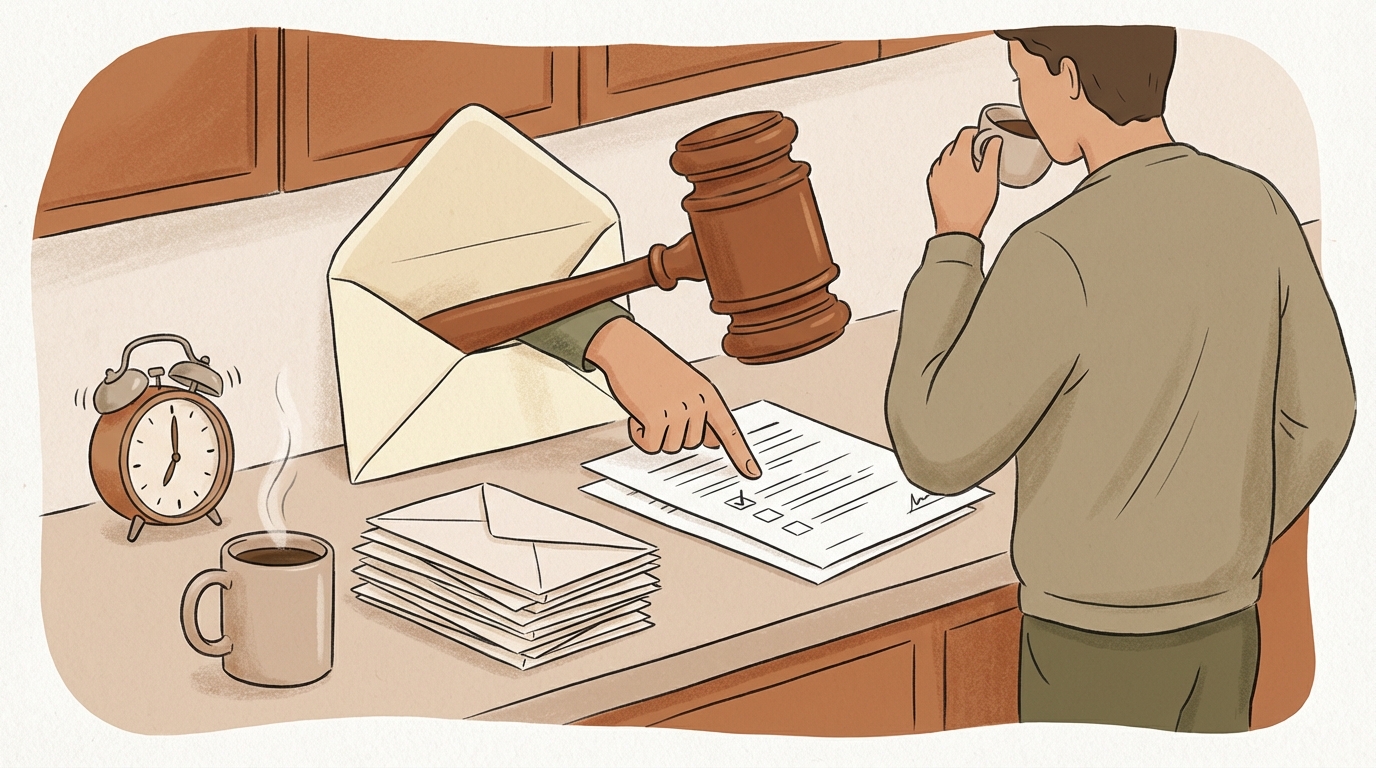
I hear the exact same sentence from mineral owners a few times a month.
“I got this thick packet of legal papers from Oklahoma. I did not want anything to do with it, so I just didn’t sign anything.”
The assumption makes sense. In almost every other area of American life, if you do not sign a contract, you are not bound by it. You ignore the junk mail and the problem goes away.
Oklahoma oil and gas law works differently. If you receive a pooling order in the mail and throw it in the kitchen drawer, the clock keeps ticking. The state will essentially sign a contract on your behalf. That default choice is rarely the one you would have picked for yourself.
For families who own small fractions of mineral rights, this creates a constant, low-level paperwork risk. You have to monitor your mailbox. You have to understand legal jargon. You have to act fast. Let’s look at how the Oklahoma system actually operates and why ignoring the mail is the most expensive decision you can make.
The Mechanics of Forced Pooling
Oklahoma law only allows one initial well in a designated drilling and spacing unit. This prevents companies from drilling hundreds of chaotic wells right next to each other.
But this rule creates a practical problem. If an operator wants to drill a well, they need the rights to the minerals in that specific unit. They try to lease those rights from the owners. If even one owner refuses to sign a lease, or cannot be found, that single holdout could theoretically block the entire multi-million-dollar well.
Oklahoma prevents this through a process called :forced pooling.
When an operator cannot reach an agreement with every single owner, they file an application with the Oklahoma Corporation Commission (OCC). The operator must prove they made a good faith effort to find you and bargain with you. They list all the unleased owners on a document called Exhibit A.
The OCC then holds a hearing with an Administrative Law Judge. The judge looks at the costs of drilling the well. They also determine the fair market value of the mineral interests. According to the OCC, the judge figures out this value by looking at open market transactions and leases signed in that unit, plus the eight surrounding units, over the past year.
The judge requires the operator to prepare a pooling order. Once that order is signed by the Commission, a very fast clock starts ticking.
The 20-Day Trap
Under Oklahoma Administrative Code 165:5-15-3, a pooling order must give you at least 20 days to communicate your choice to the operator.
That sounds like plenty of time. It is not.
The law says you have 20 days from the date of the order. The operator has three days to drop the order in the mail. The postal service takes another few days to get it to your house. By the time you open the envelope, you might have 12 or 14 days left to read a dense legal document, consult an advisor, make a financial calculation, and return your election.
If your response is not postmarked by the deadline, you miss your window.
This short timeline is exactly why so you inherited mineral rights guides always stress opening your mail immediately. The state of Oklahoma does not care if you were on vacation. They do not care if the envelope looked like junk mail. The order ran its clock.
Your Choices on the Menu
When you read a pooling order, you will usually find a menu of options. The judge has determined the fair market value of the rights and provided a few ways you can be compensated.
Usually, the options involve different combinations of a cash bonus upfront and a royalty percentage on future production.
You might see an option for a $1,000 per acre bonus with a 1/8th royalty. You might see another option for a $500 per acre bonus with a 3/16th royalty. You might see an option with no cash bonus at all, but a 1/5th royalty.
You will also see an option to participate in the well. This means you agree to pay your proportional share of the drilling and operating costs. For the vast majority of family mineral owners, participating is a terrible idea. Drilling a modern horizontal well costs millions of dollars. If you elect to participate, you will receive a massive bill. If the well turns out to be a dry hole or a poor producer, you lose your money. Leave the drilling risk to the oil companies.
The most important part of the pooling order is the default clause. The document will explicitly state what happens if you fail to make an election within the 20 days.
Often, the default election is the highest cash bonus and the lowest royalty percentage. The operator wants to keep as much of the long-term production revenue as possible. By doing nothing, you quietly hand them that higher royalty share in exchange for a one-time cash payment.
The Nightmare of Address Drift
The 20-day clock is stressful for people who actually receive their mail. It is a disaster for families with outdated title records.
People move. Grandparents pass away. Estates get split among multiple children who then move across the country. If the county courthouse does not have your current address, the operator cannot find you.
When operators cannot locate an owner, they still pool the interest. They list the person as an unknown or unlocatable respondent. The 20-day clock runs entirely without your knowledge. The default election is triggered.
Because the operator cannot find you to mail your default cash bonus, the state requires them to put that money into an escrow account. The money sits there. If a well gets drilled and produces oil, the royalty payments also go into that escrow account.
Eventually, the family realizes they own minerals. They go through the time and expense of fixing the title. They update the records. They finally contact the operator.
At this point, they discover they were pooled five years ago. They are locked into the default election. They missed the chance to negotiate a higher royalty percentage. We explain this heavily when families ask us about the probate trap because a delayed estate settlement directly leads to missed pooling orders.
Fixing Title Does Not Fix the Past
Let us say you finally fix the family title. You update your address. You reach out to the operator to claim the funds sitting in the escrow account.
Getting your money is rarely a fast process.
Oklahoma has prompt payment laws designed to protect mineral owners. Operators are supposed to pay interest on royalties held in suspense. But oil companies do not operate like banks automatically crediting your account. You often have to know your rights and specifically demand the interest you are owed.
The operator’s division order department will send you paperwork to sign. You will have to verify your decimal interest. If you do not understand how understanding your division orders works, you might sign a document that inadvertently alters your rights or fails to capture the interest you are owed from those years in escrow.
You are forced to become a part-time oil and gas accountant just to get the money the state held for you.
What to Do on Day One
If a thick packet from the Oklahoma Corporation Commission shows up in your mailbox, you need a plan.
First, look at the date of the order. Count exactly 20 days forward. Write that date on your kitchen calendar. That is your absolute deadline to have a response postmarked.
Second, read the options. Decide if you prefer money today (higher cash bonus) or money over the next decade (higher royalty percentage). There is no universally correct answer. It depends entirely on your financial situation and your belief in the well’s potential.
Third, make your election in writing. The order will specify exactly who needs to receive your decision. Send it via certified mail with a return receipt requested. You want hard proof that the operator received your choice before the deadline.
Fourth, follow up. Check your bank account or mailbox 30 to 35 days after the order date. If you elected an option with a cash bonus, Oklahoma law requires the operator to pay you within that window. Keep them accountable.
The Asymmetry of Mineral Ownership
I have sat at kitchen tables across Texas and Oklahoma talking to families about these exact packets. The frustration is always the same.
Oil companies have entire departments of attorneys, landmen, and accountants dedicated to managing pooling orders, mailing deadlines, and escrow accounts. They do this all day, every day.
You do not. You have a job, a family, and a life.
When you own a small, fractional mineral interest, the upside is real. A good well can generate meaningful monthly income. But the paperwork risk is constant. The burden of monitoring the mail, updating addresses, understanding legal orders, and fighting for suspended funds falls entirely on your shoulders.
This asymmetry is exactly why many families eventually decide they want off the treadmill. They realize that managing a scattered group of fractional interests requires more time and expertise than they want to invest.
Selling is not a failure to manage your inheritance. Often, it is a highly rational decision to trade administrative burden and uncertainty for a clean break. Knowing what your property is actually worth on the open market gives you a baseline to make that choice. You do not have to sell, but you absolutely should know your options.
In Oklahoma, silence is never neutral. Doing nothing is a decision you did not mean to make. When you understand the clock you are up against, you can at least make sure your choices remain your own.
:forced-pooling
A legal mechanism used by states to gather all mineral owners in a specific drilling unit together. If an oil company cannot get everyone to sign a lease voluntarily, the state can issue an order compelling the remaining owners to participate or accept a set compensation package. This prevents one holdout from blocking a well that benefits everyone else.
:pooling-order
The official legal document issued by a state commission that finalizes the forced pooling process. It outlines the specific choices available to unleased owners, sets the exact deadline for making a decision, and dictates what happens if an owner fails to respond in time.
:working-interest
An ownership type where you are actually a partner in the drilling operation. Instead of just sitting back and collecting a royalty check, you have to pay your percentage of the millions of dollars it costs to drill and maintain the well. You take on the financial risk if the well fails.