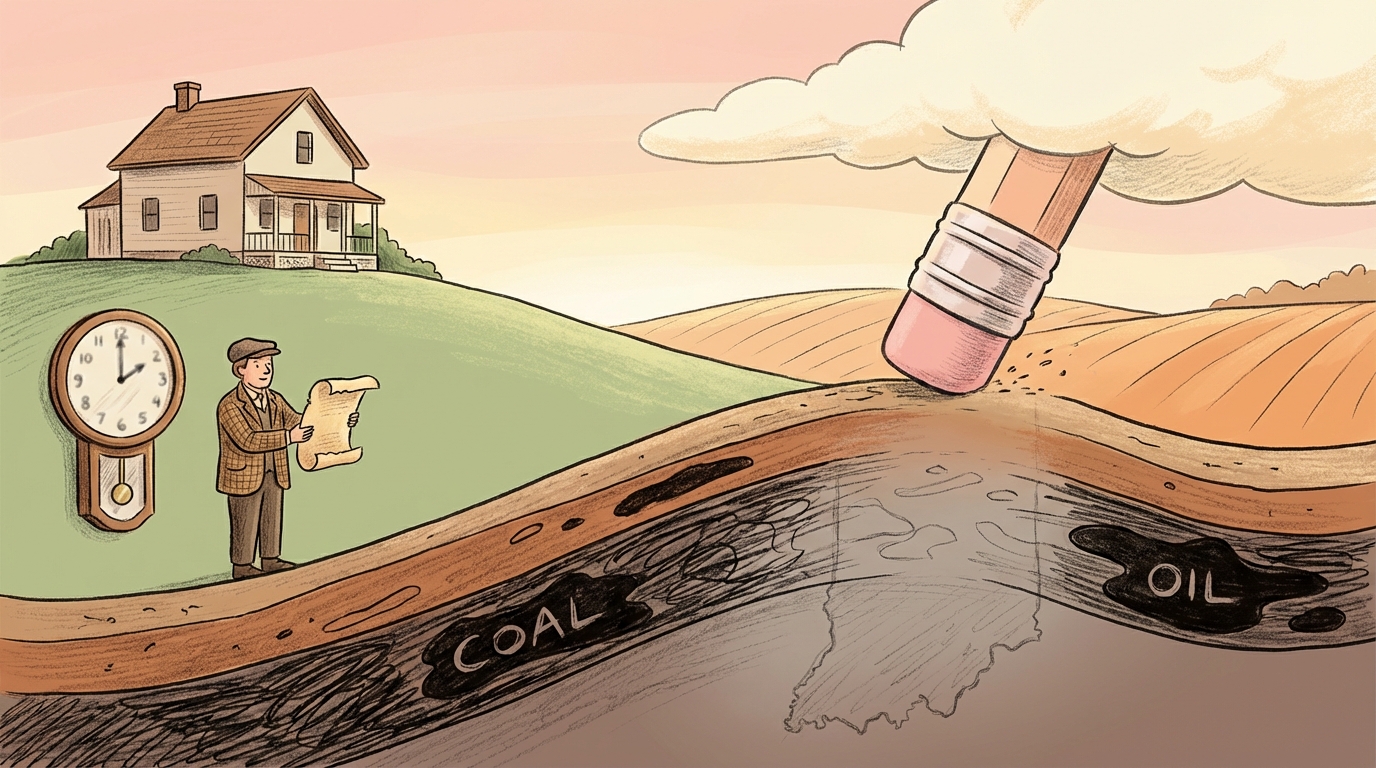
Your grandfather sold the family farm in Knox County back in the late 1960s. He knew enough to write a specific clause into the deed reserving the coal, oil, and gas rights for his descendants. He tucked the paperwork into a filing cabinet. Decades passed. No operator ever came knocking to drill a well. No one ever recorded a new deed. The family simply held onto the paper, assuming they owned those minerals forever.
Then a new surface owner decides they want to develop the land. Their title attorney notices your family’s old mineral reservation. Because the minerals have sat dormant for over two decades, the attorney files a bit of paperwork at the county courthouse.
Just like that, your family’s ownership is extinguished. The asset vanishes. The surface owner now owns the minerals.
This is not a rare legal loophole. It is a feature of Indiana state law. The state operates under a strict rule for :severed mineral interests that can catch out-of-state heirs completely off guard. If you own non-producing minerals in Indiana and do not file the right preservation documents, the asset can literally lapse and revert to the person who owns the dirt above it.
We see this happen to families constantly. You can hold a perfectly valid deed, pay a lawyer to review your estate, and still lose the property simply because of the passage of time. Let us look at exactly how Indiana’s law works, what actually counts as keeping your minerals “in use,” and what you can do about it before the clock runs out.
The Statute in Plain English
Indiana treats dormant mineral rights like abandoned property. Under Indiana Code 32-23-10, an interest in coal, oil, gas, or other minerals that goes unused for a period of 20 years is automatically extinguished. Ownership then reverts to the surface owner.
The law was originally designed to clear up messy property records. State governments generally dislike fragmented, invisible ownership. When a developer wants to build a subdivision or a solar farm, they need clean title. If the subsurface rights are owned by the great-grandchildren of a farmer who died in 1974, and those heirs are scattered across five different states with no updated addresses on file, development stalls out.
To fix this, Indiana placed the burden of proof entirely on the mineral owner. The state essentially says you must actively demonstrate you still care about the asset. If you stay silent for 20 years, the state assumes you abandoned it. We see a very similar mechanism playing out up north, which we detailed in our guide on how Michigan quietly extinguishes severed mineral rights.
The problem is that families rarely know this 20-year clock exists. They assume a deed is permanent. They assume that since nobody has tried to lease the minerals, there is nothing they need to do. That assumption is exactly how surface owners end up claiming generational wealth for pennies on the dollar.
What Actually Counts as “Use”
To stop the 20-year clock from resetting your ownership to zero, your minerals must be “used.” But the legal definition of use is very specific. According to the statute, your minerals are considered in use only if one of the following things has happened within the last 20 years.
First, actual production. If a well is actively pumping oil or gas from your tract, or a mine is pulling coal from your common seam, your rights are safe. Production proves the asset is active.
Second, active operations. This covers things like injection, withdrawal, storage, or the disposal of water or gas on the property. Even if they are not pulling profitable oil out of the ground, active industrial operations tied to the mineral estate count as use.
Third, paying delay rentals or royalties. If an energy company holds a lease on your land and pays you a delay rental to hold that lease without drilling, the state considers the minerals in use.
Fourth, unitization. If your minerals are :unitized or pooled with an adjacent tract that is producing, you are protected.
Fifth, paying taxes. If you pay property taxes specifically on the mineral interest, that counts. The catch here is that Indiana counties rarely send tax bills for non-producing severed minerals unless they are actively assessed. You cannot just pay a tax bill that does not exist.
If none of those five things apply to your situation, your minerals are sitting idle. The 20-year timer is actively counting down.
The Preservation Move
If your minerals are sitting idle with no wells and no active leases, you only have one way to save them. You must file a formal :statement of claim with the county recorder where the land is located.
Filing this document is your way of raising your hand and telling the state of Indiana you still exist. The filing resets the 20-year clock.
The rules for this filing are strict. You must file it before the 20-year period ends. It must contain the exact name and address of the mineral owner. It also needs an accurate legal description of the land on or under which the mineral interest is located.
This is where families run into trouble. You cannot just mail a letter to the county clerk saying you own grandpa’s farm. You need the formal legal description of the land, which often involves complicated township, range, and section coordinates. If the legal description is flawed, the preservation filing might be deemed invalid. If it is filed in the wrong county, it is useless.
Once properly filed and recorded in the county’s “dormant mineral interest record,” you buy yourself another 20 years of safety. Then you or your children will have to do it all over again two decades later.
The Stealth Failure Mode
You might think 20 years is a massive amount of time. It feels like an eternity to get your paperwork in order. But in the world of generational estates, two decades vanish in a blink.
The most common way families lose their Indiana minerals is through the friction of the probate process. Let us say the original owner lived in Texas and died in 2005. His will left everything equally to his four children. His Texas estate was probated properly in a Texas court.
But nobody opened an ancillary probate in Indiana. The Indiana county recorder was never notified that the original owner died. No new deeds were ever recorded transferring the Knox County minerals to the four children.
By 2025, those four children might have passed away, leaving the asset to twelve grandchildren scattered across the country. None of those grandchildren have ever seen the original deed. None of them know the legal description of the land. None of them know they are supposed to file a statement of claim in a rural Indiana courthouse.
We write often about survival guides for inheriting mineral rights precisely because of situations like this. Address drift and fragmented heirs create a perfect storm. The surface owner eventually realizes the mineral title is stuck in the 1960s. They publish a notice in the local county newspaper. Since the heirs live in California and Texas, nobody reads the notice. A few weeks later, the surface owner files an affidavit, and the family’s rights are quietly extinguished forever.
There is a tiny grace period in the law, but it is incredibly narrow. Under Title 32 of the Indiana Code, if you fail to file your statement of claim, you might be saved only if you own 10 or more separate mineral interests in that specific county, you made a diligent effort to preserve the others, the failure was pure inadvertence, and you rush to file within 60 days of getting actual notice of the lapse. For the vast majority of out-of-state heirs holding a single family tract, this exception provides absolutely no protection.
The Reality of Legally Fragile Assets
When we talk to families holding dormant Indiana minerals, the conversation usually shifts from legal mechanics to a harsh reality check. A severed mineral interest that requires constant legal babysitting is a fragile asset.
Every time a family member dies, the interest fractures into smaller pieces. Every time it fractures, the administrative burden of maintaining the title multiplies. Hiring an Indiana title attorney to track down the old deeds, confirm the legal descriptions, draft the statements of claim, and record them in the county courthouse is not cheap. Doing that every 20 years, across multiple generations, requires serious organization.
If the tract is large and located in an area with high leasing activity, that effort is absolutely worth it. You preserve the asset, wait for an operator, and collect a lease bonus or royalties.
But if you own a highly fractionalized piece of a small tract in an area with zero drilling activity, the math gets ugly. You might spend thousands of dollars in legal fees just to preserve an asset that generates no income. This dynamic creates a significant psychological burden. It turns what should be a proud family legacy into a recurring paperwork emergency.
This is why we often see families choose to step off the treadmill entirely. Selling the rights transfers that entire compliance liability to a buyer. A professional family office or mineral company has the infrastructure to file the claims, manage the probate updates, and monitor the county records. They absorb the risk of the 20-year clock.
Selling is never the only option. If you have the time, the budget, and the organizational skills to keep your family’s records airtight, keeping the minerals in the family is a wonderful thing. But it is vital to acknowledge that holding onto them is an active job, not a passive one.
Action Steps for Mineral Owners
If you suspect you own severed minerals in Indiana, you cannot afford to just wait and see what happens. You need to audit your risk immediately.
Your first step is to figure out the exact date of the last recorded instrument affecting your minerals. This could be the original deed where your family reserved the rights. It could be an old lease that expired in the 1990s. It could be a previous statement of claim your parents filed years ago.
You need to contact the recorder’s office in the county where the land is located. Ask them to run a search on your family name in their index. You are looking for the most recent date a document was recorded concerning that specific tract.
If that date is approaching the 19-year mark, you are in the danger zone. You need to hire an Indiana real estate attorney immediately to draft and file a preservation claim. Do not attempt to draft the legal description yourself based on old family letters. A single mistake in the township or range coordinates can invalidate the filing.
If the 20-year mark has already passed, the situation is grim, but you should still consult counsel. Sometimes surface owners fail to follow the exact statutory notice requirements, leaving a tiny window to fight for the title.
Indiana does not care about your family history. The state does not care that your grandfather loved that farm, or that your mother meant to update the paperwork before she passed away. The statute is cold and mathematical. It only cares about recorded activity.
You have options. You can take on the administrative work to protect the title. You can lease the minerals if an operator is interested. You can also explore a valuation to see if selling makes more financial sense than paying legal fees to preserve a dormant asset.
Whatever path you choose, the most important thing is to make an informed decision rather than letting the calendar make the decision for you. It is always worth a conversation with a professional to know exactly what you own and what it takes to keep it.
:severed-mineral-interests
A situation where the ownership of the underground resources like oil, gas, and coal is legally separated from the ownership of the surface land. One person can own the dirt for farming or building, while a completely different person owns the right to extract the minerals below.
:unitized-or-pooled
When an energy company combines multiple adjacent mineral tracts together to form a single drilling unit. This is necessary when a single tract isn’t large enough to meet state spacing requirements for a well. When your land is pooled, production anywhere within that combined unit counts as production for your specific tract.
:statement-of-claim
A formal legal document filed in the county recorder’s office by a mineral owner declaring their continued intent to own and hold their severed mineral rights. In states with dormant mineral acts, filing this document is often the only way to prevent the rights from expiring and reverting to the surface owner.