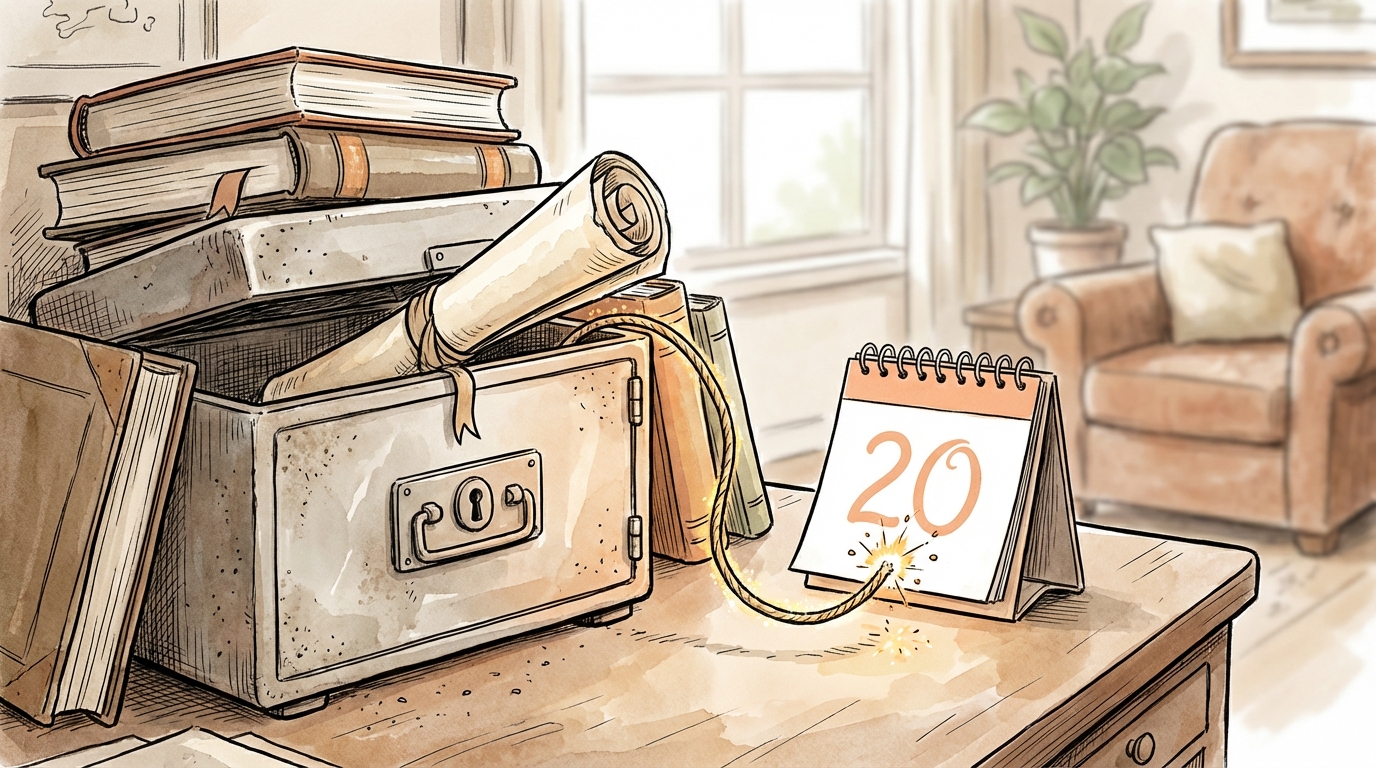
Grandpa reserved the minerals in 1957. He sold the surface acreage to a local farmer to raise some quick cash but kept the oil and gas rights. He figured an oil company might come knocking one day. He folded the original deed into a neat square, put it in a fireproof lockbox, and never thought about it again.
Decades passed. Grandpa passed away. The lockbox went to your mother. Now it sits in your home office closet. You have the original document with the county stamp on it. You assume you own those minerals.
In Texas or Oklahoma, you probably would. But if that land is in Michigan, you are likely holding a worthless piece of paper. The minerals belong to the surface owner now.
Michigan law features a mechanism that terrifies out-of-state heirs. It is a ticking clock called the Dormant Minerals Act. The state essentially decided that if you do not actively remind the county that you own your :severed mineral interest every twenty years, you abandon it. The asset simply evaporates from your family and vests automatically in the person who owns the surface dirt.
You did not commit a crime. You just failed to do paperwork. And in the world of Michigan oil and gas rights, that is an unforgivable offense.
The Law That Punishes Invisible Owners
States do not like messy property records. When oil and gas companies want to drill a well, they need to know exactly who to pay. If the original owner died fifty years ago and left fifteen heirs scattered across the country who have never updated the county records, the oil company cannot safely lease the land. Drilling stops. The state loses out on tax revenue.
Michigan solved this problem by putting a harsh expiration date on inaction.
Under MCL 554.291, any interest in oil or gas that is owned by someone other than the surface owner will be deemed abandoned if a period of 20 years passes without a specific preserving event. Once that 20-year fuse burns down, the rights automatically vest in the surface owner.
There is no judge involved. There is no court hearing where you can plead your case. You do not get a warning letter in the mail telling you the clock is almost up. The transfer happens quietly and automatically by operation of law.
We talk to families who discover this the hard way. They get an offer from a buyer or a landman. They spend weeks digging through family archives. They finally feel excited about unlocking a hidden asset. Then a title attorney looks at the county records and delivers the bad news. The 20-year window closed in 1998. The surface owner leased the minerals last year and is collecting the royalties.
What Keeps Your Minerals Alive
The statute gives you a few ways to keep the 20-year fuse from reaching zero. Some of these happen naturally if the property is desirable. Others require you to take deliberate action.
Your oil and gas rights are preserved for another 20 years if any of the following events occur and are properly recorded.
First, actual production. If someone is pumping oil or withdrawing gas from your lands, the clock resets. This also applies if your minerals are included in a larger producing unit.
Second, a drilling permit. If the Michigan Department of Environment, Great Lakes, and Energy issues a permit to drill a well on your interest, you get another 20 years.
Third, underground storage. If your interest is being actively used for underground gas storage operations, it survives.
Fourth, a recorded transfer. This is the big one. If the interest is sold, leased, mortgaged, or transferred by an instrument recorded in the local :register of deeds office, the clock resets on the date of that recording.
If none of those things are happening, you are entirely reliant on the final option. You must file a Notice of Claim.
The Paperwork Lifeline
If you own non-producing minerals in Michigan, filing a Notice of Claim every two decades is your only defense against abandonment. It sounds simple enough. You just tell the county you still exist.
But the state does not make it easy. You cannot just mail a letter saying “I claim all the mineral rights my grandfather left me.” Michigan demands precision.
The rules for this document are outlined strictly in MCL 565.105. A valid notice must contain a full and accurate legal description of the land. The law specifically states that descriptions cannot be general inclusions. You must have the exact lot, block, section, township, and range.
You also need the liber and page number of the recorded instrument that originally created the severed interest. If your grandfather reserved the minerals in a 1957 deed, you need the book and page where that specific 1957 deed is logged in the county courthouse.
The most tedious requirement is that you must list the names and mailing addresses of all current owners of the surface land. The law tells you how to find them. You have to look at the names on the last completed tax assessment roll of the county where the land is located.
You then have to get your signature notarized, format the document to Michigan recording standards, and pay the filing fee at the county register of deeds.
Doing this once is annoying. Doing it every 19 years across multiple generations is a massive logistical hurdle.
The Stealth Failure Mode
This law is a perfect trap for families who inherit partial interests.
Let’s look at the math of an inherited asset. A man leaves 160 acres of minerals to his four children. They each own 40 net acres. They pass it to their children. Suddenly you have twelve cousins who each own 13.3 net acres of :fractional ownership.
None of them live in Michigan. None of them know anything about oil and gas.
One cousin knows they need to file a Notice of Claim to save the asset. They call a title attorney in Michigan. The attorney asks for a $600 retainer to pull the deeds, check the tax assessment rolls for the surface owners, draft the notice, and record it.
The cousin emails the other eleven relatives asking everyone to chip in $50. Three cousins do not reply. Two cousins argue that they already have the original deed so they do not need to pay a lawyer. One cousin refuses to send money on principle.
The cousin who organized it gets frustrated, decides $600 is too much to spend out of pocket for non-producing land, and gives up. The 20-year deadline passes. All twelve cousins lose their inheritance forever.
If this dynamic sounds familiar, you are not alone. We have seen this exact scenario play out hundreds of times. Family coordination is the single biggest threat to generational mineral wealth. We actually wrote a comprehensive breakdown about this exact dynamic in So You Inherited Mineral Rights: A Survival Guide for the Next Generation.
People assume their property rights are absolute. They think an unrecorded will or a family trust document sitting in a lawyer’s office protects them. Michigan does not care about your private family documents. If it is not recorded in the specific county where the dirt is located, it does not exist in the eyes of the law. You can read more about how unrecorded documents destroy value in The Probate Trap: Why.
Why This Pushes Owners Toward Selling
When you hold non-producing severed minerals in Michigan, you do not just own an asset. You own a liability of time and attention.
You have to monitor the 20-year timeline. You have to track down surface owners. You have to coordinate with relatives who might not understand what is at stake. It becomes an economically annoying asset. The mental friction often outweighs the financial benefit, especially for smaller fractional owners.
Selling the rights is one entirely valid way to solve the problem permanently.
When you sell to a professional buyer, you stop managing the timeline. The buyer takes on the legal burden of filing the claims, researching the title, and dealing with the county clerks. You convert a legally fragile, high-maintenance paper asset into immediate cash.
A sale also serves as a recorded transfer under the statute. The moment a mineral deed is recorded in the county courthouse, the 20-year clock resets. The asset is instantly preserved.
We never push families to sell. Keeping the minerals in the family is a wonderful goal if you have the organizational discipline to manage them. But you need a designated person in the family who treats it like a real business. They need to set calendar alerts for a decade in the future. They need to update addresses when people move.
If your family does not have that person, selling is often the safest way to ensure the value does not simply evaporate. We discuss the emotional weight of these choices heavily in Should I Sell My Mineral Rights? A Guide for Families. The decision always comes down to what gives you the most peace of mind.
How to Audit Your Risk in 30 Minutes
If you suspect you own severed minerals in Michigan, you cannot afford to wait. You need to figure out exactly where you stand on the 20-year timeline. You can do a basic audit of your risk today.
First, identify the county. Minerals are governed by the county where the land physically sits. Find your original deed or whatever paperwork you have and look for the county name.
Second, search the county register of deeds. Many Michigan counties have online searchable databases. Search for your family name. Look for the most recently recorded document regarding that land. It might be an old oil and gas lease. It might be a deed transferring the property to a trust. Look at the date the county stamped on that document. Add 20 years to that date. That is your absolute deadline.
Third, check for production. If there is an active well on the property, the 20-year clock is paused. You can use the Michigan EGLE GeoWebFace tool online to look at the area and see if any active wells exist on your section.
If your deadline is approaching and there is no production, you have a choice to make. You can hire a local attorney or title company to draft and record a Notice of Claim. Or, you can reach out to a mineral buyer to explore a sale before the asset disappears.
Michigan is not trying to steal your property. The state is just enforcing a strict standard of ownership. They want owners who are visible, active, and legally present in the county records.
Knowing what you own and knowing the rules of the game is the only way to protect your family’s history. It is always worth having a conversation to understand what your rights are actually worth today. You might decide to file the paperwork and hold on for another two decades. Or you might decide it is the right time to cash out. At the very least, you will know your options.
:severed-mineral-interest
A situation where the ownership of the underground resources like oil, gas, or coal is completely legally separated from the ownership of the surface land above it. One person owns the right to farm the dirt, while someone else owns the right to drill beneath it.
:register-of-deeds
The specific county government office responsible for keeping all the official public records related to real estate. If a document affecting land ownership is not stamped and filed here, the law generally treats it as if it never happened.
:fractional-ownership
What happens when property is passed down through generations without being sold. A single asset is divided among multiple heirs over and over, resulting in individuals owning tiny, sometimes microscopic percentages of the original whole.