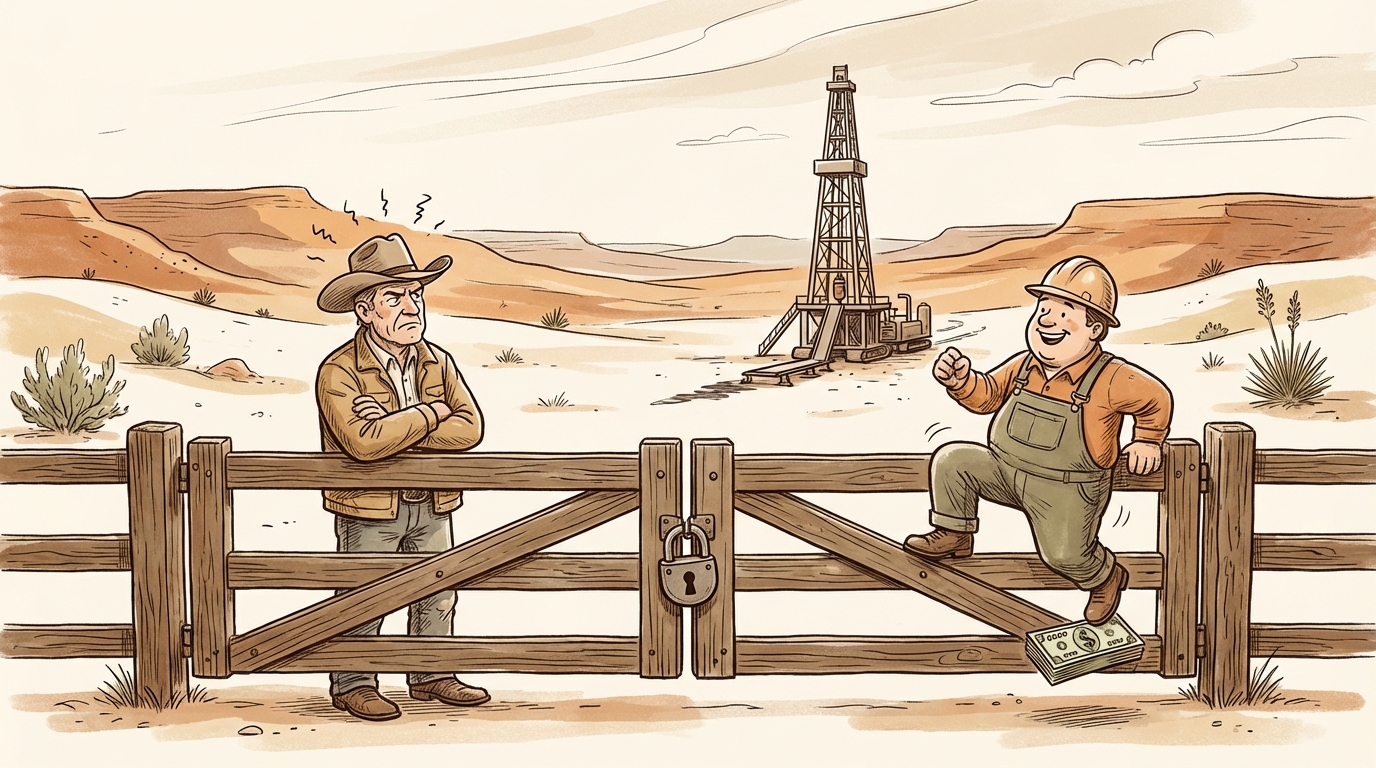
You buy a piece of property in Utah. Maybe it is a patch of rural pasture in the Uinta Basin, or maybe it is a quiet spot you bought for hunting and getting away from the noise. You hold the deed. You pay the property taxes. As far as you know, the dirt belongs to you.
Then one afternoon, an oil and gas landman knocks on your door.
They tell you an operator is planning to drill a well on your property. They hand you some paperwork, talk about access roads and surface damage, and ask you to sign a surface use agreement. You tell them absolutely not. You don’t want drilling rigs, heavy trucks, or pipelines tearing up your land. You ask them to leave.
They smile politely and explain something that completely upends your understanding of property ownership: they aren’t asking for your permission. They are just trying to do this the easy way. If you refuse, they will just do it the hard way.
Welcome to the harsh reality of the Utah :split estate.
At Double Fraction Minerals, we look at deals across the country every single day. We talk to families dealing with the fallout of severed mineral rights, and the legal mechanics governing these situations vary wildly from state to state. We have previously broken down how surface owners can hold up the process in other states, like how Montana’s damage act can freeze a mineral deal.
But Utah is a different animal. The state has laws that sound incredibly protective of surface owners. They use terms like “good faith” and “mediation” and “Surface Owner Protection Act.” But when you strip away the legal padding and look at the actual math and mechanics, the power dynamic becomes glaringly obvious. The operator is going to drill. Your opposition might cause friction, but it rarely causes a permanent stop.
Let’s look at exactly how Utah law allows operators to “bond on” to your property and why surface owners often end up holding a surprisingly weak hand.
The Problem of the Dominant Estate
To understand how a company can force its way onto your land, you have to understand who actually owns what.
According to legal experts tracking these land use issues, roughly one-sixth of all land in Utah is a split estate. This means the surface rights and the subsurface mineral rights are owned by completely different parties. You own the grass, the trees, and the dirt on top. Someone else—maybe the federal government, the state, or a distant family who inherited the rights decades ago—owns the oil and gas underneath.
Most property owners never realize this until the landman shows up. If you check your title insurance policy, you will find that title companies almost universally exclude mineral rights from their coverage. They protect you from a neighbor claiming your fence is over the property line, but they don’t protect you from a rig moving in to tap the deep rock. If you want to dive deeper into this specific structural problem, we covered the mechanics of it in our piece about the invisible estate under your property.
Under the law, the mineral estate is the :dominant estate. The surface is the servient estate.
What does that mean in plain English? It means the mineral owner has a legal right to access and extract their minerals, and they are allowed to use as much of the surface as is reasonably necessary to do so. If they couldn’t use the surface, their minerals would be worthless. The law sides with the extraction of the resource.
Decades ago, operators had broad, sweeping authority to do basically whatever they wanted to the surface. Over time, courts and legislatures began putting guardrails in place to stop operators from unnecessarily ruining the land. In Utah, that pushback took the form of the Surface Owner Protection Act.
The Illusion of the Surface Owner Protection Act
If you read the title of the law, you might feel a wave of relief. It says “Protection Act” right there in the name.
Utah Code Section 40-6-20 lays out the rules for how an operator can use the surface land. It states that an operator may enter the land and use it to the extent reasonably necessary, but they have to act in a way that allows the surface owner “the greatest possible use” of their property.
The statute forces the operator to do three things:
- Mitigate the effects of accessing the land.
- Minimize interference with the surface owner’s property.
- Compensate the surface owner for unreasonable crop loss, loss of value to existing improvements, and permanent damage to the surface.
This is the framework that leads to the landman knocking on your door. The operator wants a :Surface Use Agreement. This is a contract where the operator agrees to pay you a specific amount of money for the damage they are going to cause—covering the cost of the lost grazing grass, the torn-up roads, or the footprint of the well pad.
This is the “easy way.” The operator pays you, you sign the agreement, and they get to work without worrying about a judge telling them they committed a trespass.
But what if you don’t want their money? What if you just want them to go away?
Often, surface owners will look for loopholes. They will tell the operator to go drill from the neighbor’s property using horizontal drilling technology. After all, the statute says the operator has to minimize interference, right?
The law actually anticipates this exact argument and neutralizes it. Subsection 3 of Section 40-6-20 explicitly states that an operator is not required to utilize directional or horizontal drilling techniques if they are not technologically feasible, economically practicable, or reasonably available.
“Economically practicable” is the operative phrase. If drilling horizontally from a mile away costs the operator an extra two million dollars, it is not economically practicable. They are going to drill a vertical or deviated well right in the middle of your land.
The Mediation Mirage
When negotiations break down and you refuse to sign the Surface Use Agreement, Utah law offers a pressure valve. You can request mediation.
Under Utah Code Section 40-6-21, either the surface owner or the operator can request non-binding mediation if they cannot agree on the amount of damages for crop loss or permanent surface damage. The state even maintains a list of qualified mediators from the Department of Agriculture and Food to step in and help. You and the operator will split the cost of the mediator’s services right down the middle.
Surface owners routinely view this mediation clause as a stop sign. They think, “Great, I’ll force them into mediation, drag out the process, and eventually they will give up and go bother someone else.”
If you read down to Subsection 5 of that exact same law, the illusion shatters. The statute says, point blank: “The provisions of this section do not prevent or delay an owner or operator from conducting oil and gas operations in accordance with applicable law.”
The mediation does not pause the clock. It does not issue a temporary restraining order on the bulldozers. The operator can sit at the mediation table with you on a Tuesday while their crews are out grading your land for a well pad on Wednesday.
The state essentially says that good faith negotiations are nice, and you should try them. But the state is not going to let a stubborn surface owner stall the development of oil and gas resources.
The “Bond-On” Threat: The Hard Way
If talks fail, and you refuse to sign the surface use agreement, the operator deploys their ultimate trump card. They “bond on.”
The administrative rules governing the Utah Division of Oil, Gas and Mining outline exactly how an operator bypasses a hostile surface owner. Utah Administrative Code R649-3-38 outlines the bonding process step by step.
If the operator has tried to negotiate in good faith and you still say no, the operator can just furnish a surface use bond directly to the state division prior to getting their permit to drill approved.
The cost of this bond? A mere $6,000 per well site.
Let that sink in. Modern oil and gas wells cost millions of dollars to drill and complete. The operator is spending tens of thousands of dollars a day just to rent the drilling rig. To bypass a stubborn surface owner, all the operator has to do is hand the state $6,000 to hold in a cash account as a guarantee against “unreasonable” loss of crops or improvements.
Once that bond is posted and the permit is approved, the operator has the legal right to enter your property. They have bypassed you entirely. If you try to physically block them at the gate, you are the one violating the law, not them.
This bond sits with the state until you and the operator finally reach a contractual agreement, until a judicial appeal resolves the damages, or until the well is finally plugged and abandoned—which could be thirty years from now.
This $6,000 bond is the hammer that landmen hold behind their back when they knock on your door. They want to hand you a check for surface damages because it is cleaner and simpler. But if you demand a ridiculous sum of money, or if you refuse to negotiate entirely, they will happily pay the state $6,000 and start moving dirt.
Why This Matters for Mineral Owners
We talk to a lot of families who own severed minerals in Utah. Sometimes they feel totally disconnected from the land itself. They just receive a lease bonus or a royalty check in the mail, completely insulated from the heavy machinery and the torn-up dirt.
But this structural conflict between the surface owner and the operator does impact you as a mineral owner.
When your operator encounters a highly combative surface owner, it costs them time, legal fees, and administrative headaches. Even though the operator has the legal right to “bond on,” doing so requires jumping through regulatory hoops. They have to prove they negotiated in good faith. They have to deal with the division. They have to risk negative local PR or local zoning fights.
All of this friction slows down the drill bit. If the drill bit slows down, your royalty checks are delayed.
We see this dynamic constantly. A family inherited minerals decades ago. They don’t live in Utah. They don’t know the surface owner. But their operator is bogged down in mediation and bonding procedures because the guy who owns the surface is furious that a pumpjack is going to ruin his view.
This is the messy reality of the split estate. It puts normal people in direct conflict with industrial operations, and the legal system is built to favor the industry.
For the surface owner, the primary lesson is that fighting the operator on the basis of “it’s my land” is a losing battle. The best path is usually to negotiate a strong surface use agreement early, dictating where the roads will go and demanding fair compensation before the operator resorts to a measly $6,000 bond.
For the mineral owner, the lesson is that holding severed rights means you are a silent partner in this inherent conflict. The legal structure guarantees your minerals can be developed, but it guarantees a rocky road to get there.
Navigating these realities—understanding what the statutes actually say versus what people hope they say—is a massive part of what we do. The emotional weight of family land, inheritances, and industry friction is heavy. We know the math, we know the codes, and we know how stressful these situations get for the families involved.
Sometimes, holding onto severed minerals and waiting for these fights to resolve is the right financial move. Other times, families decide that dealing with the delays, the operators, and the structural tension just isn’t worth the headache. They realize that liquidating that asset and walking away with a lump sum gives them peace of mind and finality.
There is no single correct answer for everyone. It completely depends on the property, the operator, and your family’s tolerance for complex, slow-moving legal processes. But whatever path you choose, you should choose it with your eyes wide open to how the rules of the game are actually written. Knowing what you own, and knowing the reality of the laws governing it, is the only way to make an informed decision.
If you own minerals in Utah and find yourself caught in the middle of these development timelines, or if you are simply wondering what those minerals are currently worth in today’s market environment, having a quiet conversation to understand your options is always a smart first step.
:split-estate
A property ownership situation where the surface of the land is owned by one person or entity, and the underground mineral rights (like oil, gas, and coal) are owned by someone else entirely. In these cases, the two estates are legally distinct from one another.
:dominant-estate
A legal concept applied to property law indicating that the mineral estate has the overriding right to use the surface estate. Because minerals have no value if they cannot be accessed, the law grants the mineral owner reasonable access to the surface to extract their resources, making the surface the “servient” estate.
:surface-use-agreement
A binding contract negotiated between an oil and gas operator and a surface landowner. It dictates exactly how the operator will use the land (roads, pipelines, well pads) and specifies the financial compensation the surface owner will receive for the disruption and damage.