
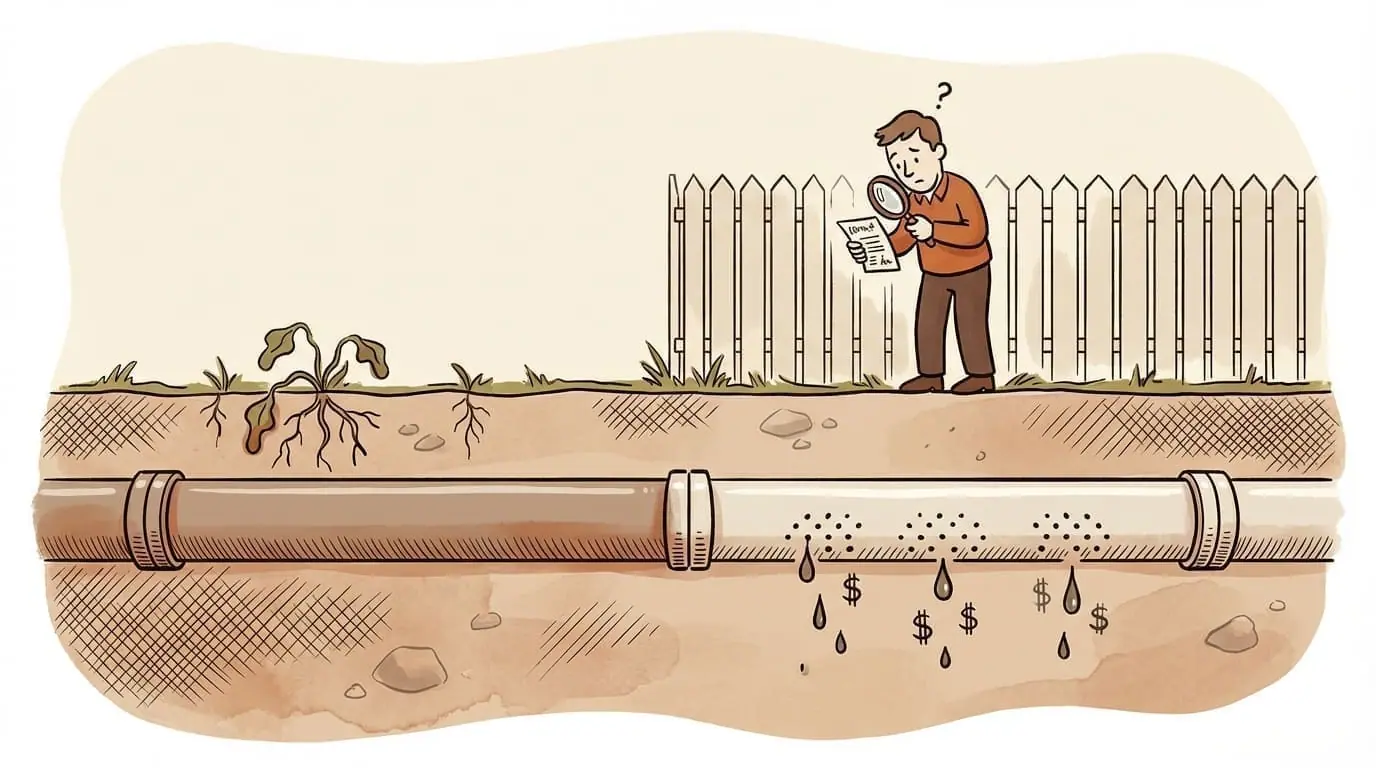
When the operator sends you a well proposal for a massive two-mile lateral in the SCOOP or STACK plays, the math feels intuitive at first. They are drilling 10,000 feet of pipe. A huge chunk of that pipe is going straight through the section of land your family owns. You look at the map, see the line crossing your property, and assume you will be paid for the oil flowing out of that specific stretch of rock.
That is how most mineral owners think it works.
But Oklahoma law dictates something entirely different.
Because of a specific legal mechanism passed over a decade ago, you are not paid based on the total pipe under your land. You are only paid based on the pipe that has holes shot into it. And because operators are legally required to leave hundreds of feet of pipe completely unperforated near section boundaries, your family ends up hosting the physical pipeline while receiving exactly 0% of the oil for that specific segment.
We look at hundreds of deals and division orders across Texas and Oklahoma. We see this exact scenario play out constantly. Families get their first royalty checks, run the math, and realize their fractional decimal is noticeably smaller than they calculated.
This is the “dead pipe” trap. It is a legally mandated dilution of your royalty. Let us walk through exactly how this happens, why the state allows it, and what it means for your bottom line.
The Problem With Imaginary Lines
To understand how we got here, we have to look back at why Oklahoma regulates oil and gas in the first place.
In the 1920s, the Oklahoma City oil boom was absolute chaos. Operators drilled wells right on their property lines, trying to suck out as much oil as possible before their neighbors could. This led to massive overproduction, wasted resources, and a complete collapse in prices. The state had to step in.
According to an excellent historical review by the Oklahoma Bar Association, the state leaned on the “police power” concept established by the US Supreme Court in an 1877 case called Munn v. Illinois. The basic idea is that when private property affects the public interest, the government can regulate it for the common good.
The Oklahoma Corporation Commission was tasked with bringing the oilfields under control. Their primary goals were to prevent the physical waste of oil and to protect :correlative rights. They did this by establishing spacing units. They drew imaginary boxes on a map, usually 640-acre square sections. They dictated that only a certain number of vertical wells could be drilled per box. If you owned land in the box, you got a proportionate share of the well, whether the physical hole was on your specific acre or not.
This system worked brilliantly for decades. When someone proposed a well, you either participated, leased, or found out exactly how forced-pooling orders make your decisions for you. But the math was simple. Your acres divided by 640 equaled your share of the unit.
Then horizontal drilling arrived and broke the entire system.
The 2011 Fix That Created the Trap
A vertical well goes straight down into the rock like a straw. A horizontal well goes down and then turns 90 degrees, tearing through thousands of feet of rock.
Eventually, operators realized that drilling a one-mile lateral inside a single 640-acre section was leaving too much oil behind. They wanted to drill two-mile or even three-mile laterals to maximize efficiency. But doing that meant crossing those imaginary section lines the state drew nearly a century ago.
To solve this, the state legislature passed the :Multi-Unit Horizontal Well Act (MUHWA) in 2011.
MUHWA allowed operators to drill across multiple spacing units. But it created a massive headache for the accountants. If a well pulls oil from Section 1 and Section 2 at the same time, how do you decide which landowners get paid for which barrel of oil?
The state could have just divided the money based on the total amount of pipe in each section. Instead, they wrote a very specific formula into Title 52, Section 87.8 of the Oklahoma statutes.
The law states that production must be allocated using an allocation factor. You find this factor by taking the length of the :completion interval located within your unit and dividing it by the entire length of the completion interval for the whole well.
This sounds perfectly fair until you read the exact legal definition of a completion interval.
Under Section 87.6 of the state code, the completion interval is strictly defined. For a cased and cemented horizontal well, it is the distance “from the first perforations to the last perforations.”
It is not the physical pipe. It is the holes in the pipe. And that tiny distinction changes everything.
The Reality of Setbacks and Dead Pipe
When an operator drills a well, they are heavily restricted by setback rules. The state does not want an operator pulling oil from right up against the edge of a section boundary, because that might steal oil from the adjacent unit.
Normally, an operator has to stay 330 feet or even 660 feet away from the unit boundary before they start perforating the pipe.
When an operator drills a two-mile lateral that crosses a section boundary, they still have to respect those setbacks. Even though the physical steel pipe crosses continuously from Section 1 into Section 2, the operator is legally barred from shooting holes in the pipe near that boundary line.
They will drill the pipe, but they will leave 330 feet on your side of the line, and 330 feet on your neighbor’s side of the line, completely blank.
This creates a “dead zone” of 660 feet of unperforated pipe right in the middle of the wellbore.
Now, go back to the MUHWA allocation formula. Your royalty is based only on the perforated completion interval.
Imagine you own minerals in Section 1. The wellbore physically travels 5,280 feet through your section. But because of the boundary setback, the operator only perforates 4,950 feet of that pipe.
You are hosting 5,280 feet of physical infrastructure in your rock. But the state formula says your allocation is based on 4,950 feet. That 330 feet of unperforated pipe under your land is completely excluded from your royalty calculation. You get zero credit for it.
The overall well is still producing massive amounts of oil and gas. The fluid is physically traveling through the pipe under your land to get to the surface. Your property is enduring the physical burden of the wellbore. But because the allocation formula is blind to unperforated pipe, your overall percentage of the well’s revenue is diluted.
The Financial Squeeze on the Family
This is not a rounding error. When you are dealing with modern high-volume wells in the SCOOP or STACK, a single well can produce tens of millions of dollars in revenue over its lifespan.
Losing credit for 300 to 600 feet of lateral length directly reduces your decimal interest on the division order. When we sit down to read a royalty statement with a family, they often notice that their decimal seems a little bit light. They assume the operator made a mistake.
We have to be the ones to explain that the operator did not make a mistake. The operator is following the strict letter of Oklahoma law. The state mandated this allocation method to prevent waste and protect the broader development of the field.
The state decided that facilitating multi-unit development was more important than paying you for the unperforated pipe running through your specific dirt. It is a legal compromise, and the individual mineral owner is the one paying for it via dilution.
Adding insult to injury, you generally cannot stop it. The pooling process and the Corporation Commission hearings are designed to approve these multi-unit wells efficiently. By the time you receive the well proposal in the mail, the engineering plans are largely set. The dead pipe is already drawn on the map.
Knowing Where You Stand
We talk to mineral owners every week who are frustrated by this kind of legal machinery. Owning minerals in a multi-unit horizontal well means accepting a very complex, highly regulated partnership with an operator who is playing by rules you didn’t write.
You have to accept the setbacks. You have to accept the unperforated pipe. You have to accept that your decimal interest on your division order will be slightly diluted by state statute.
For some families, this is just the cost of doing business. The wells are highly productive, the checks come in every month, and they are willing to accept the regulatory quirks of Oklahoma oil and gas law.
For other families, realizing how little control they actually have over their asset is a turning point. They look at the forced pooling orders, the complex allocation formulas, and the mandated dilution, and they decide they no longer want to play the game.
We completely understand both perspectives. We are a family office, not a corporation. We don’t push people to make decisions they aren’t ready for. We just believe you should know exactly how the math works so you aren’t caught off guard when the checks arrive.
If dealing with completion intervals, allocation factors, and dead pipe feels like more of a burden than a blessing, selling might be an option worth exploring. You can let a buyer take on the regulatory headaches, the pooling timelines, and the state statutes, while you walk away with certainty.
We can’t change the laws in Oklahoma. But we can help you understand what your asset is actually worth in the current market. If you are tired of feeling diluted by formulas you can’t control, it is at least worth a conversation to know your options.
:correlative-rights
The legal principle that every property owner in a shared oil and gas reservoir has the right to produce their fair share of the resources, while being protected against neighbors who might try to disproportionately drain the pool.
:multi-unit-horizontal-well-act
A 2011 Oklahoma law that allows oil and gas operators to drill horizontal wells across multiple spacing units, establishing the legal framework for how costs and royalties are allocated among the different tracts of land the well crosses.
:completion-interval
The specific portion of a horizontal wellbore that is actually capable of producing oil and gas. Under Oklahoma law, for a cased well, this is strictly measured as the distance from the very first perforation hole to the very last perforation hole.