Imagine your grandfather selling the family farm back in the 1970s. He negotiates a fair price for the dirt, but he knows oil might be down there. So, he tells the lawyer drafting the paperwork to make sure he keeps half the minerals.
The lawyer draws up a standard warranty deed. It clearly states: “Grantor reserves an undivided 50% interest in all oil, gas, and other minerals.” Granddad signs the paper, cashes the check for the surface, and goes home feeling smart. He leaves those minerals to your parents, and your parents leave them to you.
Decades pass. A landman knocks on your door. An oil company is drilling a massive horizontal well right under that old farm. You think you are about to receive a life-changing royalty check.
Then the title examiner drops the hammer. They tell you that you own exactly zero minerals.
You pull out the deed. You point right at the words “reserves an undivided 50% interest.” The text is black and white. How can they possibly say you own nothing?
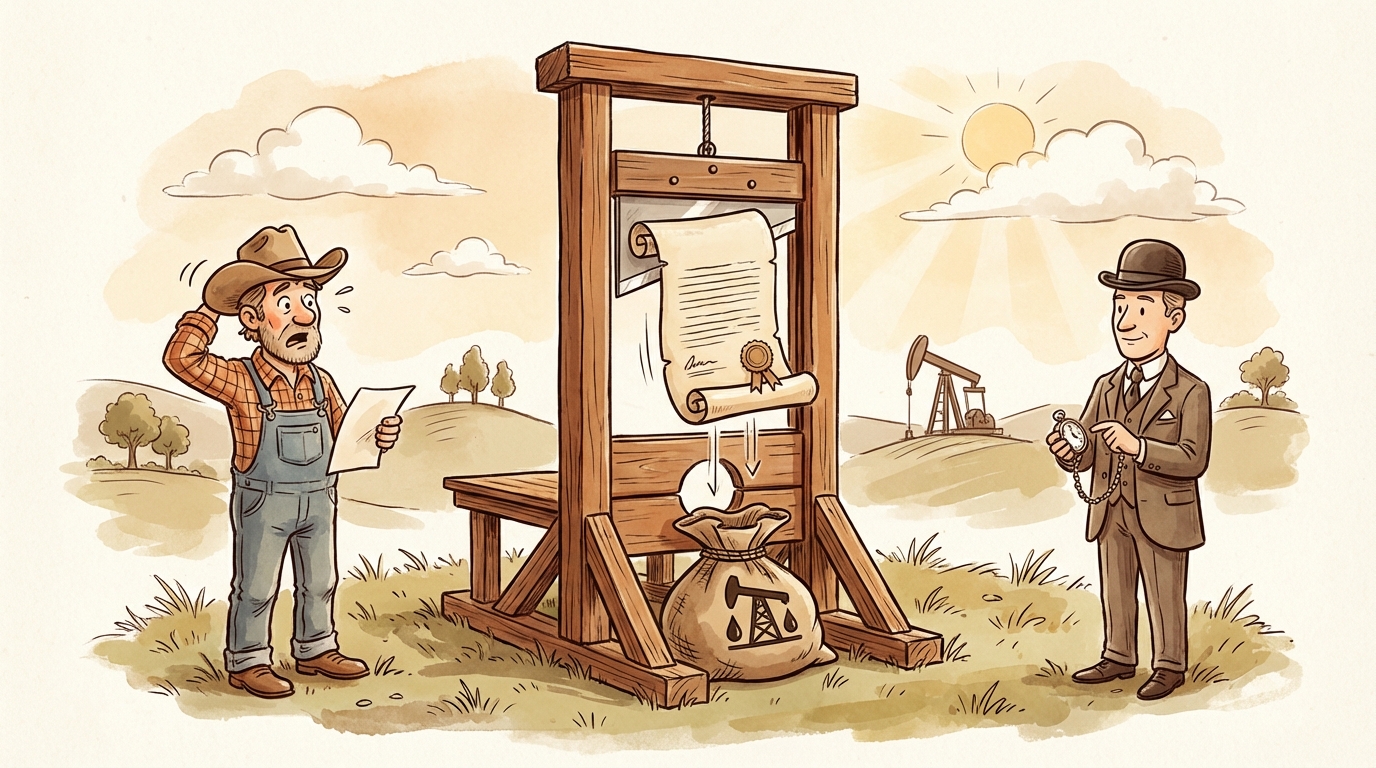
Because of a uniquely ruthless Texas legal mechanism known as the Duhig rule.
I want to walk you through exactly how this happens. It has nothing to do with geology or drilling mechanics. It is purely a paper problem. But when the Duhig guillotine falls, it is financially catastrophic. We see this constantly in our office, and it is the main reason buyers heavily discount “family deeds” that were drafted like standard real estate closings.
The Math Problem That Broke Title Law
To understand the trap, we have to look at the 1940 Texas Supreme Court case that started it all: Duhig v. Peavy-Moore Lumber Co.
A man named W.J. Duhig bought a tract of land in Orange County from the Gilmer estate. In that sale, the Gilmer estate kept 50% of the minerals. Duhig got the surface and the other 50% of the minerals.
Later, Duhig turned around and sold the land to a lumber company. He used a :general warranty deed. In the last paragraph of that deed, Duhig wrote that he “retains an undivided one-half interest in and to all mineral rights.”
Duhig thought he was keeping the 50% he owned. The problem? He failed to explicitly mention that the Gilmer estate already owned the other 50%.
Let’s do the math from the buyer’s perspective. The buyer looks at a warranty deed that promises them the land. The only exception listed is that Duhig is keeping 50%. Therefore, the buyer expects to receive the surface and 50% of the minerals.
But the Gilmer estate already owns 50%. Duhig is trying to keep 50%. That leaves 0% for the buyer.
You cannot promise a buyer 50%, take 50% for yourself, when a third party already owns 50%. There is no 150% of a property. Duhig conveyed more than he actually had the power to give, creating an :overconveyance.
The Guillotine Falls
The Texas Supreme Court had to decide who gets hurt by this bad math. Do they punish the buyer, who paid for 50% of the minerals based on a clean warranty deed? Or do they punish the seller, who drafted a sloppy document?
The court chose the seller.
They applied an old legal doctrine called :estoppel by deed. The logic is strict but simple. The moment Duhig signed that warranty deed, he broke his warranty. To make the buyer whole, the court automatically took the 50% Duhig tried to reserve and handed it to the buyer.
Duhig’s reservation was quietly and instantly deleted. He was left with nothing.
This rule doesn’t care about what your grandfather “meant” to do. It doesn’t care about fairness. If you sign a warranty deed that promises more minerals than are mathematically available, the law will cannibalize your reserved share to satisfy the promise you made to the buyer.
Why the “Family Deed” is a Minefield
You might be thinking this is ancient history. It isn’t. Families trigger the Duhig rule all the time, often by accident, usually when selling surface acreage or passing land between siblings.
Most people treat a mineral deed like a house closing. When you sell a house, you use a general warranty deed. It guarantees you have clear title to the property. That works fine for a subdivision lot. It is highly dangerous for rural Texas land.
Over the last hundred years, the mineral estate under most Texas ranches has been sliced, diced, and traded dozens of times. A family might own the surface but only 12.5% of the minerals.
If they decide to sell the surface to a neighbor, they often pull a boilerplate warranty deed off the internet. They type in “reserving all our minerals” or “reserving 12.5% of the minerals.” But they completely fail to list out the 87.5% in prior reservations made by oilmen and great-uncles back in the 1930s.
Because they didn’t explicitly carve out the prior owners’ shares from the warranty, the math fails. The Duhig guillotine drops. The family’s reservation is consumed to make the new surface buyer whole.
We covered how obscure title records can hide these traps in The Title Opinion Shadow Market: Why You Can’t See the Document That Controls Your Pay. The operator running the well knows exactly what the title says, but they aren’t going to call you and explain why your deed is broken. They just suspend the money or pay the surface owner instead.
The Nightmare of Modern Litigation
This is not a theoretical problem we only talk about in law school. It is an active nightmare in Texas courts right now.
Take the recent 2023 case, Echols Minerals LLC v. Green. This fight centered on a 1952 deed where the grantors sold land and tried to reserve a 33.25-acre royalty interest. The deed made no reference to a previous 1944 conveyance that had already given away half the minerals to someone else.
The trial court looked at the math, saw the overconveyance, and applied the Duhig rule, ruling that the reservation was completely ineffective. The family lost it all.
The Court of Appeals actually reversed that decision, but purely on a hyper-technicality. They ruled that because the grantors didn’t own the exact fraction needed to remedy the breach, Duhig couldn’t be mathematically applied. The courts spent years untangling fractions of a sixth versus fractions of a third. The legal fees spent fighting over these paper mechanics were likely staggering.
What This Means for Your Minerals
If you are holding onto minerals that were severed from the surface via a “family deed” in the last fifty years, there is a very real chance a title defect exists.
When a family office or an institutional buyer looks at acquiring royalties, we run the chain of title. We look at the exact wording of every document. If we see a 1980 surface sale using a general warranty deed that didn’t explicitly say “subject to prior reservations of record,” we immediately know there is a massive problem.
This is why buyers discount those properties so heavily. Fixing a Duhig problem often requires tracking down the heirs of the surface buyer—people who might be complete strangers to you—and begging them to sign a corrective deed acknowledging they don’t actually own the minerals. I will tell you from experience: people rarely give up oil rights voluntarily.
Selling family minerals is a heavy decision. There is often deep sentiment attached to the land. But holding onto a fractured, legally vulnerable deed hoping an oil company will eventually pay out is a tremendous risk.
If you are curious about How Do I Know if a Mineral Offer is Actually Fair?, the very first step is making sure your paper title actually holds water. The worst time to discover a Duhig issue is after the well is drilled, when the money is sitting in suspense, and the lawyers are circling.
You deserve to know exactly what you own. Understanding the real value of your title, flaws and all, gives you the power to make clear decisions. Sometimes that means going through the painful process of fixing the title. Sometimes that means selling to a buyer equipped to handle the legal heavy lifting.
Either way, having options brings peace of mind. If you want a factual look at your family’s deeds and what they actually mean in the eyes of Texas law, it is at least worth a conversation.
:general-warranty-deed
A standard legal document used to transfer property where the seller guarantees they hold clear title to the property and have the right to sell it. In mineral law, using this deed without explicitly listing every prior reservation can accidentally transfer your own reserved minerals to the buyer to fulfill the guarantee.
:overconveyance
A situation where a seller signs a deed mathematically promising more property rights than they actually have the power to convey. This usually happens when a seller tries to reserve a portion of the minerals for themselves but forgets to account for minerals already owned by a third party.
:estoppel-by-deed
A legal rule that prevents a person from arguing against the facts stated in a deed they previously signed. If you sign a warranty deed guaranteeing a buyer gets a certain percentage of minerals, this rule stops you from later claiming those minerals for yourself, even if you wrote a reservation in the same document.