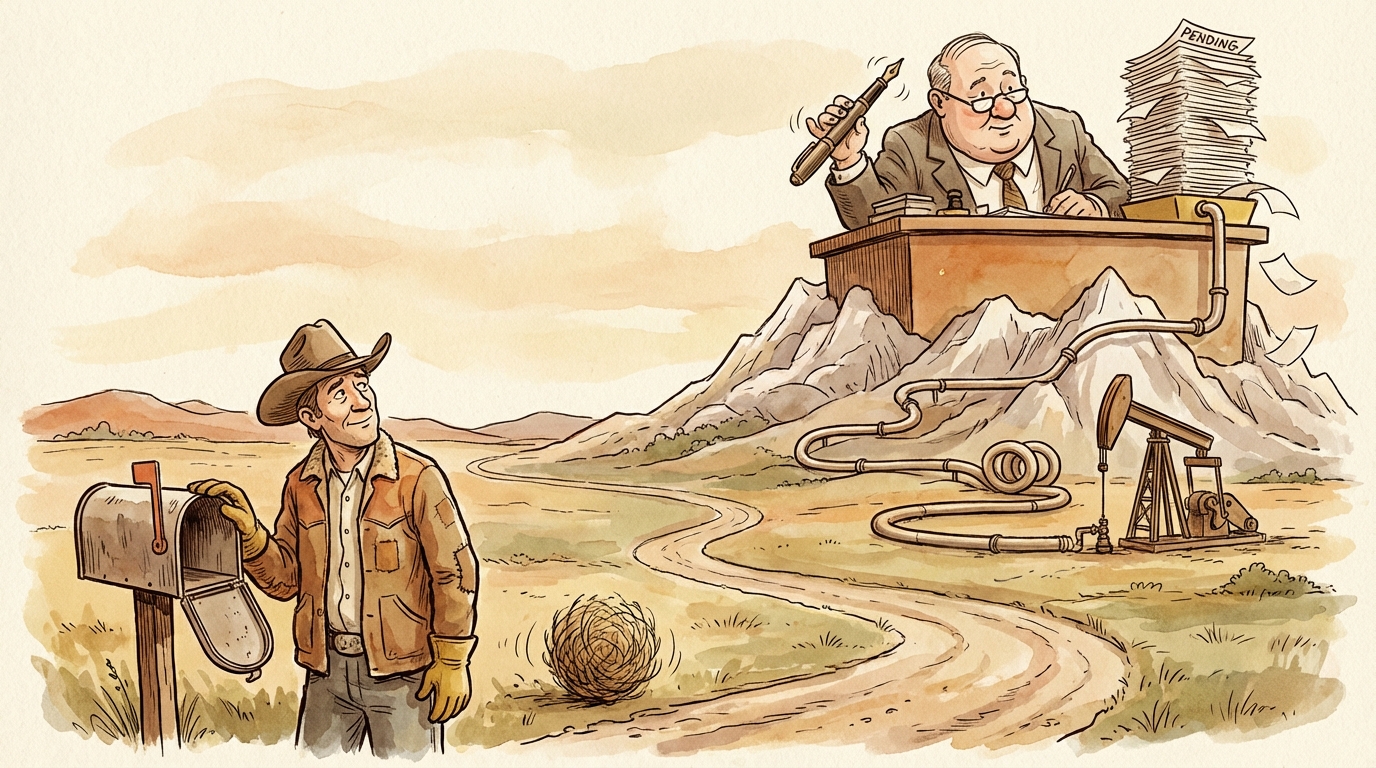
The well is online. You know it is.
Maybe you saw the rig come down on a drive out to the property. Maybe you obsessively refresh the state oil and gas commission’s website and see the production volumes ticking up. The operator is pumping oil, selling it, and making money.
So you walk to the mailbox. Nothing. You check your bank account. No direct deposit.
You call the operator, sit on hold for forty-five minutes, and finally get an owner relations clerk on the phone. They pull up your file and give you an answer that makes absolutely no sense: “Your account is in suspense pending BLM approval of the CA.”
Your minerals are private. You own them. Your family has owned them for decades. Why is the federal government involved, and why are they holding your money hostage?
This is a specific kind of administrative nightmare that hits mineral owners in the Rockies—Wyoming, New Mexico, Colorado, Utah, and Montana. The operator isn’t actually trying to steal from you. They just can’t pay you until a federal employee signs a piece of paper. We see this all the time, and it drives families crazy.
Let’s break down exactly what a Communitization Agreement is, why it paralyzes your royalty checks, and how you can handle the bureaucracy.
The Checkerboard Problem
To understand the delay, you have to look at a map of the western United States. It doesn’t look like Texas.
Out west, land ownership is a chaotic checkerboard. You have fee minerals (privately owned land). Right next door, you have federal minerals managed by the Bureau of Land Management (BLM). Down the road, you have Native American tribal minerals managed by the Bureau of Indian Affairs (BIA). State trust lands are thrown in the mix just to keep things confusing.
Fifty years ago, this wasn’t a massive issue. Companies drilled vertical wells straight down. If they drilled on your private land, they paid you. If they drilled on federal land, they paid the government.
But modern oil and gas extraction relies on horizontal drilling. Operators drill down two miles, turn the bit 90 degrees, and drill another two or three miles horizontally through the shale. A single wellbore can cross private land, federal land, and Indian land all at once.
You cannot have a single well producing oil from three different sovereign entities without a master rulebook detailing exactly who gets what percentage of the revenue. That rulebook is a :Communitization Agreement.
Protecting the U.S. Interest (At Your Expense)
When an operator drills a well that mixes federal or Indian minerals with private minerals, the federal government steps in. By law, the BLM and BIA have a strict mandate to protect the interests of the United States and Native American lessors.
They do not care about your private royalty. They only care that the federal or tribal percentage is calculated correctly.
The operator has to submit a massive packet of paperwork to the government outlining the total acreage, the exact survey lines, and the proposed revenue split between all parties. Under BLM Instruction Memorandum 2015-124, the agency clearly states its goal is to have an approved CA in place before the date of first production. They even urge operators to submit the paperwork at least 90 days before oil starts flowing.
That is the goal. The reality is much uglier.
Federal field offices are routinely understaffed and overwhelmed by the sheer volume of permits and agreements crossing their desks. A 90-day lead time often turns into a six-month, twelve-month, or eighteen-month waiting game.
During this waiting period, the operator is legally restricted. They cannot finalize the division of interest because the federal government hasn’t agreed to the math. If the operator pays you based on an unapproved calculation, and the BLM later audits the file and demands a different split, the operator is left trying to claw back money from private owners. Oil companies hate doing that.
So they take the safest route available to them. They throw your money into :suspense. They bank the cash, earn interest on it, and wait for the federal signature. We detailed how these administrative black holes operate in our guide to why your checks stopped when the well didn’t.
The Overlapping Nightmare
If waiting for one signature sounds bad, wait until you hear about overlapping CAs. This is where the paperwork gets completely detached from reality.
As operators drill more wells in a single area, they create new, larger spacing units to capture the resource efficiently. A new two-mile horizontal well might cut right through the middle of three older, smaller vertical well units.
Now the operator has a new Communitization Agreement that physically overlaps with older, existing Communitization Agreements. For years, BLM offices across different states handled this differently. Some required operators to allocate production from the new well back into the old wells, creating a tangled web of fractional payouts that left both the government and private owners completely baffled.
The accounting was so broken that the BLM had to issue permanent guidance in 2018 stating they would no longer allocate production from new overlapping CAs to existing underlying ones. Instead, every new CA has to stand alone.
But fixing the federal policy didn’t instantly fix the operator’s accounting software. If you own a small fractional interest in an area with aggressive infill drilling, your decimals are probably moving targets. You might see a temporary decimal on your check stub, followed by a mysterious code, followed by a letter stating they will “true-up” your account next year.
A true-up sounds harmless. It isn’t. When the federal government finally approves the overlapping CAs, the operator retroactively fixes the math from day one. If they underpaid you, you get a massive catch-up check. If they overpaid you—even by a fraction of a percent over two years of heavy production—they will deduct that amount from your future checks until the balance is zero. We see families go months without income because an operator is “recovering” an overpayment caused by a delayed federal signature. If your fractional share is already small, the dirty mechanics of amended units can wipe out your revenue stream entirely.
Your Playbook: What to Ask the Operator
When you are stuck in this limbo, calling the operator and yelling at the receptionist won’t speed up the BLM. But you can gather the facts to understand exactly how deep the hole is.
Here is what you need to ask the operator’s division order department:
- “What is the exact status of the Communitization Agreement?” Have they even submitted it yet? Sometimes an operator will blame the government for a delay when they haven’t actually filed the paperwork.
- “Which BLM or BIA field office is handling the file?” Get the specific location (e.g., Carlsbad, Farmington, Casper).
- “Are you holding 100% of my revenue, or just a portion?” Some operators will release undisputed funds and only hold the fractional percentage that is actively being debated in the CA.
- “Can I see the proposed tract participation schedule?” You want to see the math they submitted to the government, even if it isn’t approved yet. This tells you what they think your decimal should be.
- “What is the effective date?” CAs are usually effective back to the date of first production. You need to verify they aren’t trying to chop off your early months of high-volume flow.
Get these answers in writing. Keep a paper trail. If the operator refuses to provide the proposed schedule, remind them that you are a working partner in the unit (even if you are just a royalty owner) and have a right to understand the accounting on your asset.
The Bureaucracy Risk Factor
This brings us to a harsh truth about owning minerals in the Rockies.
When you calculate the value of your asset, you usually think about the price of oil, the production volume of the well, and the size of your decimal. But there is a hidden variable that most families ignore until it bites them: bureaucracy risk.
If your check depends on a federal signature, your yield is inherently less secure than a comparable well in Texas where private contracts rule the day. Every time an operator drills an infill well, recompletes a zone, or amends a spacing unit, you are at risk of being shoved back into suspense while the BLM processes the paperwork.
For a massive corporation, this is just a cash flow timing issue. They have thousands of wells. If twenty are held up by the BIA in New Mexico, they don’t sweat it.
But for a family relying on that monthly check to pay property taxes, fund a grandchild’s college account, or cover medical bills, a two-year freeze is catastrophic. The uncertainty of the “true-up” hangs over your financial planning like a storm cloud. You never quite know if the money in your bank account is fully yours, or if the operator is going to claw it back next spring when a federal clerk finally stamps a CA.
Buyers know this. When a family office or institution values mineral rights in states with heavy federal overlap, they price that administrative friction into the offer. They know they will have to dedicate staff time to chasing down division orders, auditing retroactive accounting, and fighting with operators over suspense funds.
We talk to a lot of families who hold onto fractional minerals simply because their grandfather bought them in the 1960s. They spend hours every month deciphering codes on check stubs, fighting with division order analysts, and waiting for federal agencies to move. They accept the headache because they think they have to.
You don’t.
Deciding to sell isn’t always about needing a lump sum of cash. Frequently, it is about deciding what you want your life to look like. It is perfectly valid to look at a tangled mess of overlapping Communitization Agreements and decide you no longer want to be an unpaid auditor for an oil company. If you are tired of the suspense files and the revised decimals, it might be time to read up on whether selling is the right move for your family.
We have met hundreds of owners who finally sold just to get the administrative burden off their kitchen table. They traded the bureaucracy risk for certainty.
If you’re staring at an empty mailbox right now because your well crossed a federal line, at least know what your asset is actually worth in today’s market. You don’t have to sell. But having options is the only way to get some peace of mind. Knowing the numbers is usually worth a conversation.
:communitization-agreement
A formal contract required when a single drilling unit includes a mix of federal, state, tribal, or private lands. Because oil and gas do not respect property lines, the agreement dictates exactly how production is apportioned among the different sovereign and private owners to ensure the federal government (or tribe) gets its fair legal share.
:suspense
A temporary holding account where an oil and gas operator parks your royalty money. Funds are usually placed in suspense when there is a title dispute, missing paperwork, an unapproved Communitization Agreement, or if your accumulated royalties haven’t reached a minimum payment threshold (like $100). The money is yours, but you can’t touch it until the issue is resolved.