
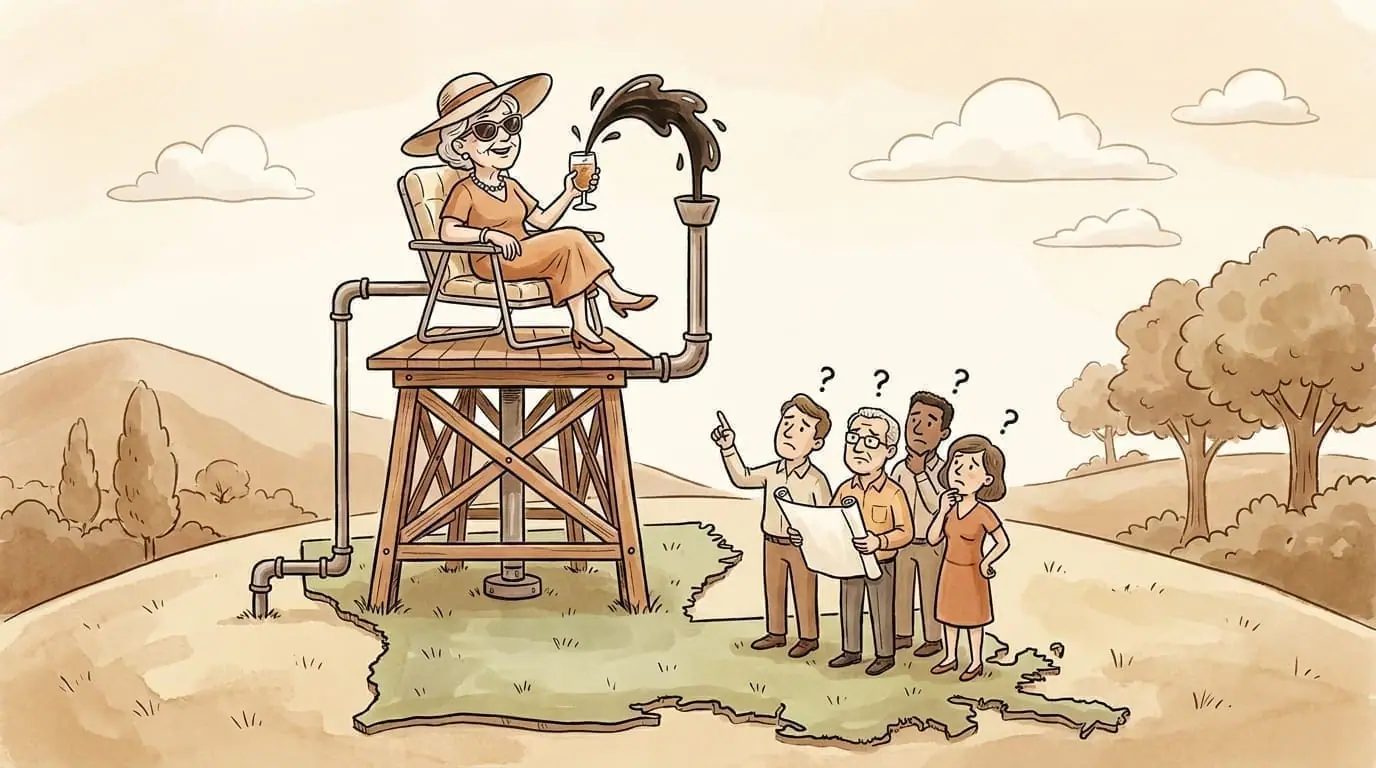
When an out-of-state family inherits mineral rights in Louisiana, the confusion usually starts right after reading the will.
You expect to see standard legal terms like “life estate” or “fee simple.” Instead, you find words that sound like they belong in a 19th-century French novel. You are told your stepmother has the “usufruct” and you and your siblings hold the “naked ownership.”
Then the next, much more stressful question inevitably follows: who actually gets the oil money?
We review hundreds of mineral deeds and probate documents at Double Fraction Minerals. When families bring us Louisiana properties, we know exactly what we are about to look at. Louisiana doesn’t rely on the common law system used by Texas, Oklahoma, or North Dakota. It uses a civil law system rooted in the Napoleonic Code. That means your property rights are sliced up in ways that simply do not exist anywhere else in the country.
If your family’s estate planning involves Louisiana minerals, you are almost guaranteed to run into the split ownership problem. We watch families completely freeze up over this quirk. It routinely causes suspended funds, massive legal bills, and messy probate fights.
Usually, the fighting happens just because nobody sat down and explained how Louisiana actually handles the timing of the drill bit. Let’s walk through the math and the law of who gets paid.
The Anatomy of Louisiana Property Law
To understand why your royalty checks might be held up, we have to talk about how Louisiana views property ownership.
In a state like Texas, if you own a piece of land outright, you hold all the rights to it. You can live on it, you can harvest timber from it, and you can sell it. In Louisiana, those rights are treated as distinct, severable pieces.
According to Louisiana property law, full ownership consists of three distinct rights:
- Usus: The right to use and enjoy the property.
- Fructus: The right to derive profit or “fruits” from the property (like rent or crops).
- Abusus: The right to alienate, consume, or destroy the property (like selling it or mortgaging it).
When someone dies in Louisiana, especially without a will, the state’s community property rules often trigger an automatic split of these rights. The surviving spouse is typically granted a :usufruct—giving them the usus and fructus. They get to use the property and keep the income it generates until they die or remarry.
The children inherit the remaining right, the abusus. Because they hold the underlying title but lack the right to enjoy it right now, Louisiana law calls them the :naked owners.
If we are talking about a rental house, the arrangement is pretty simple. The surviving spouse lives in the house or rents it out and keeps the money. The naked owners (the kids) just wait. They can’t kick the surviving spouse out, but they own the bricks and mortar. Eventually, the usufruct terminates, and full ownership reverts to the kids.
But oil and gas are not rent. They are not renewable crops. Extracting oil literally consumes the property. Pumping crude out of the ground depletes the asset, which steps directly on the naked owner’s right of abusus.
So, does the surviving spouse get to keep the royalty check, or does that money belong to the children who actually own the underlying rock?
The Open Mines Doctrine
The answer comes down to exactly when the oil company started drilling.
Louisiana codified the solution to this problem in Mineral Code Article 190. It is known in the industry as the :Open Mines Doctrine. This single rule dictates the flow of potentially millions of dollars in Louisiana generational wealth.
The rule draws a hard line based on the status of the land at the exact moment the usufruct was created (usually the date of the property owner’s death).
Scenario A: The Mine Was Already Open Let’s say your father leased the land in 2015. A well was drilled in 2016 and started producing. Your father passed away in 2020, leaving a usufruct to your stepmother and naked ownership to you.
Because the well was an “open mine” actively producing before the usufruct began, your stepmother is entitled to the ongoing royalty checks. The law treats that existing royalty stream as the “fruits” of the property. She gets to enjoy that income for the rest of her life (or until she remarries, depending on the terms of the estate). You, the naked owner, have to wait.
Scenario B: The Mine Was Closed Now imagine the property was totally quiet when your father died in 2020. No lease, no drilling.
In 2024, an operator decides they want to drill a deep Haynesville gas well. Who signs the lease? Who gets the massive lease bonus? Who gets the 20% royalty on the new production?
The naked owners do.
If the land was unleased and unproduced when the usufruct began, the surviving spouse has zero right to sign a new mineral lease. The naked owners hold the exclusive power to authorize new drilling and to collect the resulting bonuses and royalties. The surviving spouse is essentially bypassed entirely on this newly developed asset.
Why Families End Up in Suspense
The Open Mines Doctrine makes sense on paper. In practice, so you inherited mineral rights and now you have a deeply emotional family conflict on your hands.
We see this exact dynamic play out month after month. A step-parent assumes they are entitled to all the income from the estate to support themselves in their later years. The operator sends a lease offer for a new well. The step-parent tries to sign it. The operator rejects it because the title opinion correctly identifies the children as the naked owners.
The children then sign the lease and start receiving large royalty checks. The surviving spouse feels cheated. Or, conversely, the surviving spouse is receiving high six-figure royalties from an older “open” well, while the naked owners—who technically own the property—struggle to pay their own mortgages and can’t access a dime of their inheritance.
Oil companies hate family tension. An operator’s division order department exists for one reason: to make sure the company doesn’t pay the wrong person and get sued.
When title opinions reveal a complex split between usufructuaries and naked owners, and there is any ambiguity about whether a well qualifies as an “open mine,” the operator does the safest thing possible. They freeze the account. The money goes into a suspense account. It sits there, earning zero interest, while the operator demands the family hire local attorneys to draft a clarifying agreement or get a judge to rule on the probate.
The probate trap is real, and it is expensive. Legal fees eat into the estate. Years pass. The oil flows, the checks stop, and the family fractures over the misunderstanding.
The Ticking Clock: Louisiana’s 10-Year Rule
If the usufruct and naked ownership split wasn’t complicated enough, Louisiana adds a ticking clock that doesn’t exist in states like Texas or Pennsylvania.
In most states, if you sever the minerals from the surface, you own those minerals forever. A century can pass without a well being drilled, and your family still owns the mineral rights.
Louisiana is different. The state operates under a principle of “prescription of non-use.” If you hold a mineral servitude (meaning the minerals were separated from the surface ownership), you must use it within 10 years. Under the Louisiana Mineral Code, if 10 years pass without good faith drilling operations or production, the mineral rights automatically expire and revert to whoever owns the surface of the land.
This creates an intense pressure cooker for naked owners.
Let’s say you hold naked ownership of a mineral servitude. The 10-year clock is ticking. You need a well drilled to interrupt that 10-year prescription and save your family’s ownership. But maybe the surface owner is hostile. Maybe the usufructuary is causing confusion with the operator, delaying the lease.
Furthermore, the law is explicitly clear: a usufructuary cannot create a mineral servitude. Only the landowner can do that. Every decision has to be legally perfect, executed by the correct party, and done before the 10-year deadline strikes. If the family spends three years arguing in court over who has the right to sign a lease, the clock doesn’t stop. You can argue your way right past the 10-year mark, at which point the mineral rights vanish entirely and neither the usufructuary nor the naked owner gets anything.
Making an Informed Decision
Generational land is heavy. We know this because we sit across the table from families dealing with it every day. When that land is chopped up into naked ownership and usufructs, the emotional weight is compounded by extreme legal friction.
You didn’t ask for a crash course in Napoleonic property law, but you have one now.
Many owners simply endure the headache. They hire Louisiana counsel, they fight through the suspense requirements, and they eventually get the division orders sorted out. That is a perfectly valid path.
But we also talk to owners who realize they don’t have to keep playing this game. Holding naked ownership on unleased land means paying property taxes on an asset you might never see a return on if the 10-year clock runs out. Holding a usufruct means dealing with the friction of naked owners who resent your income stream.
Sometimes, realizing what you actually own allows you to view it purely as an asset rather than a family burden. There are buyers—family offices like ours—who understand the complexities of Louisiana title. We know how to value a usufruct based on life expectancy and production decline curves. We know how to value naked ownership based on future leasing potential and remaining prescription time.
We step into these exact situations and buy the interest outright. The family gets a lump sum of cash that they can divide as they see fit, entirely bypassing the legal friction and the suspended funds. We take on the burden of clearing the title and dealing with the operator.
Selling isn’t the right move for every family. But knowing what your specific slice of the Louisiana property pie is actually worth in today’s market is incredibly empowering. It gives you options. It gives you leverage.
If you’re staring at probate documents full of foreign-sounding legal terms, or if your royalty checks have suddenly been suspended due to an ownership dispute, it might be worth a conversation. Find out what your interest is worth. Knowing the real numbers is often the quickest path to peace of mind.
:usufruct
A real right in Louisiana civil law that grants a person (the usufructuary) the right to use and enjoy property, and to collect the income it produces, without actually owning the underlying title. It is similar to, but legally distinct from, a common law life estate, and typically terminates upon death or remarriage.
:naked-ownership
The condition of holding the underlying title to property in Louisiana while another person holds the right to use and enjoy it (the usufruct). The naked owner has the right to eventually claim full ownership when the usufruct terminates, and maintains the right to sell or mortgage their underlying interest in the meantime.
:open-mines-doctrine
A legal principle codified in Louisiana Mineral Code Article 190 that determines who receives mineral income when property rights are split. If a well was actively producing before a usufruct was created, the usufructuary receives the royalties. If the land was unproduced, the naked owners hold the exclusive right to lease and collect new royalties.