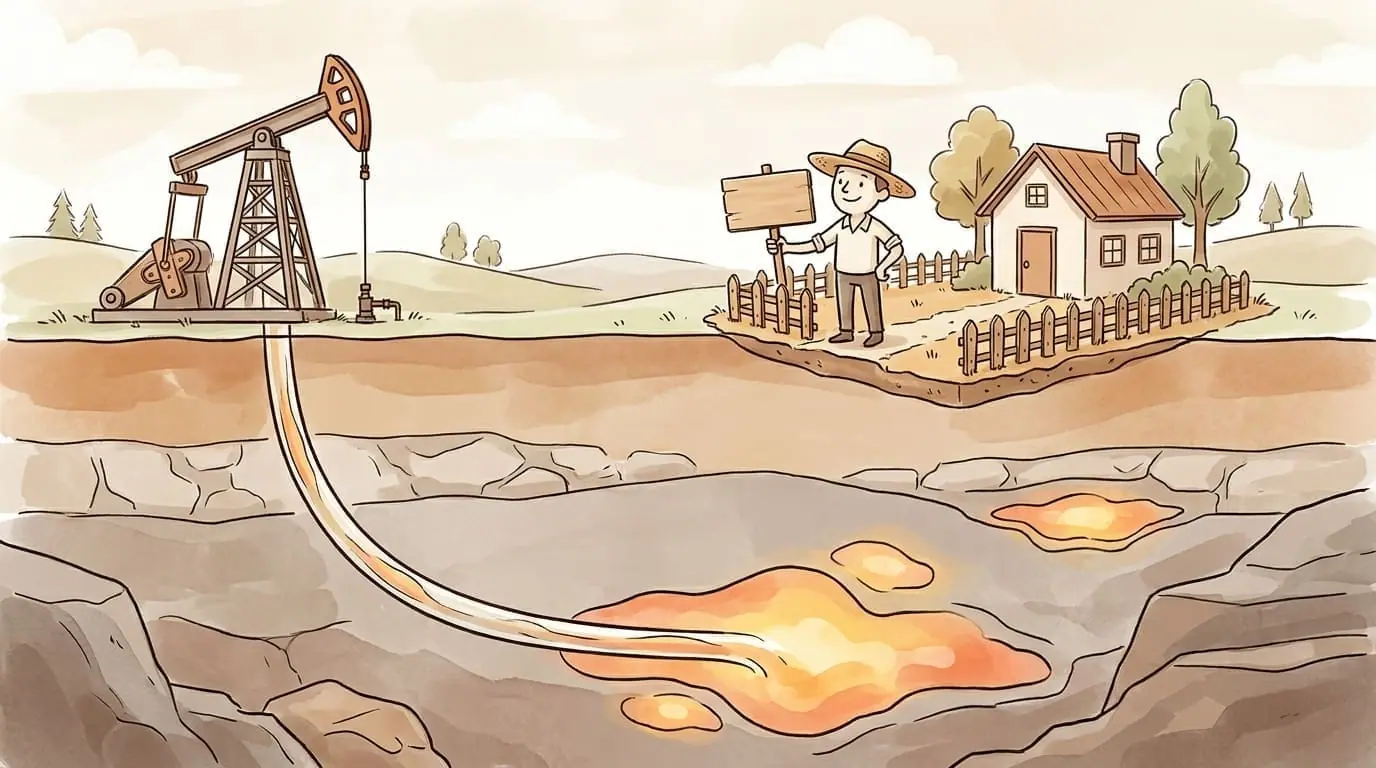
I sit across the table from mineral owners all the time who think their assets are safe. They assume that if they refuse to sign a lease, the gas under their land will just stay there, waiting for a better day, a better price, or a better operator.
It makes logical sense. If you own a piece of timber land and refuse to let a logger cut your trees, the trees stay right where they are. You can wait decades. They just grow.
But minerals don’t work like trees. And if you own oil and gas rights in Pennsylvania, assuming your unleased minerals are safe is one of the most expensive mistakes you can make.
The law actually allows your neighbor’s operator to legally suck the gas out from under your property without paying you a dime. That isn’t a loophole. It is settled law.
A 2020 Pennsylvania Supreme Court case called Briggs v. Southwestern Energy Production Co. cemented this reality for modern shale drilling. We talk to families constantly who are holding out for a better lease bonus, totally unaware that the gas they are trying to protect is already migrating across the property line.
Let’s look at exactly how this happens, what the courts have said about it, and what your actual options are when a rig shows up next door.
The Wild Animal Under Your Land
To understand the legal trap Pennsylvania mineral owners face, we have to go back to 1889. That was the year the Pennsylvania courts decided that oil and gas were sort of like wild animals.
Minerals are [:fugacious](#fugacious). That is just a fancy legal way of saying they move around underground. Because fluids naturally flow from areas of high pressure to areas of low pressure, drilling a well creates a low-pressure zone that pulls gas from the surrounding rock. It doesn’t respect property lines.
Because of this underground movement, early judges established the [:rule of capture](#rule-of-capture). The logic was simple. If a wild deer wanders from your property onto my property, and I shoot it, it belongs to me. You can’t sue me for the value of the deer just because it used to sleep in your woods.
For over a century, the rule of capture has meant that if an operator drills a well on their own leased property, and that well naturally drains gas from your unleased property, they owe you nothing. They haven’t trespassed. They just caught the wild animal after it crossed the line.
But when the Marcellus Shale boom hit, things got complicated.
The Briggs Family Fights Back
Shale rock is incredibly tight. Gas doesn’t just flow freely through it like it does in a conventional sandstone reservoir. To get the gas out of the Marcellus, operators have to use [:hydraulic fracturing](#hydraulic-fracturing). They pump millions of gallons of water and sand into the wellbore under massive pressure to physically crack the rock open.
The Briggs family owned land in Susquehanna County, Pennsylvania. They did not have an oil and gas lease. Right next door, Southwestern Energy had leased the neighbor’s land and was drilling and fracking Marcellus shale wells.
The Briggs family sued Southwestern Energy. Their argument made a lot of common sense. They pointed out that gas in shale doesn’t just naturally migrate like a wild animal. It stays trapped in the rock forever unless someone forcefully breaks the rock to suck it out. Because Southwestern was artificially breaking the rock and pulling gas from under the Briggs’ land, the family argued it was a trespass.
At first, a lower appellate court agreed with the family. The Superior Court ruled in 2018 that the old rule of capture didn’t apply to modern fracking. Mineral owners across Pennsylvania cheered. It looked like unleased owners finally had leverage.
That hope didn’t last.
The Supreme Court Slams the Door
The case went up to the big leagues. According to the Pennsylvania Supreme Court’s 2020 ruling, the method of extraction simply does not matter.
The justices overturned the lower court. They stated clearly that the 150-year-old rule of capture absolutely applies to hydraulic fracturing. An operator is totally immune from liability if they drain your gas, as long as they stay on their side of the line.
There is exactly one exception to this rule, and it is a massive legal catch-22.
The only way you can successfully sue an operator for draining your gas is if you can prove an actual physical subsurface invasion. You have to prove that their fracking fluid, their sand (proppant), or the physical fractures themselves actively crossed the boundary line into your specific subsurface property.
Think about the sheer impossibility of proving that.
As legal analysts noted after the ruling, this is an intensely factual question that requires specialized expert evidence. You can’t just walk out to the fence line and take a photo. This is happening two miles underground in solid rock.
Proving a physical invasion requires hiring petroleum engineers, geologists, and lawyers. It requires millions of dollars in litigation costs just to get access to the operator’s proprietary fracking data during discovery. For a normal family holding 50 or 100 acres, bankrolling a federal-level subsurface trespass lawsuit is financial suicide.
The result of the Briggs decision is a harsh reality for Pennsylvania mineral owners. The court essentially said: Yes, they might be draining your gas. But unless you have a few million dollars to prove their sand crossed your invisible underground boundary line, there is nothing you can do about it.
The “Do Nothing” Strategy is Failing
We see the fallout from this constantly. A family argees they shouldn’t lease. Maybe they read about how bad operator deductions are in this state. (And they are right to be cautious. We broke down how Pennsylvania operators use gag clauses and deductions to squeeze royalty owners in a previous piece.)
So they decide to hold out. They get a lease offer in the mail, look at the disappointing bonus amount, and throw it in the trash. They figure they will just wait out the operator.
Here is what actually happens.
The operator moves the well pad slightly to the left. They drill the horizontal laterals parallel to your property line instead of through it. They frack the wells. The low-pressure sinkholes they create underground begin pulling gas from your unleased acreage into their wellbore.
Months go by. The operator gets paid for your gas. The neighbor gets a royalty check for your gas. You get nothing.
Years ago, the courts offered a sarcastic remedy for this. In a 1907 case, a judge asked what a neighbor could do if they were getting drained. His answer? “Nothing; only go and do likewise.” The legal remedy for drainage is to just drill your own offset well.
That was fine in 1907 when you could drill a shallow well with a wooden rig and a steam engine. Today, an unconventional shale well costs $10 million to $15 million. You aren’t going to “do likewise.”
You Still Have Options
If you find yourself unleased next to active development, doing nothing is a decision to let your wealth slowly evaporate. You essentially have three viable paths.
First, you can capitulate and sign a lease. This is often painful because once an operator knows they can drill around you and still get a portion of your gas, your negotiating leverage drops to zero. You will likely be offered worse terms than the neighbor who signed early. You will have to fight tooth and nail just to avoid signing a lease that strips away all your royalty through deductions, a problem so common we wrote a guide explaining Pennsylvania’s minimum royalty illusion.
Second, you can pool your resources with neighbors. If you and five adjacent unleased neighbors can band together to form a block of 500 acres, the operator can no longer just drill around you. You suddenly represent a massive roadblock to their development plans. They have to deal with you. But getting five families to agree on anything is a monumental task.
Third, you can sell the mineral rights entirely.
I know selling family land is a heavy decision. Often, these rights were passed down from parents or grandparents. There is emotional weight attached to the deeds. But we regularly speak with families who realize that owning an asset that is actively being stolen legally isn’t doing their children any good.
Selling transfers the burden. When a family office or an institutional buyer acquires those rights, we have the acreage footprint, the capital, and the legal team to force the operator to the table. We don’t get ignored the way a single family does. We buy the problem off your hands for a lump sum, and the headache becomes ours.
Knowing What You Owe Yourself
The absolute worst outcome is letting an oil and gas company take your inheritance for free because you didn’t understand the rules of the game.
Pennsylvania law is not designed to protect the unleased mineral owner. The system strongly favors the operators who extract the resources. The Briggs decision was just the final nail in the coffin for the idea that holding out would keep your gas safe.
If you are unleased and there is a rig running within a mile of your property line, the clock is ticking. You don’t have to sell, and you don’t have to lease right this second. But you do owe it to your family to at least get a valuation.
If you want to read more about navigating these decisions, we have a complete framework on whether families should consider selling their mineral rights.
Know what your property is worth. Understand your exposure to drainage. Gather the facts. Only then can you make a decision that actually protects the legacy you were handed.
:fugacious
A legal term used to describe minerals like oil and gas that have a fluid nature and can migrate naturally beneath the surface of the earth, often ignoring property boundaries.
:rule-of-capture
A foundational legal doctrine holding that a landowner has the right to extract all the oil and gas they can produce from a well on their own land, even if it causes gas to migrate from a neighbor’s property, without owing the neighbor any compensation.
:hydraulic-fracturing
A well stimulation technique where millions of gallons of water, sand, and chemicals are pumped underground at extreme pressure to create cracks in tight rock formations (like shale), allowing trapped oil and gas to flow into the wellbore.