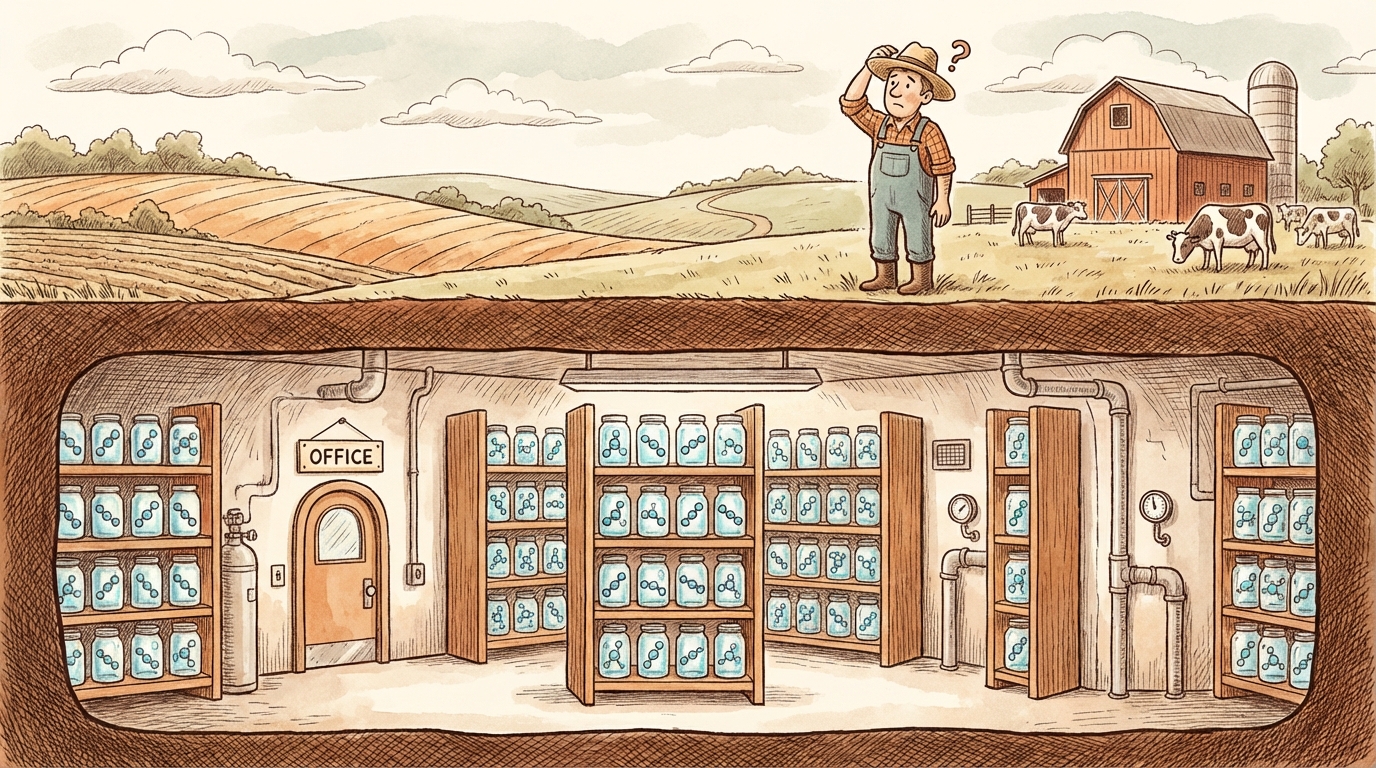
My family’s land isn’t drilled. We don’t have a rig in our pasture. We aren’t getting royalty checks for gas production. So why does a massive utility company claim they “own” the subsurface rights under our farm?
We hear variations of this question all the time. The confusion is entirely justified. Most people assume that if an energy company is involved with your land, they are taking something out of it.
But in places like Pennsylvania, they might be putting something back in.
Your acreage likely sits over—or directly adjacent to—an underground natural gas storage field. The operator isn’t producing gas from your rock. They are using the empty space down there as a giant, invisible warehouse.
This flips all your normal intuition about mineral rights upside down. You aren’t dealing with a standard oil and gas lease. Instead, you are dealing with storage rights, certificated field boundaries, federal regulations, and sometimes, outright property condemnation. Most owners only discover this after the fact, usually when a title review flags an issue, a neighbor files a lawsuit, or a bizarre “storage agreement” arrives in the mail.
Let’s break down exactly how underground storage works, why the legal mechanics are so frustrating for families, and what your options are when your asset feels more like a regulatory headache than a blessing.
Production vs. Underground Gas Storage
To understand the problem, we need to separate producing gas from storing gas.
When you sign a standard oil and gas lease, you grant a company the right to drill into the rock and extract the hydrocarbons. They sell the gas, and you get a percentage of the revenue. It is a straightforward extraction model. If you want to dive deeper into how that works, we have a whole guide on producing vs. non-producing minerals.
Gas storage is different. Demand for natural gas changes wildly throughout the year. We need a lot of it in January to heat our homes, and much less in May. But gas wells pull from the earth at a relatively constant rate. To manage this mismatch, the industry needs somewhere to keep the gas until winter.
They store it deep underground in porous rock formations—usually depleted oil or gas fields that have already proven their ability to hold pressure. The gas is pumped down into the pore spaces of the sandstone or limestone. A solid layer of rock above it, called a caprock, acts as a seal so the gas doesn’t leak upward.
A typical storage facility has three main components:
- Injection/Withdrawal Wells: The actual pipes that push gas down in the summer and pull it back up in the winter.
- Observation Wells: Monitoring holes drilled around the perimeter to ensure the gas isn’t migrating where it shouldn’t.
- The Buffer Zone: A legally defined perimeter around the active storage reservoir. No gas is supposed to be stored here, but the operator controls this area to protect the integrity of the field and prevent nearby drilling from accidentally piercing their pressurized tank.
Who Authorizes This? The FERC Process
You might be wondering how a private company gets permission to turn the rock under your house into a commercial warehouse without asking you first.
The answer usually starts in Washington, D.C.
Underground gas storage facilities connected to interstate pipelines are regulated by the Federal Energy Regulatory Commission (FERC). When a company wants to establish or expand a storage field, they apply to FERC for a :Certificate of Public Convenience and Necessity.
They submit massive geological studies showing the reservoir boundaries, the caprock integrity, and the necessary buffer zones. FERC reviews the data. If FERC agrees that the project serves the public interest—because keeping the lights and heaters on during winter is a public necessity—they issue the certificate.
Here is the scary part for property owners. Under 15 U.S. Code § 717f of the Natural Gas Act, once a company holds that FERC certificate, they are granted the federal power of eminent domain.
If they need your subsurface rock to store their gas or maintain their buffer zone, they will try to buy an easement or a storage lease from you first. If you refuse to sell, or if you demand too much money, they can take you to federal or state court and condemn the property rights they need. You get paid what the court deems “just compensation,” but you cannot stop them from taking control of the subsurface.
The Pennsylvania Twist
Pennsylvania is a massive player in this space. According to the Department of Environmental Protection, the state has over 60 active underground storage fields spread across dozens of counties, from Erie to Washington to Tioga. Many of these are old, depleted conventional gas fields from the 1930s and 1940s.
While FERC handles the interstate commerce authorization, the state handles the physical safety. The Pennsylvania DEP heavily regulates the actual operations. Under the Pennsylvania Code Chapter 78, Subchapter H, storage operators must inspect every single well at least once a month. They have to test the mechanical integrity of the wells every five years. They are subject to strict maximum pressure limits to ensure the rock doesn’t fracture.
For a landowner, this intense regulation means you are essentially living on top of a highly monitored, heavily litigated utility zone. The operator defines “field boundaries” and “buffer zones” to comply with both state safety laws and federal FERC certificates.
And that is exactly where the legal nightmares begin.
How Owners Get Burned
Storage fields turn a simple piece of family land into a complex web of regulatory filings, easements, and litigation risks. We talk to families all the time who find themselves trapped in bizarre scenarios.
“We never signed a storage lease.” This is incredibly common. Maybe your land sits inside the newly drawn buffer zone of a decades-old storage field. The operator needs control of your subsurface to satisfy FERC, but they drag their feet on formally condemning it or paying you. You end up with encumbered land—meaning you probably couldn’t lease it to a traditional drilling company even if you wanted to—but you receive zero compensation because the storage company hasn’t finalized their paperwork.
“Our minerals are severed. Who gets paid?” This is a classic legal mess. Your grandfather sold the farm in 1980 but kept the “mineral rights,” which eventually passed down to you. Now, a gas company wants to pay someone to use the empty rock for storage. Who owns the empty rock? The surface owner, or the mineral owner?
In many states, the surface owner owns the physical structure of the rock (the pore space), while the mineral owner only owns the hydrocarbons inside it. If the reservoir is totally depleted, the surface owner might get the storage rent. If there is still “native gas” left in the rock, the mineral owner has a claim. As we discussed in our article about how your pore space is the real target, this single issue triggers years of quiet title lawsuits.
“Why is my neighbor in a lawsuit about subsurface storage?” Because the buffer zones get messy. Look at the recent, high-profile Pennsylvania case Hughes v. UGI Storage Company. Landowners realized their properties were sitting inside a massive buffer zone around the Meeker Storage Field. UGI had a FERC certificate for the storage field, but they hadn’t actually acquired the property rights from these specific buffer-zone landowners, nor had they formally condemned the land yet.
The landowners filed a class action lawsuit, claiming UGI committed a “de facto taking”—meaning the company took their property rights by severely restricting their use of the land without paying for it. The court basically said: Yes, UGI has eminent domain power under federal law, but because they haven’t updated their FERC certificate to specifically condemn your exact tracts yet, you can’t sue for a de facto taking under the eminent domain code. You might have to sue them for plain old trespass instead.
Imagine inheriting your grandmother’s land and immediately having to decipher whether a utility company is trespassing a mile beneath your boots. It is exhausting.
The Owner’s Playbook: What to Request
If you suspect your land is involved in an underground storage field, you need facts. Do not rely on verbal assurances from a landman over the phone. Here is exactly what you should request in writing from the operator:
- The Storage Field Map: Ask for the official map showing the certificated reservoir boundaries and the protective buffer zone. You need to see exactly where your property lines intersect their regulatory lines.
- The Lease or Easement: Ask for a copy of the specific document that grants them the right to store gas under your tract. If they say they don’t need one, ask them to explain their legal basis in writing.
- The FERC Docket Number: Every interstate storage field has a paper trail at the federal level. Get the docket or certificate number so you (or your attorney) can pull the public filings.
- The Basis of Authority: Ask point-blank if they claim storage rights by private contract (a lease you or a prior owner signed), by formal condemnation (a past court order), or by “existing field authority” (grandfathered rights).
You have a right to know how your property is being used. Make them show their work.
Why Selling Often Makes Sense
We are a family office. We buy minerals, royalties, and energy assets. But we never tell anyone they have to sell. Keeping family land in the family is a deeply personal choice. If you inherited a clean, producing mineral interest that drops a healthy check in your mailbox every month, holding onto it is a great option. We wrote a survival guide for inheriting minerals exactly for that scenario.
But underground storage is a different animal.
When your asset is tied up in a storage field or a buffer zone, you are not holding a royalty-generating asset. You are holding a regulatory risk. You are holding an easement dispute. You are holding a potential trespass lawsuit.
For many owners—especially those who live out of state or inherited fractional shares alongside a dozen cousins—the administrative friction simply isn’t worth the headache. You have very little control. You cannot force them to drill. You cannot easily negotiate a better storage rate when they have the ultimate trump card of federal eminent domain.
In these situations, selling the rights is often a highly rational financial decision. It allows you to convert a complex, litigation-adjacent property issue into immediate capital. You hand the legal mess, the FERC dockets, and the buffer zone disputes over to someone who deals with them every day.
You get peace of mind. We get the paperwork.
If you own rights in Pennsylvania and you are tangled up in a storage field dispute, or if you just want to know what your options are, it might be worth a conversation. You deserve to know exactly what you own, and more importantly, what it is actually worth in the real world.
:certificate-of-public-convenience-and-necessity
A formal authorization issued by the Federal Energy Regulatory Commission (FERC) that allows a company to construct, extend, or operate natural gas facilities, including interstate pipelines and storage fields. Crucially, holding this certificate grants the company the federal power of eminent domain under the Natural Gas Act.
:buffer-zone
A legally defined boundary surrounding an active underground natural gas storage reservoir. While gas is not intentionally stored in this area, operators strictly control the buffer zone to monitor for migrating gas and to prevent third parties from drilling wells that could accidentally puncture and depressurize the storage field.
:eminent-domain
The legal power of a government—or an authorized private entity like a utility or pipeline company—to take private property for public use without the owner’s consent, provided the owner is paid “just compensation.” In gas storage, this is often used to secure subsurface rights when a landowner refuses to sign a storage lease.