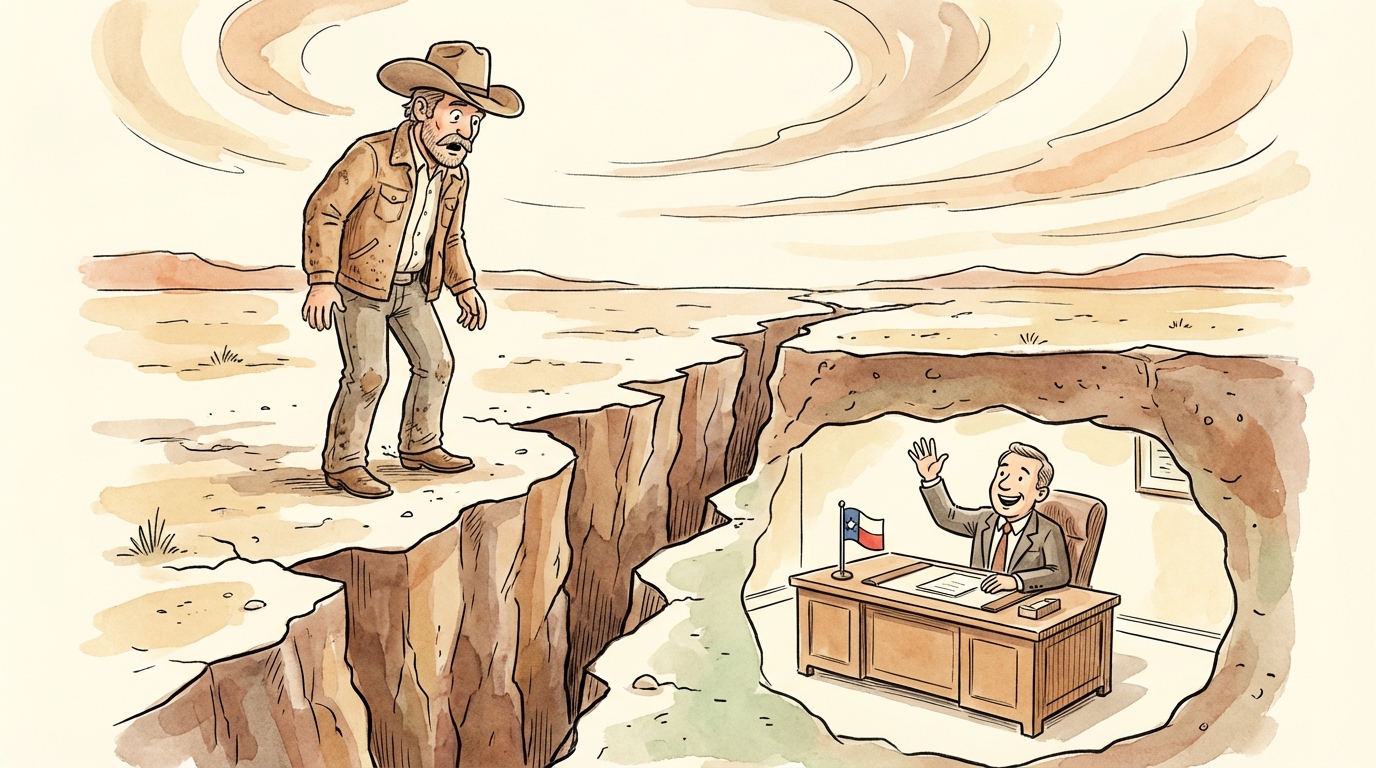
You thought Grandpa just bought a ranch. You have the deed. It looks like a standard piece of private property out in the Trans-Pecos. The dirt is yours, the scrub brush is yours, and naturally, you assume the minerals underneath are yours too.
Then an oil and gas landman knocks on your door. He wants to lease the property. He hands you paperwork, and you notice something strange. You aren’t listed as the absolute owner of the minerals. You are listed as an “agent for the State of Texas.”
Welcome to the bizarre, highly specific, and deeply confusing world of Texas :mineral-classified land.
We talk to families every month who are completely blindsided by this. They inherit land in West Texas, look at the surface deeds, and assume they have a standard private royalty situation on their hands. Instead, they discover they’ve accidentally inherited a part-time job as a leasing manager for the government.
Let’s break down exactly what the Relinquishment Act is, why the state is quietly sitting in your mineral stack, and what this actually means for your bottom line.
A Quick History of West Texas Dirt
To understand why the state is your secret partner, we have to look backward.
Texas mineral law is a patchwork quilt of different eras and different governments. Under early Spanish and Mexican land grants, the sovereign government always kept the minerals. When Texas won its independence, it kept that tradition alive for a while, holding onto the minerals beneath vast tracts of unsurveyed land.
As the Texas Real Estate Research Center notes, things got messy in the late 1800s. The state needed to encourage settlement and development, so they started giving away land. They gave odd-numbered sections to the railroads to encourage them to build lines out west. They kept the even-numbered sections for the state and put them into the Public School and Asylum Fund.
Eventually, Texas started selling off that school fund land to ranchers and settlers. But in 1895, the state drew a line in the sand. For certain tracts of land—especially out West—they sold the surface but explicitly classified the property as “mineral land.” The state kept the mineral rights.
The ranchers owned the grass. The State of Texas owned the oil.
You can probably guess what happened next. Decades passed. The oil boom hit. The state started leasing its retained minerals to oil companies. Suddenly, ranchers out in West Texas had oil rigs showing up on their land, tearing up their pastures, and polluting their water sources. The ranchers didn’t own the minerals, so they didn’t get a dime of the profits. All they got was ruined dirt.
The settlers were furious. They locked their gates. They met oil crews with loaded rifles. The situation was escalating into literal violence.
The 1919 Relinquishment Act Compromise
The Texas legislature had to do something to stop the bloodshed and get the oil flowing again. In 1919, they passed the :Relinquishment Act.
The state essentially made the surface owners an offer: If you let the oil companies drill, we will let you act as our leasing agent, and we will split the money with you.
Originally, the wording of the act made it sound like the state was actually giving ownership of 15/16ths of the oil and gas directly to the surface owner. But the courts later clarified that this was unconstitutional. The state couldn’t just give away public school assets.
The final legal interpretation settled on this: On mineral-classified land, the surface owner owns exactly zero percent of the minerals. The State of Texas owns 100% of them. However, the surface owner holds the exclusive right to negotiate the lease on the state’s behalf.
In exchange for doing the legwork and dealing with the surface disruption, the state splits the economics with you. You get 50% of the bonus payment, 50% of the delay rentals, and 50% of the royalties. The Public School Fund gets the other 50%.
The General Land Office is the Real Boss
This is where things get tedious for families trying to manage these properties today. Because you are acting as an agent for the state, you don’t actually have the final say on the lease. The Texas General Land Office (GLO) does.
You can spend weeks negotiating with a landman. You might fight for a higher bonus or a better royalty percentage. But once you sign that lease, it isn’t a done deal. You have to submit it to the state.
According to the GLO’s official leasing rules, your lease isn’t effective until it is reviewed, approved, and filed by the General Land Office. The state is legally the lessor. They are looking out for the permanent school fund, and they demand the best possible deal.
If the GLO looks at the lease you negotiated and decides the bonus is too low for the current market, they will reject it. We have seen families negotiate what they thought was a fair deal, only to have the state kick it back because an adjacent county tract leased for a few hundred dollars more per acre. The GLO’s guidelines specifically require you to secure the highest consideration paid, and they hold you to that fiduciary standard.
You also have to use the state’s specific Relinquishment Act lease form. You can’t just use whatever standard producer’s form the oil company hands you. If you try to slip in custom clauses without state approval, the whole thing gets bounced.
The “Damages to the Soil” Quirk
There is another weird trap door in this law that catches landowners off guard.
Normally, if you own the surface of a ranch and an oil company comes in to drill, you negotiate a separate Surface Use Agreement (SUA). You charge them for building the pad site, cutting roads, laying pipelines, and using your water. That surface damage money belongs entirely to you.
But Relinquishment Act lands are different. Under Texas Natural Resources Code Section 53.066, the money you receive from the lease—that 50% of the bonus, rentals, and royalties—is legally “in place of all damages to the soil.”
Read that again. The state’s position is that they are already paying you for the surface damage by giving you half of the oil revenue. Therefore, you cannot demand a second, separate payment for general soil damages from the oil company just for the privilege of drilling.
You can sometimes negotiate specific damages for ruined crops, destroyed timber, or use of your personal groundwater, but you cannot charge standard location fees. The oil company knows this. The landman knows this. If you try to fight them on it, they will just point to the statute.
Can You Sell Relinquishment Act Royalties?
This is the question we get asked the most. A family inherits a piece of West Texas scrubland. They have no interest in ranching. They don’t want to deal with GLO paperwork. They just want to cash out and move on.
But how do you sell mineral rights you don’t actually own?
The short answer is: you can’t sell the minerals. You can’t separate the leasing rights from the surface. Whoever owns the dirt holds the :executive right to lease the minerals.
However, if the land is already leased or actively producing oil, you do have options. Texas law allows a surface owner to sell or assign their right to receive that 50% royalty stream.
But there is a massive catch. You can only sell that income stream for the life of the current lease.
If you sell your royalty interest to an investor, and two years later the oil company stops pumping and the lease expires, the investor loses everything. The right to the royalties instantly reverts back to the surface owner. When the next oil company comes along to sign a new lease, the surface owner gets to negotiate again, and they get the new 50% cut. The previous buyer is entirely out of the picture.
This temporal limitation makes valuing these assets incredibly difficult. We laid out How We Value Your Royalties in a previous piece, but Relinquishment Act lands require an entirely different math model. You are effectively pricing a temporary cash flow, not a perpetual asset. Most standard mineral buyers won’t touch them because the risk of the lease dying is too high.
If you want to completely wash your hands of the property forever, your only real option is to sell the surface dirt entirely. The mineral agency rights will automatically transfer to the new ranch owner.
The Burden of Bureaucracy
I’ve sat across from families who are completely exhausted by this process.
They thought they were inheriting a simple royalty check. Instead, they are dealing with state agency approvals, rigid lease forms, operators who won’t negotiate surface damages, and a constant underlying anxiety that they might mess up the paperwork and lose the deal altogether.
It is a heavy administrative burden. The state does not hold your hand through this. They simply expect you to act as a competent land manager, secure top-dollar bids, and send them their 50% cut on time.
If you are currently managing mineral-classified land, the most important thing you can do is understand exactly what you hold. Don’t sign anything a landman hands you without running it past someone who actually understands the GLO framework. Treat the state like the strict business partner they are.
Selling isn’t always the right answer. Sometimes, holding the land and playing the state’s game yields incredible generational wealth. We’ve seen Producing vs. Non-Producing Minerals dictate entirely different strategies for families in the Permian.
But if the bureaucratic headache is too much, or if you simply want to diversify away from West Texas oil exposure, it is absolutely worth a conversation to see what your options are. Finding out what your surface and temporary royalty rights are actually worth in today’s market costs you nothing.
You didn’t ask to be an agent for the State of Texas. But since you are one, you might as well ensure you’re getting paid exactly what you deserve.
:mineral-classified-land
These are specific tracts of land in Texas—mostly in the western part of the state—where the state sold the surface to private owners but explicitly retained 100% of the mineral rights for the public school fund. The surface owner acts as the leasing agent for the state.
:relinquishment-act
A 1919 Texas law designed to end conflicts between ranchers and oil companies. It dictates that on mineral-classified lands, the state owns the minerals, but the surface owner has the power to execute leases. In return, the surface owner and the state split all bonuses, rentals, and royalties 50/50.
:executive-right
The legal authority to negotiate and execute an oil and gas lease. On normal private land, this right can be severed and sold separately from the surface. On Relinquishment Act land, the executive right is permanently attached to the surface ownership and cannot be sold off by itself.