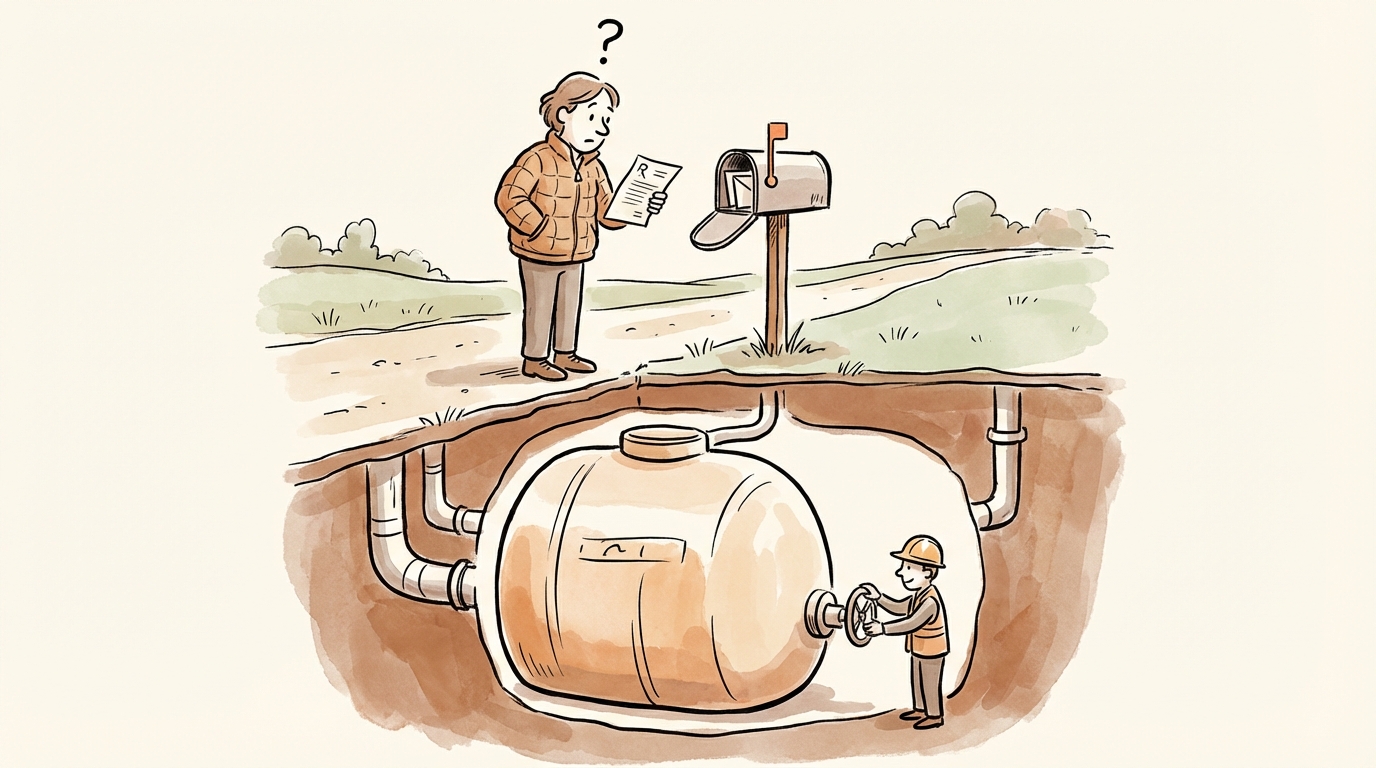
Most people who own mineral rights expect one of two things to happen. Either an oil and gas company drills a well and sends a royalty check, or nothing happens at all and the minerals sit quietly in the family estate.
But if you own land or minerals in Illinois, there is a third, highly unusual possibility.
You might check your mail one day and find a legal notice from a utility or midstream company. They don’t want to drill for your oil. They don’t want to extract your natural gas. Instead, they want to pump their natural gas into the ground directly beneath your property.
They want to turn your family’s subsurface into an active, pressurized storage tank. And thanks to a quirky, very specific set of state laws, they might not actually need your permission to do it.
At Double Fraction, we look at mineral ownership across the entire country. We see the weird variations in state laws. We’ve talked before about how your pore space is becoming just as valuable as your minerals, and we’ve covered similar storage issues in Pennsylvania. But Illinois has its own distinct, aggressive flavor of underground storage law. It catches families completely off guard.
Let’s break down exactly what the Illinois Gas Storage Act is, how condemnation works, and what it actually means for the value of your property.
The Problem: Your Land as Infrastructure
Natural gas demand fluctuates wildly. People need a lot of it during a harsh Midwest winter to heat their homes, and less of it in the mild spring. Because gas isn’t produced at the exact moment it is consumed, companies have to store massive quantities of it somewhere.
Above-ground tanks are expensive and impractical for the volumes needed. The solution? Pump the gas back underground into a :depleted reservoir or a deep water aquifer, hold it there under pressure, and pull it back out when the market needs it.
The Illinois Commerce Commission (ICC) explicitly recognizes subsurface geologic formations as the primary method for natural gas storage. Utility companies rely on this. But to build a storage field, a company needs contiguous control over thousands of acres of subsurface rights.
If even a few landowners refuse to sign a storage lease, the entire project could fail. Gas doesn’t respect property lines once it is injected underground. It will migrate into the unleased neighbor’s subsurface.
Illinois lawmakers recognized this bottleneck decades ago. Their solution was the Gas Storage Act.
The Illinois Gas Storage Act (220 ILCS 15)
Under 220 ILCS 15/, any corporation engaged in distributing, transporting, or storing natural gas for public distribution is granted a massive superpower. They have the right to enter upon, take, or damage private property for gas storage operations using :eminent domain.
Read that again. A private corporation can condemn your subsurface property rights.
They don’t just take the area where the injection well is drilled. They condemn the entire underground geologic formation where the gas will sit, often taking a surrounding “buffer zone” to ensure the pressurized gas doesn’t escape the project boundaries.
This isn’t a simple handshake deal. The company cannot just declare eminent domain and start pumping. They have to jump through specific regulatory hoops first.
The ICC Approval Process
Before a company can force a condemnation, they have to apply to the Illinois Commerce Commission for an order approving the storage project.
The law puts a few strict guardrails on what the ICC can approve. According to Section 2 of the Act, the storage project must be confined to geological strata lying more than 500 feet below the surface. They cannot legally condemn a shallow formation right under your basement.
The ICC also must find that the project will not injure water resources. Most importantly for mineral owners, the company cannot condemn any formation that currently contains oil, gas, or coal in “commercial paying quantities.” They are only supposed to take the empty space, or zones that are already fully depleted.
But here is where the mess begins. Who decides what constitutes “commercial paying quantities”? If you own an old, marginal oil well that only produces a few barrels a month, the storage company might argue your zone is depleted and subject to condemnation. You might strongly disagree. That disagreement often leads to expensive legal fights.
The 21-Day Notice
If a company files an application to build a storage field under your land, the law requires them to notify you. Under Section 3 of the Act, the company must publish a notice in a local newspaper for three successive weeks.
More importantly, they have to send you a notice by registered mail at least 21 days prior to the hearing. They pull your address from the county tax collector’s records.
This is exactly why we constantly warn families about keeping their county records updated. If you inherited land but never properly updated the tax records, that notice goes to a dead relative. The 21-day clock runs out, the hearing happens without you, and your subsurface gets condemned by default. We detailed a very similar issue with leasing in our guide to Illinois’ missing owner trap. You cannot defend property you don’t actively monitor.
IDNR Part 240 Rules: The Operational Reality
Getting ICC approval is just the first step. The actual physical drilling, injection, and maintenance of these gas storage wells are heavily regulated by the Illinois Department of Natural Resources (IDNR).
Under Title 62, Part 240 of the Illinois Administrative Code, Subpart R contains the specific requirements for underground gas storage fields. These aren’t standard oil wells. They are high-pressure, high-volume infrastructure projects.
The IDNR rules require rigorous testing, casing standards, and boundary monitoring. The state wants to ensure the gas stays where the company put it. If a “natural gas incident” occurs—meaning gas migrates outside the approved boundaries or leaks—the company has strict reporting and mitigation duties.
But knowing the state is watching the operator doesn’t change the reality for the landowner on the surface. You now have a high-pressure gas facility operating hundreds of feet beneath your home or farm.
What Does This Mean for Your Rights?
If your property falls inside an approved gas storage boundary, your rights are fundamentally altered.
The Gas Storage Act explicitly states that the ICC order must protect the rights of mineral owners to drill for oil or gas in strata other than the one being condemned for storage. So technically, if the storage company takes the St. Peter Sandstone formation at 2,000 feet, you still own the right to drill into a different formation at 3,500 feet.
In reality, drilling through an active, highly pressurized gas storage reservoir to reach deeper oil is a nightmare. Operators hate doing it. It requires specialized casing programs, extra regulatory approvals, and massive liability risks. Many oil and gas companies will simply refuse to lease your minerals if they have to drill through a storage field to get to them. Your theoretical right to drill remains, but your practical ability to monetize those deep minerals plummets.
You also lose the ability to lease that specific condemned zone for anything else, such as carbon capture and sequestration (CCS), which is a rapidly growing market in the Midwest.
The Question of Compensation
When a company condemns your property under the Gas Storage Act, they are required to pay you “just compensation” under standard eminent domain law.
But how do you value a hole in the ground?
Storage companies often argue that empty :pore space has zero independent value to a farmer or homeowner, offering mere pennies per acre. Landowners argue that the subsurface is a critical piece of a multi-million dollar infrastructure project and demand a premium.
This leads to a grueling negotiation. The company will likely make a low initial offer. If you refuse, they take you to court to enforce the condemnation. You then have to hire a specialized attorney, pay for expert appraisers to value the geological strata, and fight a massive utility company in front of a judge.
The legal fees alone can rapidly eclipse the amount of money actually in dispute. The utility companies know this. They bank on attrition.
Making the Hard Decisions
I talk to families every week who feel overwhelmed by these situations. Selling family land or mineral rights is a deeply emotional decision. You want to hold onto what your parents or grandparents left you.
But becoming an involuntary landlord to a utility company’s gas storage project is exhausting. You aren’t cashing big royalty checks from an oil boom. You are just holding a piece of paper that says a company is legally allowed to pump gas under your feet, while you fight them in court for a few thousand dollars in compensation.
Sometimes the honest answer is that fighting a state-sanctioned condemnation is just a bad return on your time and mental health.
When a family realizes what is actually happening with a gas storage project, they often start looking for an exit. They realize that trading the uncertainty, the legal fees, and the long-term liability for a clean, fair valuation today makes sense for their specific situation. Knowing what your ownership is actually worth on the open market gives you leverage. You don’t have to accept the utility company’s lowball offer, but you also don’t have to spend years in court fighting them.
You have options. The worst thing you can do is ignore the notices and let the process happen to you by default.
If you are dealing with a gas storage lease request, a condemnation notice, or you just own minerals in Illinois and want to understand your exposure, get some facts together. Understand the math. At least know what your options are. It is always worth a conversation.
:depleted-reservoir
A geologic formation underground that previously held oil or natural gas but has been mostly pumped empty. Storage companies love these formations because nature already proved they can hold pressurized gas without leaking.
:eminent-domain
The legal right of a government (or a utility company authorized by the government) to take private property for public use, provided they pay “just compensation” to the owner. It forces a sale whether the landowner wants to sell or not.
:pore-space
The microscopic empty gaps between the grains of rock deep underground. While mineral rights usually refer to the oil or gas inside the rock, pore space refers to the actual physical storage capacity of the rock itself.