I talk to families every week who thought they had a done deal. They got a great lease offer from an operator. The bonus money was agreed upon. The royalty percentage was locked in. They started planning what to do with the check—maybe pay off a medical bill, maybe help a grandchild with college tuition.
Then the communication just stopped.
Weeks turned into months. When they finally got the landman back on the phone, the answer was short and devastating: “The surface owner won’t agree to the road. We are pulling the permit.”
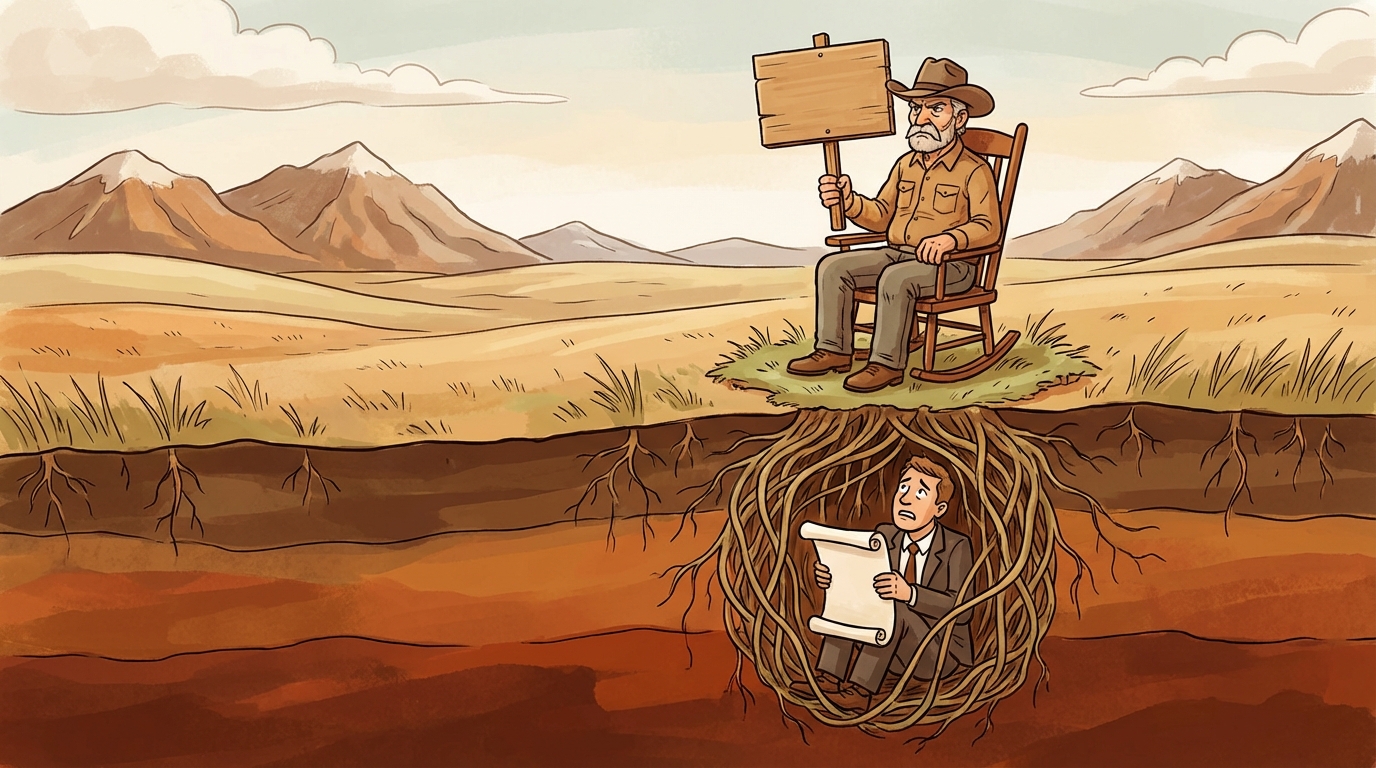
If you own minerals in Montana, you own property in a state where the dirt has teeth. You can be entirely right on paper. You can own a perfectly clean, unencumbered mineral deed. But if you don’t own the surface above those minerals, you are operating in a reality where your asset can be held hostage by the person growing wheat or grazing cattle on top of it.
The friction between the dirt and the rock below it can stall leasing, delay development, and turn your inheritance into a paperwork nightmare. It is a reality that catches a lot of families off guard, especially if they live out of state and just assume oil companies can do whatever they want.
They can’t. And understanding why is the only way to accurately value what you own.
The Split Estate Reality in Montana
In most parts of the country, owning minerals but not the surface is completely normal. It is called a :split estate. The historical rule in the United States oil patch was that the mineral estate is “dominant.” That meant the oil company (who leased your dominant minerals) had the implied right to use as much of the surface as was reasonably necessary to get the oil out.
Surface owners hated this. They watched heavy trucks tear up county roads, well pads consume prime agricultural acreage, and pipelines cut across grazing land.
Montana decided to do something about it. The state built a formal, statutory machine designed specifically to compensate surface owners for the headache of oil and gas development. They passed the Surface Owner Damage and Disruption Compensation Act.
The law was passed with good intentions. Farmers and ranchers absolutely deserve to be compensated when an industrial operation moves into their pasture. But for the severed mineral owner—the person who only owns the rights underground—this law creates a massive bottleneck. It gives the surface owner incredible leverage over your timeline and your money.
The Operator’s Mandated Checklist
An operator in Montana cannot just roll a bulldozer onto a property and start pushing dirt. Under Montana Code Annotated 82-10-503, the state forces oil and gas developers through a very specific set of hoops before they can touch the ground.
First is the notice period. The operator must give the record surface owner written notice of the planned drilling operations. This cannot be a last-minute heads-up. The law requires this notice to be given no more than 180 days and no fewer than 20 days before any activity that disturbs the land surface begins.
That 20-day minimum is a hard pause button on development. It gives the surface owner nearly three weeks to lawyer up, evaluate the plan, and prepare their demands.
The state even forces the operator to educate the surface owner on how to fight back. Along with the notice, the developer is legally required to hand the surface owner a copy of the state’s official publication, “A Guide to Split Estates in Oil and Gas Development”. The operator is literally mandated to hand the rancher the playbook on surface rights.
The Compensation Machine
Once notice is given, the real fight begins: the money.
Under Montana Code Annotated 82-10-504, the surface owner and the operator have to attempt to negotiate a :surface use agreement in good faith. The law outlines exactly what the operator has to pay for. They must compensate the surface owner for “loss of agricultural production and income, lost land value, and lost value of improvements caused by oil and gas operations.”
These are not arbitrary numbers. These are real, heavy :statutory damages. If a well pad takes up five acres of wheat, the operator has to calculate the lost yield of that wheat over the life of the well. If the dust from the heavy truck traffic causes the rancher’s cattle to drop weight or get sick, that is a compensable damage. If the road cuts off a corner of the property and makes it unusable for grazing, the operator pays for that lost land value.
The surface owner can choose how they want to be paid. They can take a lump sum upfront, or they can demand annual damage payments over a period of time.
If the operator agrees to annual payments and then misses a check, Montana law brings down the hammer. If the installment is not paid within 60 days of receiving notice from the surface owner, the operator is liable for twice the amount of the unpaid installment.
If the two sides cannot agree on the math, the state allows either party to request a formal dispute resolution process, including mediation.
The Mineral Owner’s Nightmare
Read through those requirements again. Notice periods. Mandated state brochures. Complex agricultural damage calculations. Dispute resolution. Mediation.
Do you know who is entirely absent from that process?
You. The mineral owner.
If you do not own the surface, you have absolutely zero say in these negotiations. You do not get an invite to the mediation. You do not get to suggest a different route for the access road. You are a completely passive bystander watching two other parties argue over the logistics of your asset.
This is the core problem with owning a split estate in a state with strong surface damage laws. Your asset behaves exactly like a minority business position where someone else holds veto power. We see this dynamic play out internally among relatives, which we outlined in The Family vs. The Operator: Why Sentiment Can Freeze Your Royalty Check. But family drama is one thing. Statutory gridlock is entirely different.
The friction created by the Montana damages act usually manifests in two distinct war stories we hear from families.
War Story 1: The Surface Holdout
An independent operator looks at your minerals and decides they want to drill a single vertical well or a short horizontal. The economics of the well are decent, but the margins are tight.
They send notice to the surface owner. The surface owner hates oil companies and wants nothing to do with it. They demand an exorbitant amount of money for the access road, claiming the well pad will ruin their organic farming certification or destroy the aesthetic value of the land. They demand mediation.
The operator looks at the timeline. They look at the legal fees required to fight the surface owner in mediation. They look at the bloated cost of the surface damages being demanded. They rerun their internal math. Suddenly, the well doesn’t make financial sense anymore.
The operator decides the headache isn’t worth it. They pull the permit, let your lease expire, and move their rig to another county where the surface owner is friendlier. You lose the well, and your minerals go back to generating zero income.
War Story 2: The Toxic Relationship
The well actually gets drilled. The operator and the surface owner sign a surface use agreement with annual payments. You start getting royalty checks, and everything seems fine.
Then the operator changes hands, or oil prices drop and the operator gets sloppy. They miss an annual damage payment to the surface owner. Or maybe a saltwater disposal line leaks, and the surface owner claims massive agricultural damage.
The surface owner invokes the 60-day penalty clause under MCA 82-10-504. They threaten to lock the gates. Lawyers get involved. The relationship between the operator and the surface owner turns violently toxic. The operator starts spending money on litigation instead of well maintenance. Production drops. The well gets shut in while they fight over access rights. Your royalty checks shrink to nothing while a fight you have nothing to do with plays out in a county courthouse.
Evaluating Your Position
If you own minerals in Montana, you need to understand the realities of the ground game. The value of your minerals is not just about the geology. It is heavily dependent on the operator’s ability to navigate the surface owner.
When you get an offer to lease your minerals, or when a landman tells you a well is planned, you need to ask entirely different questions. You cannot just ask about the royalty fraction. You need to ask about the dirt.
Ask the operator: “Who owns the surface?” “Have you initiated the 82-10-503 notice process yet?” “Do you have a signed surface use agreement in place?” “What is your timeline if the surface owner demands mediation?”
If they don’t have good answers to these questions, their timeline to drill is entirely theoretical. They are selling you a best-case scenario that completely ignores Montana statutory law.
This dynamic is why many families ultimately decide that holding small, severed mineral tracts in Montana isn’t worth the uncertainty. If you own a massive tract of minerals, maybe you ride out the delays. But if you own a fractional share of a split estate, your leverage is nonexistent. You hold a highly illiquid asset that is subject to the whims of a surface rancher you have never met.
We break down the financial differences between holding producing assets and gambling on future drilling in Producing vs. Non-Producing Minerals. The reality is that unleased, unpermitted minerals in a split estate carry a specific type of risk that is very difficult for a family to manage. You cannot control the outcome. You can only wait.
Selling all or a portion of those rights is a very valid way to remove that risk from your family’s portfolio. You don’t have to sell everything. We often help families restructure their holdings so they keep some upside while taking cash off the table today, a concept we explain in The All-or-Nothing Myth: Selling Partial Rights.
The point is not that you have to sell. The point is that you should understand exactly what you own. You own an asset governed by strict rules that heavily favor the person standing on top of the ground.
Getting a realistic valuation of your minerals—one that factors in the surface risk, the current operator climate, and the geology—is the best way to make an informed decision. Having options is always better than just waiting by the mailbox, hoping the operator and the rancher can learn to get along.
If you are dealing with a stalled lease or just want to know how surface issues might impact the value of your Montana minerals, it is at least worth a conversation to know what your options really are.
:split-estate
A legal reality where the ownership of the surface land is completely separated from the ownership of the oil, gas, and minerals underneath it. The two estates are owned by different people, which frequently leads to conflict over access and land use.
:surface-use-agreement
A binding private contract between an oil and gas operator and a surface owner that dictates exactly how the land will be used, where roads will be built, and how much compensation will be paid for the disruption of the property.
:statutory-damages
Specific categories of financial compensation that state law mandates an operator must pay to a surface owner. In Montana, this specifically includes compensation for lost agricultural production, lost land value, and damaged improvements.