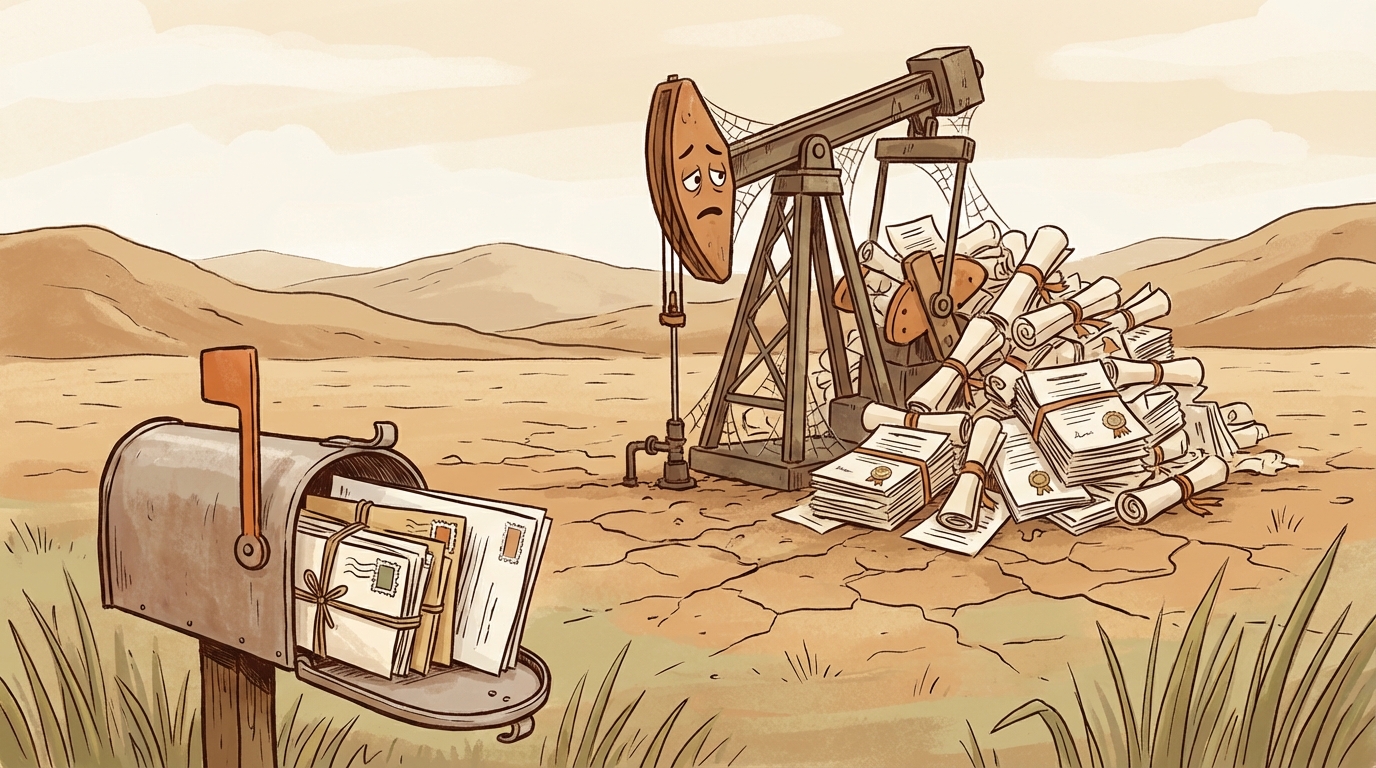
We review a lot of mineral packages here in Texas. When a family brings us a portfolio that includes land in Kern County, California, our underwriting process immediately shifts gears.
Most people think of mineral rights as a simple equation. You own the rock, an operator pumps the oil, and you get a check in the mail. If the pump stops, the oil stays in the ground until someone else comes along to pump it. It feels like a safe, hard asset. You assume your wealth is literally locked in the earth.
But in California, that equation is completely broken. If you own minerals under an old, inactive field in Kern County, you do not just own geology. You own exposure to one of the most aggressive regulatory environments in the country. And the operators tasked with pulling your oil out of the ground are getting squeezed to the point of collapse.
We talk to families who inherited these rights from grandparents who worked the local agriculture or oil booms. They remember the days of heavy production in places like the Midway-Sunset or Kern River fields. Today, they look at their statements and see shrinking decimals. Or the checks stop arriving entirely. They drive by the property and see a rusty pump jack sitting perfectly still in the dirt.
They assume it is just waiting for higher oil prices. In reality, that silent pump jack is a ticking financial time bomb for the company that owns the lease. And by extension, it transforms your family’s mineral title from an asset into a paralyzed liability.
Here is the uncomfortable math about what happens when your Kern County royalty gets caught in the middle of a regulatory crisis.
The New Math of Doing Nothing
To understand why your minerals are at risk, you have to understand what the state of California is doing to oil companies.
The state currently tracks roughly 35,000 wells that fit the definition of an :idle well. According to CalGEM, the agency that regulates California’s oil and gas, this means the well has not produced anything for at least two years and has not been permanently sealed.
Historically, operators would just leave these wells sitting. Keeping a well inactive was cheap. Maybe commodity prices would jump and they would turn the pumps back on. Maybe they would bundle them up and sell them to a smaller company. It was a free option on future oil prices.
The state got tired of waiting. Regulators realized that thousands of these aging steel pipes were essentially abandoned, posing risks to groundwater and surface development. So they changed the rules.
In late 2024, California passed Assembly Bill 1866. Starting in 2025, the fees to simply allow a well to sit idle skyrocketed.
Let me show you the actual numbers, because the math is staggering. If a well is idle for up to three years, the operator owes $1,000 annually. If it sits for three to eight years, the fee jumps to $2,500. If it hits eight years, it becomes $5,000. And if a well has been sitting idle for 20 years or more, the operator now owes an incredible $22,500 per year. Per well.
Think about a mid-sized operator in Kern County holding a legacy lease on your family’s land. They might have 200 old wells that haven’t produced since the early 2000s. Under the new rules, doing absolutely nothing will cost them millions of dollars a year in state fees. They are heavily incentivized to get rid of these wells.
They have two choices. They can pay the massive costs to get them :properly plugged and abandoned, which requires cement, heavy equipment, and environmental reporting. Or they can try to drill new, profitable wells to generate enough cash to pay their idle well taxes.
The Permitting Wall
Drilling new wells sounds like the obvious business solution. But this is Kern County, and drilling new wells is nearly impossible right now.
You might own phenomenal underground reserves. That geology means absolutely nothing if your operator cannot legally move a drilling rig onto your dirt.
In 2015, Kern County tried to make things easier by creating a streamlined permitting ordinance for oil and gas development. They ran a massive environmental review to cover future drilling. But environmental groups sued. In 2020, a state appeals court ruled that Kern County’s streamlined permitting process was illegal. The court found the county failed to mitigate impacts on air, water, and agricultural land.
That ruling essentially froze the local permit machine. The county was blocked from issuing new permits under that system.
If that wasn’t enough, operators are also fighting Senate Bill 1137. This law bans new drilling within 3,200 feet of sensitive sites like homes, schools, and hospitals. That is well over half a mile. In a place as populated as Kern County, a 3,200-foot radius eliminates vast stretches of mineral acreage.
Local producers are fighting back. Chad Hathaway, a Kern County operator, has argued in a federal lawsuit challenging these setbacks that the law is an unconstitutional taking of property. He points out the absurdity of the situation. An oil well might have existed on a lease for decades. If a developer builds a house nearby, suddenly the operator is banned from drilling new wells on their own valid lease.
Operators are trapped. They face catastrophic fees for old wells. They are legally blocked from drilling new wells to pay those fees. This is the exact recipe for corporate bankruptcy.
The Counterparty Risk Nightmare
This brings us directly to your family’s inheritance.
When you sign an oil and gas lease, or inherit one that your grandparents signed, you are entering into a long-term financial partnership. The value of your mineral rights is entirely dependent on the health of the company operating them. We call this :counterparty risk. It is the single most misunderstood concept in mineral ownership.
When a good operator hits a financial wall in Kern County, they usually try to sell their older, less productive fields to cut costs. The buyers are almost always smaller, private companies with less capital. These smaller companies operate on razor-thin margins. They milk whatever tiny trickle of oil is left in the old wells to pay their overhead. They do not maintain the infrastructure. They definitely do not have the capital to plug a 20-year-old well.
Eventually, the math catches up with them. The CalGEM fees hit. The oil prices dip. The smaller operator runs out of money and goes bankrupt.
When the operator dies, the wells become orphans. They are deserted. The state steps in to deal with the environmental hazard, drawing from the Hazardous and Idle-Deserted Well Abatement Fund to seal the wellbore.
How Orphaned Wells Destroy Mineral Value
If you own the minerals under an orphaned well, you are in a terrible position.
First, your income vanishes. We broke down the mechanics of The Royalty Black Hole: Why Your Checks Stopped (But the Well Didn’t) in a previous article. But the Kern County version of this story is much worse than a simple accounting error. The money stopped because the company literally ceased to exist.
Second, your asset becomes functionally radioactive.
In a normal market like Texas or Oklahoma, if an operator goes bankrupt and loses their lease, the mineral owner just signs a new lease with a different company. You get a new lease bonus and a new royalty percentage.
You cannot easily do that in California. If there is a deserted, decaying well on your property that the state is currently investigating for closure, no reputable oil company is going to touch your minerals. The legal and environmental liabilities of stepping onto that tract are too high. A new operator does not want the state to accidentally assign them the plugging liability for the previous guy’s mess.
Your mineral rights become quarantined. You own them on paper. You pay property taxes on them. But they are entirely illiquid. You cannot lease them. You cannot produce them. The state closure process can drag on for years, creating a massive cloud on your title.
Understanding the gap between producing vs. non-producing minerals is usually a conversation about cash flow. In this specific region, it is a conversation about identifying a liability before it detonates. A non-producing asset in Kern County is not just waiting for a better economy. It is actively accumulating regulatory debt that will eventually break the operator holding your lease.
Knowing What You Actually Own
Selling family land is a heavy choice. You hold onto it because it feels like a connection to the past. It feels like a lottery ticket for the future. I completely understand that sentiment. We hear it every single day.
But you have to look at what you actually own with clear eyes.
If you own minerals in Kern County today, you are no longer just betting on the global price of crude oil. You are betting on the specific balance sheet of your operator. You are betting that they can survive CalGEM’s massive new fee structure. You are betting that they can navigate CEQA lawsuits and state setback laws. You are betting they won’t go bankrupt and leave an orphaned liability sitting on top of your mineral estate.
Sometimes holding onto your rights makes perfect mathematical sense. If you are leased to a massive, well-capitalized major operator who is actively maintaining their fields, you might be fine.
But if you are receiving tiny checks from a company you can barely find on Google, and your family’s land is dotted with old wells that haven’t moved in years, the reality is much darker. Your asset is bleeding out.
You deserve to know the actual health of your property. You deserve to know if your operator is on the verge of defaulting on their state obligations. It is entirely possible that transferring that massive regulatory risk to a buyer who can absorb it is the smartest financial decision you could make for your family.
If you are wondering what your options are, we wrote a detailed breakdown called Should I Sell My Mineral Rights? A Guide for Families that walks through the actual math of these decisions.
Do not let a zombie lease sit in the dark while the state rewrites the rules. Look at your royalty statements. Look at the names of the wells. Find out what you are actually holding. Having real, factual options is the only way to find peace of mind in a market this complicated.
:idle-well
In California, this is legally defined as any well that has not produced oil, natural gas, or injection water for 24 consecutive months. Once a well hits this status, the state begins assessing annual fees on the operator to force them to either return the well to production or permanently seal it.
:properly-plugged-and-abandoned
This is the expensive, state-mandated process of permanently decommissioning an oil well. It involves removing the surface equipment, cleaning out the wellbore, and pumping specialized cement plugs deep underground to seal off the hydrocarbon zones and protect the drinking water aquifers from contamination.
:counterparty-risk
The financial danger that the company on the other side of your contract will default on their obligations. For mineral owners, this is the risk that the company holding your lease goes bankrupt, leaving you with unpaid royalties, unresolved surface damages, and a tangled legal mess that prevents you from leasing the land to anyone else.