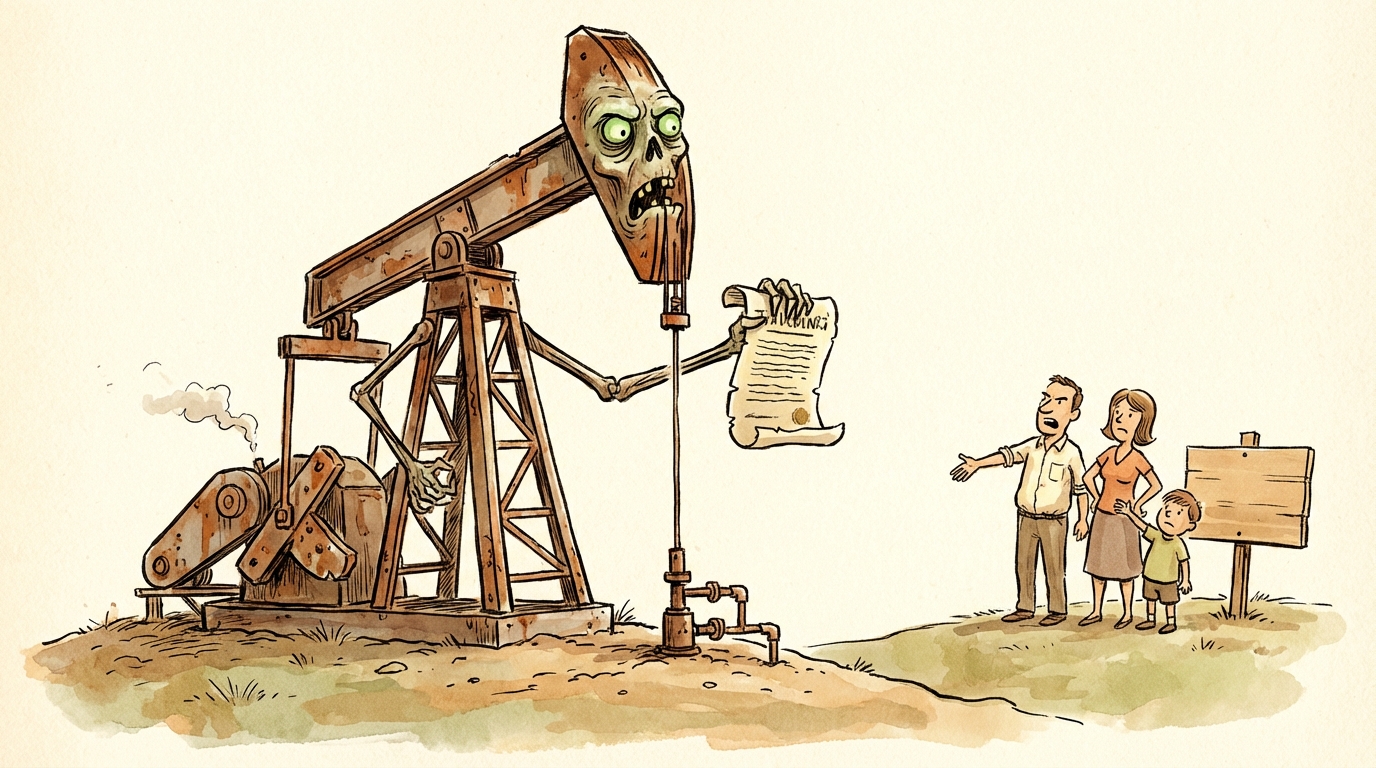
You think the lease expired years ago. The original operator packed up their heavy equipment, the royalty checks slowed to a trickle of pocket change, and you figured you were finally free to lease the family land to someone new. Then a landman for a new company does a title search. They come back with bad news. The old operator still thinks that original lease is very much alive.
It turns out one low-rate well is enough to keep your minerals locked up indefinitely. We call that a “zombie lease.”
Mineral owners constantly ask us why they cannot sign a fresh lease or sell their rights for top market value when the current well on their property barely produces. It feels wrong. It feels like the operator is breaking a promise to develop the land. The answer is almost always buried in a document signed decades ago by a parent or grandparent. The result is a lease that never dies, even when the economics are completely dead.
Let’s look at how this happens, how the courts view it, and what actually breaks the spell.
The Paperwork That Never Dies
When an oil and gas company signs a lease, they get a primary term. That is a set number of years to drill a well. If they fail to drill, the lease expires. If they do drill and hit oil or gas, the lease enters its secondary term. This is where the trap lies.
The transition from primary to secondary term relies on the concept of :Held By Production. You have to look for a specific phrase in the habendum clause of your lease. Owners almost never notice these words: “so long thereafter as produced.”
That language means the lease stays in effect forever, as long as the well is producing. The problem is that “production” does not always mean profitable for the mineral owner. A well can produce two barrels of oil a week. That might generate an eight dollar check for you. But to the operator, that tiny trickle of oil is a cheap insurance policy. It holds the lease on your hundred acres of land so they can eventually sell those rights to a larger company when a new drilling boom hits.
We broke down some of the physical differences in our piece on producing vs. non-producing minerals. But the zombie lease issue adds a layer of state-specific legal friction. States treat the definition of production very differently.
Profits vs. Paperwork
State courts look at the actual contract first, but they interpret the limits of those contracts based on local property law. Some states lean toward a strict “paying quantities” test. This means the operator actually has to turn a profit after operating expenses to keep the lease alive.
Other states treat pretty much any production as enough unless your specific lease clearly says otherwise.
If you own land in Pennsylvania, the law treats an oil and gas lease as a property interest called a :fee simple determinable. This means complete ownership automatically reverts back to the landowner upon the occurrence of a special event. That special event is non-production.
A 2023 Pennsylvania Superior Court dispute highlighted exactly how these disputes play out. A family owned a farm with a lease dating back to 1994. The well on the property stopped producing in 2008. The operator kept making annual shut-in payments for a decade to keep the lease alive. The family assumed the lease was dead and signed a new one in 2016. The courts had to step in. The ruling confirmed that because the original lease capped shut-in payments at three years, the automatic termination rule kicked in. The lease was dead. The original operator lost their rights.
But not every case goes the landowner’s way. Look at the 2017 Ohio Supreme Court case Bohlen v. Anadarko. A family tried to terminate a lease covering 500 acres because the energy companies failed to pay a minimum $5,500 annual rental. The court ruled that because the company actually drilled two wells in the very first year, the delay rental clause was satisfied. The lease had entered its secondary term. The family was stuck fighting a messy battle over underpaid royalties rather than getting their land back.
How Operators Keep the Zombies Staggering
Operators use a few very specific strategies to keep these leases alive. I review family estates every week and see the exact same patterns holding up millions of dollars in generational wealth.
The stripper well anchor is the most common. A single decaying well making marginal volumes of oil keeps hundreds of acres tied up. The operator has zero intention of drilling new horizontal wells. They simply want to hold the acreage.
Then you have the shut-in shuffle. The well is physically capable of producing, but the operator shuts it in due to low gas prices or pipeline issues. They send you a nominal check every year. Owners get stuck arguing about whether they are being paid the right amount. The real argument should be about whether the lease limits how many years a well can be shut in before the agreement terminates.
The continuous operations loophole is another favorite. The operator files fresh permits, moves a bulldozer onto the dirt, or does minor maintenance work. The lease vaguely defines these actions as “operations.” It extends the timeline just enough to keep the paper active without actually generating a royalty check for your family.
A Fast Diagnosis for Mineral Owners
You need to know if you are dealing with a zombie lease before you can fight it. Complaining to the operator over the phone achieves nothing. You need facts.
Start by pulling your original lease from the county clerk. You also need every amendment or ratification your family signed over the decades. Read the habendum clause to find the exact primary term and the transition language. Find the shut-in clause to see how many consecutive years they can pay a fee instead of pumping actual oil.
Check if you have a :Pugh clause. This is a mechanism that releases land not actively being drilled.
Once you have the paper, cross-check it with reality. Go to your state’s oil and gas commission website. Look up your specific well by its API number. Pull the production history for the last five years. You are looking for long periods of total inactivity. A well that reports zero production for eighteen months is a prime candidate for lease termination.
We discussed how to locate these details and read the fine print in The Fine Print That Eats Your Check.
Building Leverage
What actually gives you leverage is paper. You have to build a demand package.
Gather the production history printouts from the state. Pull exact excerpts from your lease clauses. Build a simple timeline showing when production stopped and when the lease terms were violated. You want to show their legal department that you understand the mechanics of the agreement.
You might not get the entire lease terminated. Often the best path is negotiating partial releases. You can demand a depth severance. This forces the operator to release the deep rights they are ignoring while they keep the shallow producing well. You can demand a horizontal acreage release, freeing up the land outside the immediate spacing unit of the token well. You might get them to agree to a strict schedule of acreage releases if they fail to drill new wells by a certain date.
The absolute last resort is filing a lawsuit for a declaratory judgment. You are asking a judge to declare the lease dead. That gets expensive fast. It requires an attorney who specializes in oil and gas litigation. You have to weigh the legal fees against the actual value of your land.
The Financial Reality of Selling
We meet a lot of families sitting on these locked-up tracts. They are tired of managing the paperwork. They want to sell, but they have no idea how to price an asset that is technically leased but barely producing.
If you take a zombie lease to the open market, buyers will discount it heavily. Nobody wants to buy a lawsuit. A buyer has to assume they will spend fifty thousand dollars on legal fees just to free up the land.
But if you can force a release of the non-producing acreage yourself, the value of your minerals can jump dramatically overnight. You suddenly own open acreage in an active basin. You can command a modern lease bonus of several thousand dollars per acre, plus a high royalty rate on future wells.
Selling family land is a heavy decision. Sometimes fighting the operator for three years makes sense for your family. You might have the capital and the patience to see it through. Sometimes it is better to let a professional buyer take on the legal headache and cash out now.
Knowing what you own is worth in both scenarios is the only way to make a decision you can sleep with. Having options brings peace of mind. It might just be worth a conversation to see where you stand.
:held-by-production
This is the status of a lease that has been extended beyond its original primary term because oil or gas is actively being extracted. Once a lease is held by production, the operator retains the rights to the minerals indefinitely, as long as production continues in accordance with the specific terms of the contract.
:fee-simple-determinable
An estate in property law that automatically ends and reverts back to the original grantor when a specific condition is no longer met. In oil and gas, the condition is usually the production of hydrocarbons. When production ceases, the operator’s interest terminates and full ownership reverts to the mineral owner.
:pugh-clause
A provision added to an oil and gas lease to prevent an operator from holding all of your acreage with just one well. It specifies that drilling a well only holds the lease for a certain amount of acreage or specific depths. The rest of the land is released back to the owner at the end of the primary term.