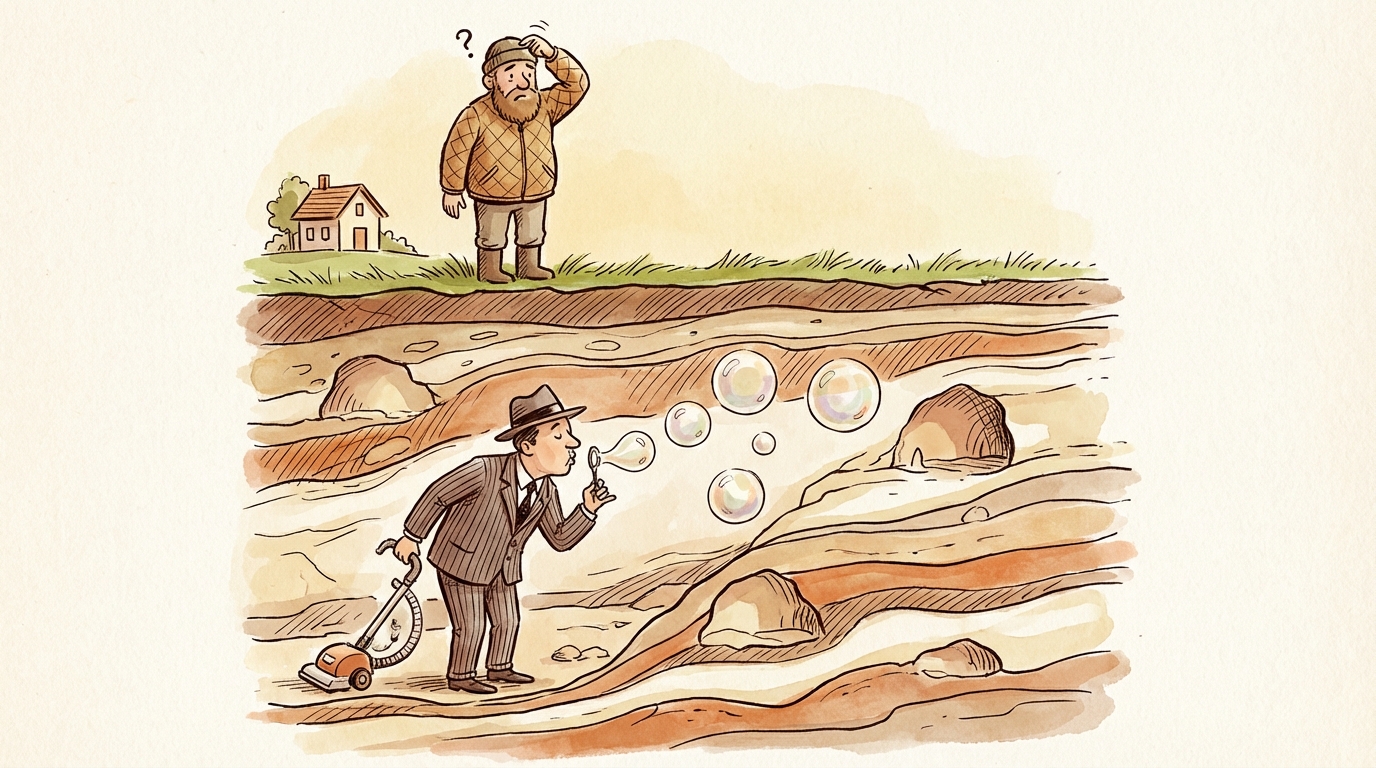
You open the mail expecting a division order, a tax form, or maybe a standard lease offer. Instead, you find a polite, highly technical letter from a company you’ve never heard of. They aren’t asking to drill for oil. They aren’t asking to extract gas.
They want to talk about “carbon storage.” They want your “pore space.”
We review hundreds of mineral files at our family office. Over the last few years, the paperwork coming across the desks of Louisiana landowners has changed dramatically. A massive wave of capital is chasing Carbon Capture and Storage (CCS) projects. The goal isn’t pulling resources out of the ground. The goal is pumping liquefied carbon dioxide into the ground and leaving it there forever.
If you own subsurface rights in Louisiana, you are sitting on prime real estate for this new industry. But the playbook is entirely different from traditional oil and gas. If you don’t understand the rules of this new game, you can easily get dragged into a massive, multi-decade regulatory project against your will.
Let’s break down exactly what pore space is, how Louisiana law allows operators to assemble it, and what happens when your neighbors decide to sign but you don’t.
The Physical Reality of Pore Space
First, we need to clear up a massive misconception about what carbon storage actually looks like underground.
When most people hear “subsurface storage,” they picture a giant underground cave. They imagine an operator pumping gas into a massive hollow room. That isn’t how it works.
Deep below the surface, the rock is solid, but it is porous. Think of a hard kitchen sponge made of sandstone or limestone. Between the grains of sand and rock are microscopic voids—pores. For millions of years, those pores held saltwater, oil, or natural gas.
When a carbon capture company approaches you, they are trying to lease those microscopic empty spaces. They plan to compress carbon dioxide until it acts like a liquid, drill a specialized injection well, and push that liquid CO₂ down into the rock formation, displacing the saltwater that is currently there.
They are essentially renting your underground sponge.
The Three-Rights Taxonomy of Louisiana
In most of the country, property rights are a simple two-layer cake: the surface estate and the mineral estate.
Louisiana is a different animal. We’ve talked before about how Louisiana Is Different: The 10-Year Rule and New Legal Battles, specifically how mineral servitudes can expire if they aren’t used. But CCS introduces a completely new wrinkle. Now, we are looking at a three-rights taxonomy:
- The Surface: The dirt you walk on, the trees, the topsoil.
- The Minerals: The right to explore for and extract valuable hydrocarbons (oil and gas).
- The Pore Space: The actual void space within the rock formations, used for geologic storage.
Who owns the pore space? Generally, the surface owner owns the underlying rock and the empty space within it, unless it was specifically severed and sold off. But the legal lines get incredibly blurry when old mineral deeds vaguely mention “all rights to the subsurface.”
If your family separated the minerals from the surface fifty years ago, you might think a carbon storage project has nothing to do with you. The carbon company will likely disagree. They know that pumping millions of tons of CO₂ underground will increase subsurface pressure. That pressure might push existing oil and gas around, or it might prevent you from ever drilling a traditional oil well through their storage zone.
Because of this, carbon companies usually try to acquire rights or waivers from both the surface owner and the mineral owner. Your signature has value, even if the primary target is the empty space.
The Statutory Backbone: RS 30:1101
To understand why this is happening so fast, you have to look at the state level. Louisiana wants this business. The state government sees CCS as a massive economic driver that will keep chemical plants and refineries operating in a lower-carbon economy.
The legal foundation for this is the Louisiana Geologic Sequestration of Carbon Dioxide Act (often referred to as RS 30:1101). This law officially authorizes the underground storage of carbon dioxide and sets up the regulatory framework.
It establishes that storing CO₂ is a valid and legal use of the Louisiana subsurface. It also hands the regulatory keys to the Louisiana Office of Conservation. Under Title 43 of the Louisiana Administrative Code, the state outlines the incredibly strict rules for “Class VI” injection wells.
A Class VI well isn’t a normal oil well. It requires massive amounts of engineering, geologic modeling, and continuous monitoring to ensure the carbon dioxide doesn’t migrate up into drinking water aquifers. The paperwork alone for a Class VI well can take years and cost millions of dollars.
When a company commits that kind of money to a project, they cannot afford to let one stubborn landowner derail the whole thing. And that brings us to the most aggressive legal tool they have.
The Scary New Lever: H.B. 966 and the 75% Rule
If an oil company wants to drill a well under your land, they usually need a lease. If you refuse to sign, they can sometimes use forced pooling to group your land with your neighbors.
Until recently, it wasn’t entirely clear how you could assemble a massive underground carbon storage reservoir if a few landowners flat-out refused to participate. Carbon plumes are huge. They spread out over thousands of acres underground. You can’t just draw a square around the holdout’s property and tell the injected carbon dioxide to respect the property line.
In August 2024, Louisiana solved the carbon companies’ problem by enacting H.B. 966.
This bill gave the Commissioner of Conservation the authority to mandate :unitization for carbon dioxide storage projects. Here is the exact math of how it works:
If the storage operator can get the agreement of landowners who own a minimum of 75% of the pore space in the proposed storage area, they can file an application with the state. The state will hold a public hearing. If the Commissioner finds that the unit serves a “public and necessary purpose,” they will issue an order that forces the remaining 25% of owners into the unit.
Read that again. If 75% of your neighbors (or your distant cousins who co-own the family land) decide to sign the carbon storage agreement, your refusal to sign does not matter. The project will move forward, and your pore space will be used.
This process closely mirrors traditional oil and gas pooling, but the stakes feel different to many landowners. We see families who are perfectly fine with oil extraction but deeply uncomfortable with the idea of a company permanently burying industrial waste beneath their great-grandfather’s farm. Under H.B. 966, that discomfort won’t stop the project.
Eminent Domain and the “Public Convenience” Concept
When the state forces you to allow your property to be used against your will, it touches on a raw nerve. In legal terms, this skirts the edges of :expropriation (the Louisiana term for eminent domain).
The law requires that the Commissioner’s order provide for “just and equitable compensation” to all owners, whether they consented or not. But who decides what is just and equitable?
Usually, the state looks at what the 75% who signed agreed to accept. If the going rate in your parish is $50 an acre per year for storage rights, the state will likely deem that fair for you too.
The justification for this heavy-handed approach is the concept of “public convenience and necessity.” The state argues that reducing atmospheric carbon and protecting Louisiana’s industrial economy benefits the entire public. Therefore, assembling these storage tracts is a public necessity, much like building a highway or laying a major electrical transmission line.
If you find yourself in the 25% minority, ignoring the letters from the carbon company is the worst thing you can do. Silence won’t stop the project. Silence just means you waive your right to show up at the Office of Conservation hearing and argue your case. As we’ve detailed in other situations, Your Decimal Isn’t Sacred: The Dirty Mechanics of Amended Units—and you have to aggressively protect what you own.
The Paperwork Reality and Long-Term Liability
Let’s say you decide to engage. You negotiate a pore space agreement or a mineral waiver. What does the paperwork actually look like?
First, you have to be highly visible in the public record. Carbon companies send armies of landmen to county courthouses to map out who owns what. If your family hasn’t updated its title, or if an estate was never properly probated, you might not even get the initial notice. The project will simply list your tracts as belonging to “unknown owners,” place a legal notice in the back of a local newspaper, and proceed to unitize your land without you ever knowing.
Second, there is the issue of liability. A traditional oil well eventually stops producing. It gets plugged with cement, the surface is remediated, and the lease expires. The land goes back to normal.
Carbon storage is designed to be permanent. The CO₂ is supposed to stay down there for thousands of years. So who is responsible if it leaks in 2080?
The state thought of this. Louisiana law creates specific trust funds and long-term stewardship concepts. Operators are required to pay into a state-managed fund during the injection phase. Ten years after the injection stops and the well is plugged, if the operator can prove the carbon plume is stable, they can actually transfer the long-term liability over to the State of Louisiana.
This brings peace of mind to the carbon companies, but it leaves landowners with a highly complex, encumbered piece of real estate. Your property title will forever show that a massive, state-managed carbon reservoir sits beneath it.
The Owner’s Playbook: What You Can Do
If you receive one of these carbon storage packets, you need a strategy. We see owners make massive mistakes in the first 30 days.
1. Do not sign a blanket consent. Often, the first document you get is positioned as a simple “surface access” or “seismic testing” agreement. They offer you a small check to let their trucks drive on your land to map the subsurface. Read the fine print. Some of these agreements contain stealth clauses that grant the company an exclusive option to lease your pore space later, at a price they dictate.
2. Demand the maps. If they want your space, they have a geologic model. Ask to see it. Where is the proposed Class VI well? How far will the carbon plume extend? What is the total acreage of the proposed unit? They have this data. Don’t negotiate blindly.
3. Define the monitoring. If you own the surface, you need to know exactly what kind of monitoring equipment they plan to leave on your land. Class VI wells require extensive monitoring wells to track the CO₂. You don’t want a permanent industrial footprint in the middle of your best pasture without heavy compensation.
When to Negotiate vs. When to Exit
This is where the reality of the situation hits hard. Negotiating a specialized pore space agreement in Louisiana requires a specialized lawyer. You are dealing with entirely new statutes, complex administrative law, and massive energy corporations.
For a large landowner with thousands of contiguous acres, hiring legal counsel to fight for a lucrative, decades-long storage royalty makes perfect sense. The math works.
But what if you are one of fifty cousins who inherited a fractional share of a 200-acre tract? What if you live in Texas and haven’t seen the Louisiana property in twenty years?
The prospect of managing a regulatory machine, tracking public hearings at the Office of Conservation, and fighting over “just and equitable compensation” under a forced unitization order is daunting. Frankly, it’s exhausting.
Many small or fractured ownership groups look at the rising tide of CCS unitization and decide they simply don’t want to play the game. They don’t want the liability, they don’t want the legal bills, and they don’t want to be forced into a 50-year relationship with a carbon operator.
In these cases, choosing to exit is a completely rational financial decision. The All-or-Nothing Myth: Selling Partial Rights is something we constantly remind owners about. You can sell your interest, realize the cash value of the asset today, and let a larger entity take on the regulatory headache of fighting the carbon companies at the state hearings.
In Louisiana CCS, the asset isn’t just your minerals anymore. It’s your subsurface real estate. You own an industrial warehouse located two miles straight down.
Managing that warehouse takes time, capital, and a high tolerance for bureaucratic friction. If that doesn’t sound like how you want to spend your time, it might be worth at least knowing what your rights are worth in today’s market. You always have options, and having a conversation to understand them costs you nothing.
:unitization
The legal and regulatory process of combining multiple separately owned tracts of land into a single, unified operational block. In the context of carbon storage, it allows an operator to manage a massive underground reservoir as one cohesive unit, even if it crosses dozens of different property lines.
:expropriation
The Louisiana legal term for eminent domain. It is the inherent power of the state to take private property for public use, provided that the taking is necessary for the public interest and the owner is paid just compensation.