
We spend a lot of time analyzing how oil and gas operators calculate royalty payments. If you own minerals in Texas or Pennsylvania, you are probably used to seeing a graveyard of deductions on your check stub. We have thoroughly documented how Texas operators erase cost-free royalty clauses and how Pennsylvania’s minimum royalty laws still leave owners getting squeezed.
But if you own minerals in Colorado, the math is supposed to be completely different.
Colorado is arguably the most landowner-friendly state in the country regarding post-production deductions. The state courts figured out a long time ago that when an operator pulls natural gas out of the ground, it isn’t ready to be sold. It needs to be gathered, dried out, and squeezed through high-pressure pipes.
The question has always been: who pays for that?
In Texas, the operator uses the :Net-Back Method to legally bleed your royalty check dry. They take the final sale price of the gas and subtract every conceivable cost incurred between the wellhead and the pipeline, passing a proportionate share of those expenses directly to you.
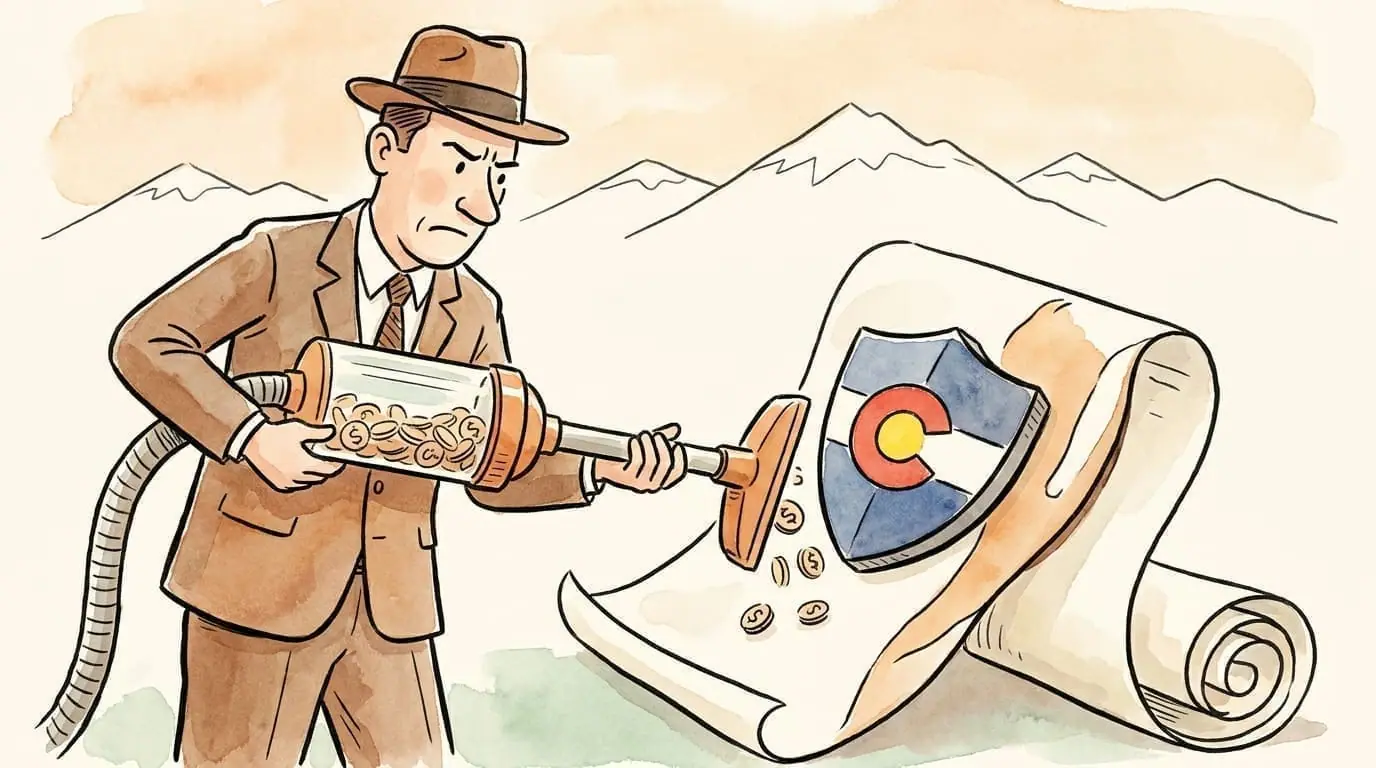
In Colorado, the courts went the exact opposite direction. They established the :First Marketable Product rule. The operator legally bears all costs required to get the gas into a marketable condition. They cannot charge you for the gathering, dehydration, or :compression required to make the gas sellable.
Yet we review Colorado royalty stubs every week that are loaded with gathering and processing deductions.
Operators are pulling money straight out of Colorado families’ pockets. Most mineral owners never realize it is happening because the check clears and the math looks official. Let’s talk about why this happens, how operators get away with it, and what your actual options are when you catch them.
The Accounting Software Trap
We see the exact same story play out over and over. An independent operator based in Houston or Oklahoma City buys a package of producing wells in the DJ Basin. They take over the operations and load the new assets into their internal accounting software.
Here is the problem: that software is programmed for Texas or Oklahoma rules.
In those states, deducting gathering and processing fees is standard operating procedure. The accountants sitting in a corporate office hundreds of miles away simply check a box to apply their standard deduction formulas to their newly acquired Colorado wells. They do not read the nuances of Colorado case law. They might not even read your specific lease. They just run the software.
Suddenly, gathering, dehydration, and compression fees start quietly slipping onto your check stub.
This is not necessarily a malicious corporate conspiracy. Usually, it is just bureaucratic laziness. The operator applies a blanket accounting practice across their entire portfolio because it is easier than segmenting their royalty payment system state-by-state. They know that out of a thousand mineral owners, maybe five will actually read the check stub closely enough to spot the deductions. Out of those five, maybe one will complain. And out of that one, the odds of them actually hiring a lawyer are almost zero.
The math heavily favors the operator. If they illegally deduct $150 a month from your check, they pocket $1,800 a year. Multiply that across thousands of decimal interests in a drilling unit, and the operator is padding their bottom line by millions of dollars annually, entirely on the backs of uneducated royalty owners.
The Landmark Cases That Protect You
To understand why these deductions are illegal, you have to look at how Colorado courts have consistently defended mineral owners.
The baseline was set in 1994 by the Colorado Supreme Court in Garman v. Conoco. The court looked at the fundamental relationship between a mineral owner and an operator. They ruled that an oil and gas lease implies a duty to market the product. Because the operator has a duty to market the gas, they must absorb the costs required to make it marketable.
A few years later, the Fawcett case reinforced this. The courts looked closely at what “marketable” actually means. Natural gas coming straight out of the wellhead is often wet, full of impurities, and at a low pressure. Nobody buys gas in that condition. To find a willing buyer, the operator must treat the gas and compress it to meet pipeline standards.
Under the First Marketable Product rule, every single cent spent getting the gas from its raw state to a marketable state is the sole responsibility of the operator.
If you see a charge for “gathering” on your Colorado check stub, the operator is almost certainly violating this rule. They are charging you for moving the gas from the wellhead to the treatment facility. If you see a charge for “compression,” they are charging you for the massive engines used to push the gas into the sales line.
Both of these are required to make the gas marketable. Both of them should be paid entirely by the operator.
The Ironclad Lease Illusion
You might be thinking, “I don’t need to worry about case law. My lease explicitly forbids deductions.”
I wish it were that simple. We frequently meet families who negotiated beautiful, landowner-friendly leases. They paid an attorney to draft custom addendums stating the operator cannot deduct a single penny for gathering, treating, or transporting the gas.
And the operator deducts the money anyway.
When this happens, mineral owners assume they can just call the state regulatory agency, report the operator, and get their money back. That is not how the system works.
Take a look at a real dispute that went before the Colorado Oil and Gas Conservation Commission (COGCC). In 2018, a mineral owner named Richard Casey filed a complaint regarding his Garfield County minerals. He had a 20% royalty lease with Antero Resources and Ursa Operating.
The lease language was incredibly clear. The parties even stipulated to the exact wording. It said royalties must be paid “free of production costs, gathering costs, dehydration costs, compression costs, manufacturing costs, processing and treating costs, marketing costs, transportation costs and free of any and all other costs…”
You cannot write a clearer prohibition against deductions than that. Yet Casey alleged the operators were still shorting his royalty payments. He eventually ended up in front of the Commission to demand his money.
The result? The Commission dismissed his case.
In Administrative Order No. 1-206, the hearing officer pointed out a harsh reality of administrative law: the COGCC does not have the jurisdiction to interpret contracts. If an operator claims they are calculating the royalty correctly and the owner disagrees, that is a contract dispute. The Commission ruled that because a “bona fide dispute” existed over the contract interpretation, they could not force the operator to pay.
They told Casey he had to go to district court.
The Burden of Enforcement
This is the dirty secret of the mineral rights business. Having the law on your side is meaningless if you cannot afford to enforce it.
When the state commission tells you to file a lawsuit in district court, the dynamic changes entirely. You are no longer just making a few phone calls to a regulatory body. You have to hire an oil and gas litigator. You have to pay a retainer. You have to go through discovery, depositions, and potentially years of legal maneuvering.
The operators know this. They have in-house counsel already on payroll. They can afford to drag out a dispute for three years over a few thousand dollars in deductions. Can you?
If an operator is taking $400 out of your check every month, that is infuriating. It is theft. Over a year, that is almost $5,000. But an oil and gas attorney is going to charge you $450 an hour. You will spend $10,000 just getting a lawsuit filed. The math simply does not work for the average family.
We sit across the table from mineral owners all the time who are trapped in this exact scenario. They know they are being cheated. They have the spreadsheet proving it. But they are completely paralyzed because the cost of fighting the operator exceeds the money they would recover.
It turns an asset that should be a generational blessing into a constant source of stress. You open the mail every month, look at the check stub, see the illegal deductions, and just feel helpless.
What Are Your Options?
If you own Colorado minerals and suspect your operator is ignoring the First Marketable Product rule, you generally have three paths forward.
1. Form a Coalition If the operator is deducting costs from your check, they are doing it to everyone else in the unit. Sometimes, you can find the other mineral owners in your well by looking at the county deed records. If you can pool your resources and hire a single attorney to represent ten or twenty owners, the legal fees become manageable. Operators are also much more likely to settle quickly when faced with a coordinated group rather than a single angry phone call.
2. Send a Demand Letter Sometimes a formal demand letter on a law firm’s letterhead is enough to scare an accounting department into fixing your account. You don’t necessarily have to file a lawsuit. You just need to show the operator that you know Colorado case law, you know your lease terms, and you are not going away quietly. This works best with smaller operators who want to avoid litigation costs themselves.
3. Exit the Asset entirely This is where we have very candid conversations with families. Sometimes, the most logical decision is to stop fighting.
If you own a minority interest in a well and the operator is stubbornly skimming your royalties, you can spend the next five years of your life fighting them in court. Or you can sell the interest to a group that has the scale and capital to fight that battle for you.
When a family office or institutional buyer looks at an asset, they run their own valuation models. If we see an operator illegally deducting costs in Colorado, we know exactly what is happening. We know how to audit the historical payments. We have the legal infrastructure to force the operator to correct the accounting. When we acquire the minerals, we acquire the headache.
Selling is not admitting defeat. It is simply transferring a complex legal problem to someone equipped to solve it, in exchange for a clean, immediate lump sum. We have broken down how we actually value royalties to give families a clear picture of what this looks like.
Knowing Where You Stand
The worst thing you can do as a mineral owner is ignore the check stub. If you own acreage in the DJ Basin, the Piceance, or anywhere else in Colorado, you have some of the strongest legal protections in the country. Do not let a software default in Houston steal your equity.
Pull your last three months of check stubs. Look past the gross payment number. Find the columns labeled “Gath,” “Dehy,” “Comp,” or “Trans.” Calculate exactly what percentage of your gross revenue is evaporating before the check is cut.
If that number is higher than zero, something might be wrong.
These decisions carry a lot of weight, especially when you are dealing with family land. We understand that. You might decide to hire an attorney and fight for every penny. We respect that entirely. But if you look at the situation, look at the legal hurdles, and feel like you are just tired of managing the chaos, it might be worth a conversation to see what the asset is actually worth on the open market.
At the very least, you should know your options. Give us a call. We are happy to look at the math with you.
:first-marketable-product
A legal doctrine heavily favored in Colorado (established by cases like Garman v. Conoco). It states that an oil and gas operator must bear all expenses necessary to convert raw, extracted gas into a condition where it can actually be sold to a commercial buyer. The mineral owner’s royalty is calculated on the value of the gas after it reaches this marketable state, protecting the owner from gathering and processing fees.
:net-back-method
An accounting calculation used primarily in states like Texas and Pennsylvania to determine royalty payments. The operator takes the final sales price of the gas at a distant market hub and subtracts (“nets back”) the costs of gathering, transporting, and processing the gas. This method legally passes post-production costs directly to the mineral owner, resulting in a smaller royalty check.
:compression
The mechanical process of increasing the pressure of natural gas so it can flow from a low-pressure wellhead into a high-pressure commercial pipeline. It requires massive, expensive engine-driven compressors. Under Colorado’s First Marketable Product rule, compression is typically viewed as a cost required to make the gas sellable, meaning the operator cannot deduct this cost from the royalty owner’s check.