
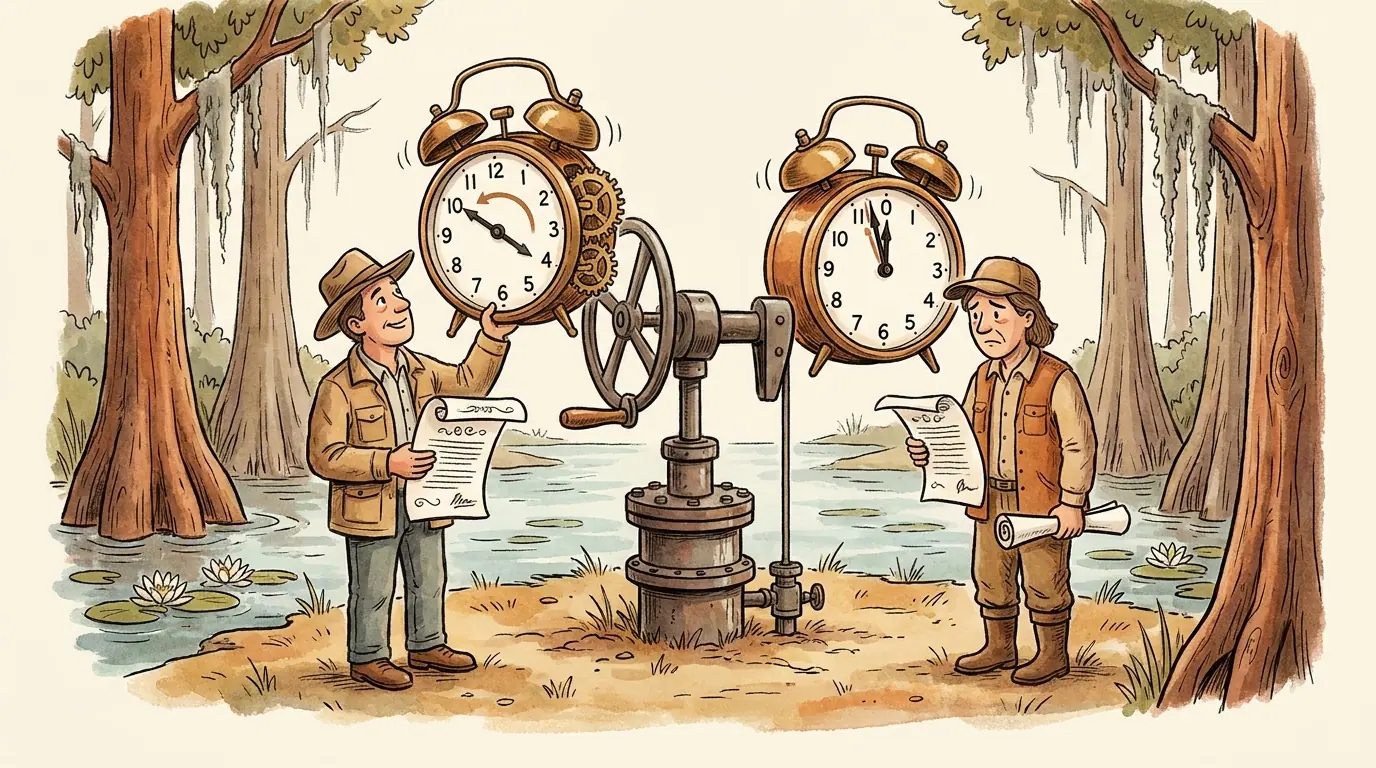
When landowners sever minerals in Texas, Oklahoma, or New Mexico, they create a permanent property right. You can buy minerals in Midland County, move to another state, leave the paperwork in a drawer for fifty years, and your grandchildren will still inherit the title.
Louisiana does not work that way. Under the Louisiana Mineral Code, the state civilian legal system enforces the :prescription of nonuse. If a severed mineral interest sits idle for ten continuous years, the law treats it as abandoned. The interest automatically extinguishes and reverts to the surface owner. We discussed the basic ten-year window in our look at how Louisiana treats mineral ownership differently.
Many heirs believe that any drilling rig showing up on their property resets this ten-year clock. If an oil company clears a location, drills a borehole, tests a formation, and plugs the hole as a dry duster, the family assumes their inheritance has been renewed for another decade.
For the owner of a :mineral servitude, that assumption is correct. For the owner of a :mineral royalty, it is completely wrong.
The distinction between Louisiana Mineral Code Article 29 and Article 87 creates an unwelcome discovery for families holding pure royalty deeds. An operator can drill a multimillion-dollar dry hole on your tract, resetting your neighbor’s mineral servitude for another ten years, while your royalty interest marches straight toward extinction on schedule.
- Governing statuteLa. R.S. 31:29La. R.S. 31:87
- Interruption standardGood-faith drilling operationsActual commercial production
- Dry hole effectResets the 10-year clockDoes not reset the clock
- Executive rightCan sign leases and take bonusPassive share of proceeds only
Comparison of prescriptive requirements for servitudes versus royalties under Articles 29 and 87.
The two classes of severed interests in Louisiana
To see why a dry hole helps one owner and leaves another empty-handed, you have to examine the legal interest granted in the original conveyance. Louisiana recognizes two primary types of non-surface mineral interests: servitudes and royalties.
A mineral servitude is the full right to enter land, explore for oil and gas, execute leases, collect upfront lease bonuses, and receive royalty payments. When a landowner sells the surface of their property but writes, “seller reserves all oil, gas, and other minerals,” that reservation creates a mineral servitude under Louisiana law.
A mineral royalty is a much narrower property right. It is a passive right to participate in production proceeds if and when minerals are extracted. Under Louisiana law, a pure royalty owner has no executive right. You cannot sign an oil and gas lease. You cannot negotiate bonus money. You cannot give an operator permission to drill, and you cannot stop an operator from drilling. You own a fractional check on production, nothing more.
Deeds often obscure this difference. A grandfather might have signed an instrument titled “Mineral Deed” in 1978, but the granting language inside the document conveyed only the right to receive a share of production, without the right to lease. In Louisiana, courts look past the title of the document to the rights conveyed. If you do not have executive leasing authority, you hold a mineral royalty, not a servitude.
Article 29: How a servitude survives a dry hole
Under La. R.S. 31:29, the prescription of nonuse running against a mineral servitude is interrupted by the good-faith commencement of drilling operations.
The statute sets explicit requirements for this interruption:
- The operator must commence drilling operations on the property or on land pooled with it.
- The operations must be conducted in good faith.
- The well must be drilled to a depth at which there is a reasonable expectation of discovering oil or gas in paying quantities.
Notice what Article 29 does not require: it does not require oil or gas to come out of the ground.
If an operator moves a rig onto a tract covered by a mineral servitude at year nine of the ten-year period, drills five thousand feet into the target formation, finds only salt water, and plugs the well, the requirement of use has been satisfied. The servitude owner exercised their right to explore.
The moment that well spuds in good faith, the prior nine years of prescription are erased. When the operator leaves the location, the servitude owner’s ten-year clock begins anew from day one. That dry hole gives the servitude owner another ten years of ownership to find a new operator or negotiate a new lease.
We have seen this save mineral titles repeatedly across North Louisiana, particularly when units are pooled shortly before prescription runs out, as outlined in our analysis of unit production under RS 31:37.
Article 87: Why production is required for a royalty
If you own a mineral royalty rather than a mineral servitude, Article 29 does not govern your asset. Your interest is controlled by Article 87 of the Louisiana Mineral Code (La. R.S. 31:87).
Article 87 establishes an entirely different standard: the prescription of nonuse running against a mineral royalty is interrupted only by the actual production of minerals in paying quantities.
Operations alone do not count. Rigs on location do not count. Drilling down ten thousand feet does not count. Good-faith efforts by a reputable operator do not count. Unless the well produces oil or gas in commercial quantities before the tenth anniversary arrives, the clock does not stop.
The legal philosophy behind this difference comes from the nature of the right itself. A mineral servitude owner holds the right to explore. Drilling a well, even an unsuccessful one, is an active use of that exploration right. A royalty owner holds only the right to share in production. Because the royalty owner has no exploration rights, drilling without production is not considered a legal use of a royalty interest.
Under La. R.S. 31:85, a mineral royalty is extinguished by the prescription of nonuse for ten years. If that ten-year anniversary passes without actual production, the royalty vanishes by operation of law.
- Year 0Royalty interest created and 10-year clock starts
- Year 9Operator drills dry hole; servitude resets, royalty clock keeps ticking
- Year 10Royalty interest extinguishes under Article 85
- Year 12New producing well drilled; landowner collects royalties, former owner gets zero
A dry hole resets the mineral servitude clock at Year 9, but the royalty interest extinguishes at Year 10 without commercial production.
A common inheritance scenario
To understand how this operates in practice, consider a scenario we frequently encounter when auditing heirship title in parishes like De Soto, Caddo, or Bossier.
In 2014, an owner sells a 160-acre farm. In the deed, the seller conveys the land but retains a one-sixteenth royalty interest on all oil and gas produced from the acreage. The seller does not reserve a mineral servitude. The buyer of the surface acquires the executive mineral rights, subject to that passive royalty interest.
Nine years pass with no activity. The calendar turns to 2023. Under Louisiana law, both the surface owner and the former seller know the ten-year prescription deadline is approaching in 2024.
In late 2023, an exploration company leases the land from the surface owner and drills a vertical test well. The rig runs for three weeks, logs the formation, encounters non-commercial shows, and plugs the well as a dry hole.
The original seller hears the news that a well was drilled on the family land. Knowing about the ten-year rule, the seller assumes that because drilling occurred on the tract, the ten-year clock has been pushed back to 2033.
In 2024, the tenth anniversary arrives without any production on the land. Under Article 85 and Article 87, the royalty interest is extinguished. It reverts automatically to the surface owner. No lawsuit is required, and no courthouse filing is necessary to complete the reversion.
In 2026, horizontal drilling technology improves, or natural gas prices rise. A new operator enters the section, permits a horizontal Haynesville Shale lateral across the 160 acres, and completes a prolific gas well.
The former seller contacts the operator expecting royalty checks, only to receive a letter from a title attorney explaining that their interest expired two years earlier. The dry hole in 2023 reset nothing for the royalty owner. The surface owner now collects the entire royalty revenue.
Auditing your deed: Servitude or royalty?
If you have inherited rights in Louisiana, you cannot rely on what your family has historically called the property. Relatives routinely say, “Grandpa left us the minerals,” when the conveyance paperwork shows something else entirely.
You must read the exact granting or reservation clause in the deed that severed your interest from the land.
An instrument creating a mineral servitude typically uses language such as:
- “Grantor reserves all of the oil, gas, and other minerals in, on, and under the subject property.”
- “Grantor conveys the exclusive right to explore, drill, develop, and operate for oil and gas.”
- “Together with the right of ingress and egress and the executive right to lease said lands.”
An instrument creating a mineral royalty typically contains language such as:
- “Grantor reserves a one-eighth royalty interest out of all oil, gas, and other minerals produced and saved.”
- “Grantee shall receive one-sixteenth of all production, provided that Grantee shall have no interest in lease bonuses or delay rentals.”
- “This conveyance is a royalty interest only and carries no right to participate in the leasing or development of the land.”
The absence of executive leasing power is the most reliable indicator of a pure mineral royalty. If you have no legal ability to execute an oil and gas lease, your interest is subject to the strict requirements of Article 87.
The risk of carrying an unproductive royalty
Holding a severed mineral interest in a state like Louisiana involves unique timing risks. In states where mineral estates are perpetual, an owner can comfortably wait out market downturns. If commodity prices collapse and drilling halts for fifteen years, a Texas mineral owner loses income during those years, but the underlying capital asset remains intact.
In Louisiana, time is a depleting resource. Every month that passes without drilling activity moves a royalty interest closer to total extinction.
Consider an owner holding a royalty interest on an unleased or undeveloped 80-acre tract. If that interest is in year six of its prescriptive period, four years remain to establish commercial production.
To prevent that asset from becoming worthless, several external variables must align:
- An operator must decide that the regional geology warrants exploration.
- The surface owner (or servitude owner) must be willing to execute a lease on commercially acceptable terms. If the landowner refuses to lease, the royalty owner cannot force the issue.
- The operator must secure permits, line up drilling rigs, and source capital.
- The operator must drill the well and complete it before the ten-year date.
- Crucially, under Article 87, the well must actually find and produce hydrocarbons in paying quantities.
If any link in that chain fails, or if the well turns out to be dry, the royalty owner loses everything. The entire value of the asset drops to zero on midnight of the tenth anniversary.
Evaluating certainty versus reversion risk
When heirs review an inherited Louisiana interest, they often view the choice as a basic binary: keep the family property, or sell it and give up the future upside.
That framing overlooks the real mechanics of Louisiana property law. Holding a mineral royalty in an inactive area is not a risk-free choice. It is a wager that commercial production will be established before an unyielding statutory clock runs out.
If an interest is in year seven or eight without a rig in sight, an owner faces a steep asymmetry. If they hold the interest and no production occurs, they receive nothing. If they explore a sale of the interest, or even a partial sale, they can convert an asset racing toward a legal cliff into capital today.
- Review current prescriptive status
- Hold full interest
- Commercial production beginsClock resets
- Dry hole or no drillingExtinction at Year 10
- Execute partial sale
- Secure capital today and transfer risk
- Retain portion to participate in upside
Strategic paths available to an owner holding a royalty approaching prescription.
A sale does not have to be an all-or-nothing proposition. Many owners choose to sell a portion of their acreage to de-risk their position while retaining the remainder. If you want to explore how partial transactions work mechanically, we examined the trade-offs in our guide on selling all or part of your mineral rights.
Selling transfers the decline risk, commodity price risk, and prescription risk to a professional buyer. Buyers who acquire interests in Louisiana understand how to manage prescriptive periods across broad portfolios, whereas an individual family usually holds only one or two tracts. For an individual family, the loss of that single tract means total elimination of their position.
What a genuine valuation reveals
Generic statewide estimates or county-wide averages cannot tell you the value of an aging royalty interest. Two tracts in the same parish can have completely different financial profiles depending on when their respective prescription clocks began ticking.
A royalty tract with nine years of nonuse sitting outside an active drilling unit has a very different risk profile than an identical royalty tract with nine months of nonuse inside an active unit. A credible buyer evaluates:
- The exact conveyance language to determine whether you hold an Article 29 servitude or an Article 87 royalty.
- The precise date of the last qualifying use or commercial production to establish the exact prescription deadline.
- Active permits, pooling orders, and pipeline infrastructure nearby.
- Operator drilling schedules and historical decline curves for offset wells.
Getting a concrete offer provides useful information. It attaches an objective financial figure to an interest that may have sat in family records for decades without a defined value.
Seeing that figure does not obligate you to sell. You can examine an offer and determine that the likelihood of imminent drilling justifies the risk of waiting. Or you can look at the offer and realize that securing several years of value today makes more sense than gambling on whether an operator will drill a commercial well before the clock runs out.
Knowing where your interest sits under Louisiana law is the starting point. If you hold a severed royalty interest, relying on an operator’s dry hole will not save you from Article 87. Auditing your deeds before the ten-year window closes is the only reliable way to preserve family capital.
:prescription-of-nonuse
A principle in Louisiana civil law where a mineral servitude or mineral royalty is extinguished if it is not used for a period of ten continuous years, returning the rights to the surface owner.
:mineral-servitude
Under the Louisiana Mineral Code, the executive right to go onto land and explore for, develop, and produce minerals, which includes the power to sign leases and collect upfront lease bonuses.
:mineral-royalty
Under the Louisiana Mineral Code, a non-executive, passive property right that gives the owner a share in the proceeds of oil or gas production, without the right to lease the property or collect lease bonuses.