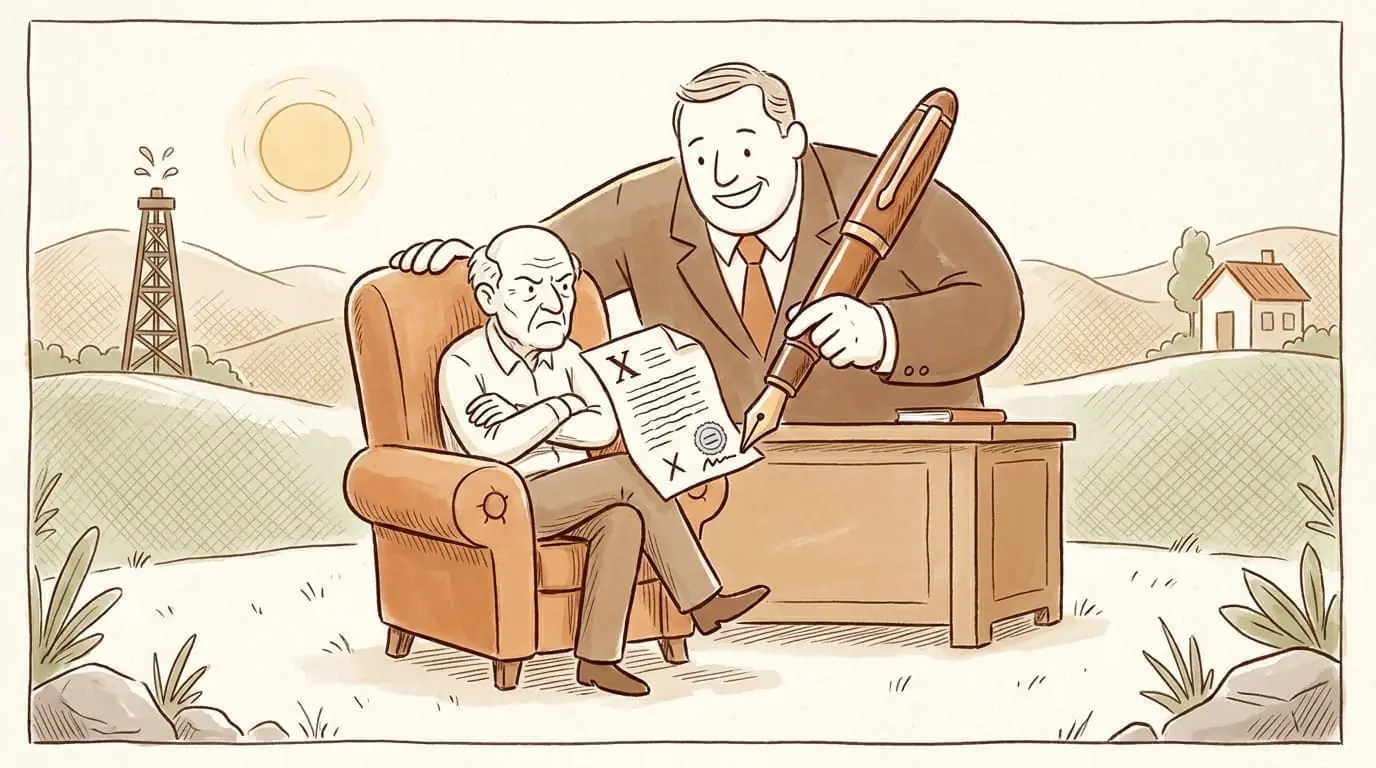
Most mineral owners believe that their signature is their ultimate leverage. If an oil and gas company sends you a lease offer with terrible terms, you just say no. You put the paperwork in a drawer. You assume your minerals are safe in the ground until a better offer comes along.
In Texas, that strategy often works. In Ohio, holding out can trigger a legal mechanism that quietly strips you of your negotiating power.
We see families get caught in this trap constantly. They hold out for a fair market bonus or a better royalty percentage. They think they are protecting their inheritance. Then a notice from the state arrives in the mail. The operator decided they did not need your signature after all.
This is the reality of Ohio’s oil and gas laws. When you refuse to sign a lease, you do not stop the drilling. You simply pass your authority over to the government. Let’s talk about how this process works, why the threshold to bypass you is shockingly low, and what it means for your financial future.
The Illusion of Refusal
Oil and gas companies operate on efficiency. They want to drill long horizontal wells that cross multiple property lines. To do this, they need to bundle dozens of individual tracts of land into a single drilling unit.
The ideal scenario for the operator is to get every single mineral owner in that proposed unit to sign a voluntary lease. But operators know that achieving 100 percent agreement is nearly impossible. Someone will always hold out. Someone will demand more money. Sometimes an owner simply cannot be found.
If one person holding out could stop a multi-million dollar well from being drilled, the entire industry would grind to a halt. Ohio lawmakers recognized this problem. They created a legal workaround to ensure resources get developed.
Under Ohio Revised Code 1509.28, an operator can apply for :statutory unitization through the Ohio Department of Natural Resources. This law allows the state to force unleased minerals into a drilling unit to prevent the “waste” of underground resources.
Other states have similar laws. You might hear them called forced pooling or forced integration. We wrote about similar dynamics in The Lease You Never Got to Negotiate. But Ohio’s version is particularly aggressive because of the specific math required to trigger it.
The 65 Percent Threshold
In many states, an operator needs a vast majority of the land leased before they can ask the government to force the holdouts into a unit. Ohio sets the bar incredibly low.
According to the Ohio Department of Natural Resources, unitization is available when the operator secures voluntary leases for just 65 percent of the land overlying a proposed drilling pool.
Think about what that means for a moment. An operator can fail to reach an agreement with owners holding 35 percent of the land in a unit. They can offer terrible terms that a third of the neighborhood rejects. It does not matter. Once they hit that 65 percent mark, they have the legal right to ask the state to step in and handle the rest.
The application process is heavily weighted in the operator’s favor. The operator simply has to prove to the division that the proposed unit is reasonably necessary to increase the ultimate recovery of oil and gas. They also must show that the value of the expected additional oil and gas exceeds the estimated cost of the operation.
That is purely an engineering and economic math problem. The state does not look at the application and ask if the operator offered you a fair lease. They only look at whether the well makes financial sense for the state’s resource development.
The Fractional Ownership Trap
The 65 percent rule gets even more restrictive when you factor in how families actually own mineral rights today.
Very few people own 100 percent of the minerals under a large tract of land. Ownership fractures over generations. A single 100-acre farm might have its mineral rights split among ten cousins.
For years, there was confusion in Ohio about how partial ownership counted toward that 65 percent threshold. If an operator leased three of the ten cousins, did they get to count a fraction of the tract toward their total, or did the whole tract count as unleased until everyone signed?
The state legislature closed that loophole and made it easier for operators. In 2019, Ohio passed House Bill 166. A legal analysis of the amendment by Babst Calland clarified exactly how this works. The law now explicitly states that an owner’s entire interest in a tract, including any divided, undivided, partial, or fee interest, shall be included to the fullest extent of that interest when calculating the 65 percent.
This means any type of interest held by the operator in a unitized tract counts toward the minimum threshold. Your relatives can essentially trigger the regulatory process that locks in your financial future without your consent.
Imagine you and three siblings inherit mineral rights. The operator offers a lease bonus of $500 an acre. You know the market rate in your county is closer to $2,500 an acre. You want to negotiate. Your siblings just want a quick check to pay off some bills, so they sign immediately.
Because of the way Ohio calculates the threshold, the operator uses your siblings’ signatures to build their 65 percent majority across the unit. Your refusal to sign no longer protects you. It just puts you on a list of unleased owners headed for a state hearing.
The Hearing You Will Probably Lose
When an operator files for unitization, the state sets a time for a hearing. You will receive a notice in the mail.
The ODNR website explains that mineral owners can attend these hearings online or by phone. You are allowed to present oral or written statements. You can unmute yourself on Webex and explain to the division staff that the operator lowballed you. You can point out that your neighbors got a better deal.
The harsh truth is that your testimony rarely changes the outcome.
The division staff are engineers and regulators. They are tasked with preventing the waste of natural resources. They are not mediators for private lease disputes. If the operator presents valid geological data showing the well will be profitable and efficiently drain the pool, the Chief of the division will almost certainly issue an order approving the unit.
Once that order is issued, the operator can drill inside the unit. You are now part of the well, completely against your will. We touched on how states handle these involuntary setups in Use It or Lose It: The Reality of Ohio.
The Two Punishing Financial Outcomes
When the state signs your lease for you through a unitization order, they impose terms on you by default. These terms are rarely in your favor. The state basically gives you two terrible options.
The first option is the default lease. The Chief’s order will dictate the terms of your compensation. Because you did not negotiate on the open market, you get the absolute bare minimum.
This typically means a 12.5 percent royalty. If you had negotiated privately, you might have secured 15, 18, or even 20 percent. On top of the low royalty, the state usually imposes a bonus payment that is a fraction of current market rates. The operator gets to drill your minerals on the cheapest possible terms just because they filed some paperwork.
The second option is even worse. You can be forced into the position of a non-consenting :working interest owner.
When you own a working interest, you are responsible for paying your share of the costs to drill and operate the well. Most families do not have hundreds of thousands of dollars sitting around to pay a drilling invoice. The law accounts for this by letting the operator front your share of the money.
But they do not do it for free. They charge you a :risk penalty for carrying your costs.
In Ohio, that penalty is brutal. The state allows operators to assess a 200 percent risk penalty against unleased owners who are forced into a unit as working interest participants.
Let’s break down the math. Assume your share of the drilling and completion costs for a new horizontal well is $50,000. Under the 200 percent penalty rule, the operator gets to withhold your revenue until they recover their original $50,000 plus an additional $100,000 penalty.
They will take $150,000 out of your oil and gas revenue before you ever see a royalty check. If the well produces poorly and only generates $100,000 in total revenue for your share, you will never receive a single dime. The operator absorbs your minerals to pay off a penalty the state allowed them to assess.
Reclaiming Your Options
We talk to families every week who are staring down the barrel of an Ohio unitization hearing. They feel backed into a corner. They are angry that family land can be leveraged this way.
That anger is completely justified. The system is built to favor the people drilling the wells, not the people living over them.
But anger does not protect your wealth. Strategy does. Once you understand that “no” is not a protective shield in Ohio, you can start making real decisions.
Your first option is to swallow your pride and negotiate the best voluntary lease you can before the 65 percent threshold is met. An imperfect voluntary lease is almost always financially superior to a state-imposed unitization order.
Your second option is to step off the playing field entirely. Selling your mineral rights removes the headache of forced integration. It takes the uncertainty of 200 percent risk penalties and default 12.5 percent royalties off the table. You trade a complicated, high-risk regulatory mess for a clean lump sum.
Some families choose to sell everything. Others choose to sell just a portion to diversify their risk, a strategy we discussed in The All-or-Nothing Myth: Selling Partial Rights.
The right choice depends entirely on your specific property, your family dynamics, and your financial goals. What matters is that you make a choice. Letting the Ohio Department of Natural Resources make the choice for you is the most expensive mistake you can make.
Knowing what you own is worth on the open market gives you a baseline to compare against any lease offer. It gives you clarity. If you are dealing with aggressive lease offers or unitization notices in Ohio, having a clear valuation is your best defense.
It is always worth a conversation to at least know your options. Having facts on your side brings peace of mind when the state tries to force your hand.
:statutory-unitization
A legal process where a state agency forces unleased mineral owners into a designated drilling unit to allow an oil and gas operator to drill a well. This prevents individual holdouts from blocking resource development, but usually results in less favorable financial terms for the unleased owner.
:working-interest
A type of oil and gas ownership where the individual is responsible for paying a proportionate share of the costs to drill, complete, and operate a well. Unlike royalty owners who receive a cost-free percentage of production, working interest owners carry financial risk.
:risk-penalty
A financial fee assessed against a mineral owner who refuses to lease or participate in paying upfront drilling costs. The operator fronts the money to drill, then takes the unleased owner’s share of production revenue to recover the original costs plus a massive percentage penalty before paying out any royalties.