Most mineral owners spend their time watching commodity prices. They track the price of West Texas Intermediate. They keep an eye on what their operator is doing. They check their monthly statements to see if production is holding steady.
But if you own mineral rights in California, none of those things are your biggest problem right now. Your biggest threat is not a drop in oil prices. Your biggest threat is the local city council.
We have watched a troubling trend accelerate across the country. We wrote about how this started in Colorado: The Local Control Trap and Your Stranded Minerals. Now the exact same playbook has arrived in California.
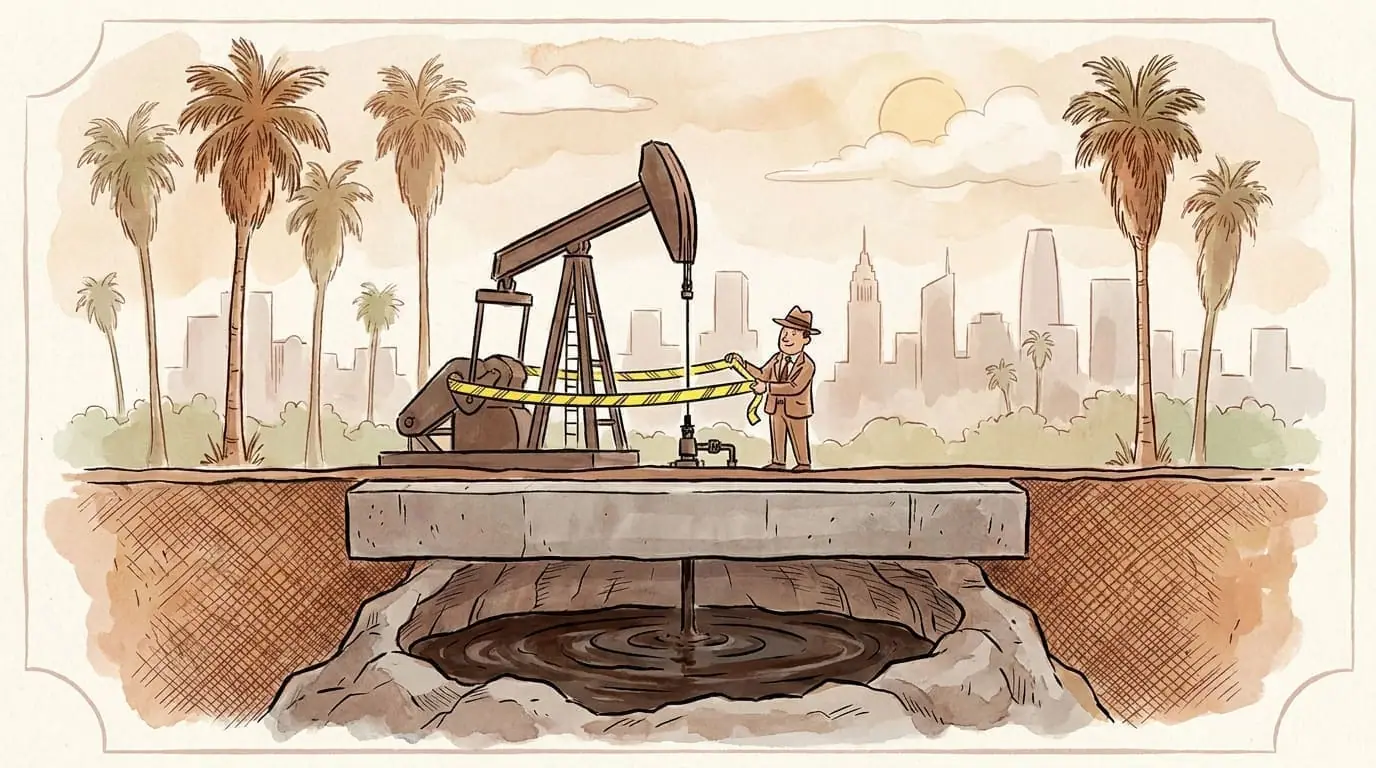
Mineral owners in Los Angeles are facing a unique and frustrating crisis. Their rights are not being drained by aggressive operators. They are being systematically legislated out of existence. The government is creating a scenario where you still own the rock beneath the ground, but you are legally forbidden from ever bringing the value of that rock to the surface.
Let us talk about what is actually happening in Los Angeles, the legal whiplash of the past few months, and what it means for your family’s inheritance.
The Los Angeles Phase-Out Ordinance
Los Angeles sits on top of massive oil reserves. For over a century, urban drilling has been a fact of life in the city. Pumpjacks are hidden behind fake building facades. Wells operate quietly next to schools and residential neighborhoods. Many families hold royalty interests from these urban wells that have paid steady dividends for generations.
City lawmakers recently decided they want all of it gone.
The city passed an aggressive ordinance making oil and gas extraction a “nonconforming use” of land. They banned the drilling of any new wells. More importantly, they demanded the total phase-out of all existing production within 20 years. They prohibited basic maintenance and redrilling of current wells.
This is a death sentence for a producing mineral interest.
An oil well requires maintenance to keep producing. Things break. Pressure drops. Operators need to routinely service the wellbore to keep the fluids moving. By banning maintenance and redrilling, the city guarantees that production will fall off a cliff long before that 20-year clock runs out.
For the families who own the royalties underneath these neighborhoods, this triggers a very real panic. You own a private property right. It has economic value. The city just passed a rule that will eventually drop that value to zero.
The Legal Whiplash of September 2024
When a city tries to ban an entire industry, lawsuits happen immediately. Oil operators and royalty owners fought back. The central argument was simple. In California, the state government regulates oil and gas. State law dictates how natural resources are managed to meet the state’s energy needs. A local city council does not have the authority to override state law.
For a brief moment, it looked like the operators had won.
In January 2023, operators filed a lawsuit against the city known as Warren E&P, Inc. v. City of Los Angeles. The companies argued that they had relied on city approvals for years. They had even spent massive amounts of money converting their operations to be 100% electric just to comply with local environmental requests. The city took their compliance and banned them anyway.
On September 6, 2024, a California Superior Court judge agreed with the oil companies. The judge ruled that state law preempted the Los Angeles ban. The court stated that the state’s Public Resources Code expressly tasks the State Oil and Gas Supervisor with approving production methods. The city ordinance directly contradicted state law.
Mineral owners breathed a heavy sigh of relief. The court essentially said that cities cannot play oil and gas regulator.
That relief lasted exactly nineteen days.
On September 25, 2024, Governor Newsom signed a package of bills designed to completely destroy the court’s ruling. The cornerstone of that package was AB 3233.
This new law explicitly grants local governments the ultimate authority to prohibit oil and gas operations. The text of the bill is blunt. It says that regardless of any state law, and regardless of any permit issued by the state supervisor, a city or county can ban oil and gas development within its borders.
The state legislature saw the court protect mineral owners and operators. They immediately changed the law to remove that protection.
The Crisis of Inverse Condemnation
This legislative maneuvering creates a massive constitutional problem. It is called :inverse condemnation.
When the government wants to build a highway through your farm, they use eminent domain. They condemn the property, take the land, and write you a check for fair market value. That is a direct taking. The Fifth Amendment requires just compensation.
But what happens when the government does not want to take the title to your land? What if they just pass a law that makes it impossible for you to use it?
That is a :regulatory taking. You still hold the piece of paper that says you own the mineral rights. But the city has regulated the economic viability of that asset down to nothing. They have stranded your minerals.
In a fair world, the city of Los Angeles would calculate the value of the oil beneath the ground and write a check to every single mineral owner in the city limits. They are destroying your private property for a public policy goal. They should pay for it.
Of course, they are not offering anyone a check.
Instead, the burden falls on the property owners. If you want compensation for your stranded asset, you have to sue the city. You have to fund a massive legal battle to prove that a taking occurred. For a family receiving a few thousand dollars a year in royalty checks, financing a multi-year constitutional lawsuit against a major municipality is completely impossible.
The government knows this. They know most families will simply absorb the loss.
The Domino Effect and the Inglewood Oil Field
The Los Angeles phase-out is not an isolated incident. The September legislative package included other targeted attacks on the industry.
Take the Inglewood Oil Field. This is one of the largest urban oil fields in the country. Another bill passed in that same September package sets a hard execution date for the entire field. The state is now requiring all wells in the Inglewood field to be permanently shut down by December 2030.
Think about the math on that. If you own royalties in the Inglewood field, your asset will stop generating revenue in less than five years.
Furthermore, the state passed rules drastically increasing the fees operators must pay for idle wells. We discussed the dangers of these non-producing assets in The Zombie Field Next Door: How Kern County’s Idle Wells Turn Royalties Into Liabilities. Operators are being squeezed from every side. They are forbidden from drilling new wells. They are banned from maintaining existing ones. They are facing mandatory phase-out deadlines. And they are being taxed heavily on any well that sits idle.
When an operator is put in a financial vice grip like this, the royalty owner always suffers.
An operator facing a forced shutdown is not going to spend money optimizing production. They are going to milk whatever natural pressure is left in the reservoir while spending the absolute minimum on overhead. Your royalty checks will decline faster than they should.
Worse, the operator is legally responsible for :plugging and abandoning the wells and remediating the surface site. This costs hundreds of thousands of dollars per well. If the operator goes bankrupt before the phase-out date because the regulatory environment destroyed their cash flow, the state has a massive environmental mess on its hands. And your royalty checks will stop long before the city’s deadline.
The Emotional Weight of Family Land
We talk to a lot of families who own California minerals. The frustration is usually thick.
Many of these assets were purchased by grandparents or great-grandparents. The royalty checks paid for college tuitions, weddings, and retirement accounts. There is a deep emotional connection to the land and the legacy it represents. Holding onto the minerals feels like honoring the family member who had the foresight to acquire them.
But the reality on the ground has fundamentally changed. Your grandfather did not have to worry about the city council voting to make his property illegal.
Inheriting mineral rights is complicated enough. You have to manage the division orders, track the tax documents, and make sure the operator is paying you correctly. When you add the constant threat of regulatory extinction, the mental burden becomes overwhelming. You are no longer managing an investment. You are managing a liability.
It is completely valid to feel exhausted by this. We see families who simply want off the ride. They are tired of reading about new assembly bills. They are tired of lawsuits. They just want the peace of mind that comes with stepping away from an asset that the government is actively trying to destroy.
How to Value an Asset with an Expiration Date
If your minerals are sitting under a phase-out zone, the valuation math changes completely.
Normally, when we value a mineral interest, we look at the decline curve of the producing wells. We estimate how much oil is left in the ground. We model out future commodity prices over decades. We look at the likelihood of the operator drilling new wells on the property.
In Los Angeles, almost all of those variables are gone.
We know there will be no new wells. We know the existing wells cannot be maintained. And we know there is a hard legal date when the pumps will be turned off forever.
Instead of an open-ended cash flow model, we have to calculate a strict terminal value. We have to estimate how fast production will fall off without maintenance. We have to calculate exactly how many months are left before the city forces the operator to plug the well.
The gap between what your minerals are worth today and what they will be worth in a few years is widening rapidly. Every month that passes is one less month of production you can claim in a valuation. The legal countdown clock is running.
Knowing Your Options
We are not here to tell you that you must sell your family’s mineral rights. That is a deeply personal decision. We wrote an entire guide on navigating this choice in Should I Sell My Mineral Rights? A Guide for Families.
Some families want to hold on out of principle. They want to ride the asset into the ground and perhaps join a class-action lawsuit against the city down the road. If you have the financial stability and the patience for a decade of litigation, that is a perfectly valid path.
But it is not the only path.
Selling to a buyer who understands the regulatory risks is another valid option. Yes, a buyer will price in the phase-out risks. The offer will reflect the shortened lifespan of the asset. But it allows you to trade an uncertain, depreciating future for capital today. It transfers the legal headaches, the regulatory monitoring, and the operator bankruptcy risks to someone else.
If you own minerals in a California phase-out zone, the worst thing you can do is ignore the news. The laws have changed. The state has given cities the green light to strand your asset.
You deserve to know exactly what your property is worth in this new environment. Finding out the current value of your royalties costs you nothing. It gives you the facts. It gives you a baseline. Whether you decide to hold onto the minerals or pass the risk to a new owner, having actual numbers in front of you brings clarity.
If you are dealing with California minerals and feeling the pressure of these new regulations, it might be worth a conversation. You should at least know your options before the clock runs out.
:inverse-condemnation
A legal concept where the government takes or damages private property for public use without going through the formal eminent domain process. The property owner must sue the government to secure the just compensation guaranteed by the constitution.
:regulatory-taking
A situation where a government regulation severely limits the uses of private property to such a degree that it effectively deprives the owner of all economically reasonable use or value, triggering a requirement for compensation.
:plugging-and-abandoning
The strict regulatory process of safely and permanently closing an oil or gas well. It requires filling the wellbore with cement to prevent fluid migration, cutting off the well casing below the surface, and restoring the ground above it.