
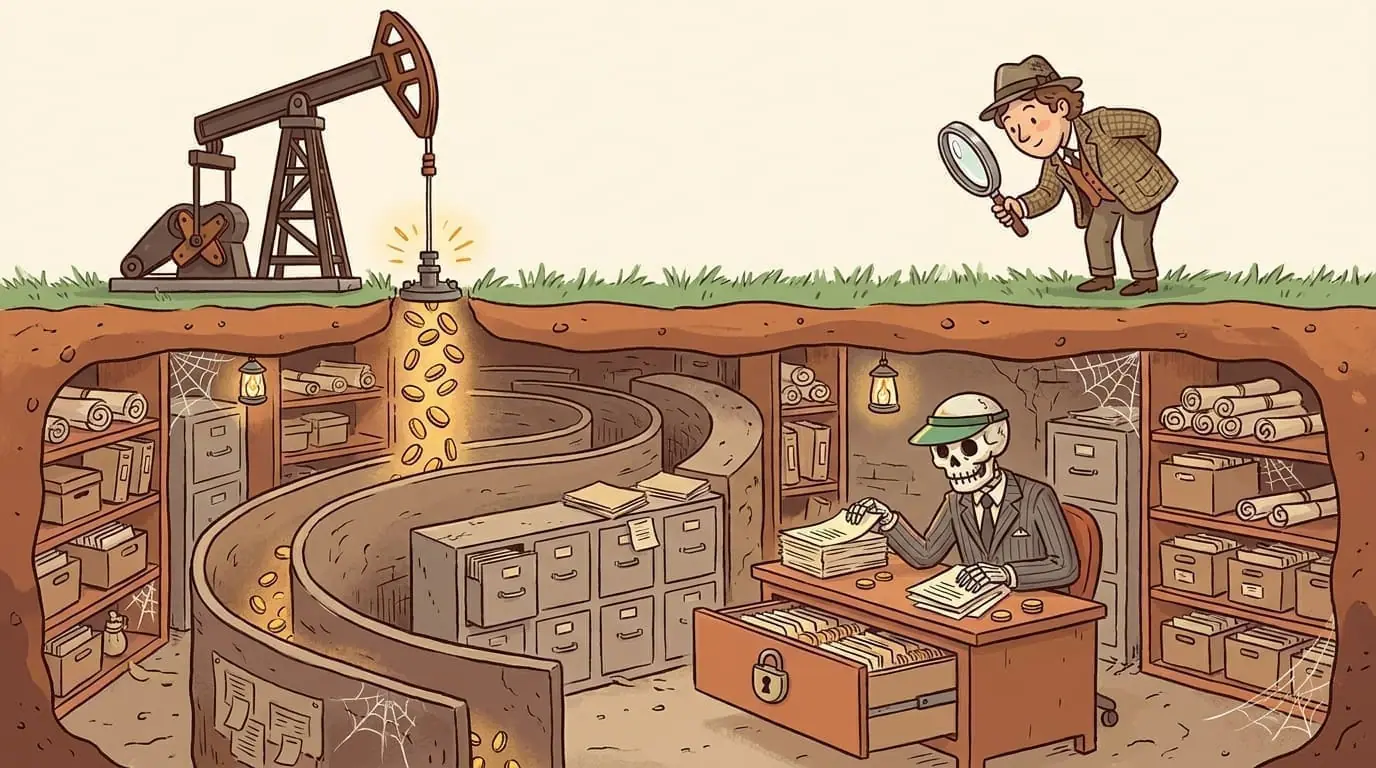
Families often find out about their Oklahoma mineral rights by accident. Usually, it happens late at night, clicking around a state treasury website, searching a deceased grandparent’s name out of curiosity.
Suddenly, a record pops up. Unclaimed property. Mineral proceeds.
At first, it feels like winning a minor lottery. You found money your family didn’t know existed. But then the paperwork arrives. You realize the money is trapped behind decades of messy title, missing wills, and bureaucratic red tape. The minerals didn’t disappear—they are sitting exactly where they always have been. The cash, however, is stuck in a highly specific Oklahoma purgatory.
We see this constantly at our family office. Families come to us exhausted, holding a printout from the state, wondering how a producing oil well turned into an administrative nightmare.
Let’s look at exactly how Oklahoma handles the money of unlocated mineral owners, where the cash actually goes, and why getting it back is much harder than simply proving you are related to the person on the check.
The Drill Bit Does Not Wait
To understand the escrow graveyard, you have to understand how drilling works in Oklahoma.
When an oil and gas operator decides to drill a well, they map out a drilling unit. They pull the deed records at the county courthouse to find everyone who owns minerals in that unit. Then, they send out lease offers.
But title records are notoriously messy. People die and their families never file probate in the county. People move and leave no forwarding address. Sometimes, the records show an owner from 1954, and the trail goes completely cold.
The operator cannot just skip drilling the well because they cannot find your great-grandfather. Instead, they turn to the Oklahoma Corporation Commission (OCC) and request a :forced pooling order.
We wrote about how Oklahoma pooling orders make decisions for you in a previous piece. The short version is this: the state steps in. The OCC issues an order pooling all the unleased and unlocated owners into the unit. The operator gets the green light to drill.
But what happens to the money owed to the missing people?
The operator cannot keep it. They are legally required to put the cash bonuses and ongoing royalty payments into a specific holding pen. For the first few years, that holding pen is the state’s Mineral Owner’s Escrow Account.
Welcome to the Mineral Owner’s Escrow Account (MOEA)
Oklahoma maintains the Mineral Owner’s Escrow Account to hold funds generated by forced pooling when the rightful owner cannot be located or when the title is fatally flawed.
If the operator cannot pay you—because you moved, because your ancestor’s estate was never probated, or because two cousins are actively suing each other over the deed—they dump the money here.
You can actually look for these funds yourself. The state runs a public database called the Oil & Gas Information Management System (OGIMS). You can type in a last name and see a list of unlocated mineral owners whose money was deposited by operators.
The database is clunky. It is a snapshot of missing people and messy estates. But the money listed there is very real.
Here is the part that surprises most people. While your family’s money sits in the :MOEA, it does not just collect dust in a vault. It earns interest. But you do not get to keep that interest.
The State Funds Itself With Your Interest
This is where the escrow graveyard gets controversial.
When millions of dollars of unlocated owners’ money sit in a state account, it generates a massive yield. Under Oklahoma Statute Title 52, Section 52-555, the State Treasurer is directed to invest the monies in the Mineral Owner’s Fund.
Then, the state apportions the interest earned on your trapped cash:
- 25% goes to the Corporation Commission (up to $300,000 per year) to plug abandoned oil and gas wells.
- 50% goes to the State Treasurer (up to $200,000 per year) to pay for advertising, personnel, and expenses related to searching for unclaimed property owners.
- The remainder gets added back to the principal of the fund.
Read that carefully. If your family’s pooling bonus is stuck in the state escrow account because you haven’t completed probate, the interest generated by your money is literally funding the plugging of dead wells across Oklahoma. It is also paying the salaries of the state employees tasked with running the unclaimed property division.
The state is using the friction of your bad title to fund its own operations.
The Next Stop: Unclaimed Property
The money does not stay in the MOEA forever. Eventually, the funds become statutorily “stale.”
If no one steps forward to claim the money and cure the title defect, the MOEA transfers the funds to the Oklahoma State Treasurer’s Unclaimed Property Division. This is the massive database where most families finally discover the lost cash.
Finding the money is simple. Unlocking it is the real challenge.
When you contact the state treasury to claim the funds, they will ask for proof of ownership. A birth certificate proving you are the grandson of the deceased owner is not enough. An old will sitting in a shoebox is not enough.
The state needs clean, legally binding, recorded title. They need to know, without a shadow of a legal doubt, that you are the sole rightful heir to those specific mineral acres in that specific county.
And that brings us to the probate wall.
The Probate Friction
This is the exact moment when the excitement of finding “lost money” turns into a crushing headache.
If your ancestor died owning minerals in Oklahoma, and their estate was never probated in Oklahoma, you have a broken chain of title. Even if they lived in California and their estate was probated there, you often still need an ancillary probate filed in the specific Oklahoma county where the dirt sits. We covered the mechanics of this in our guide on surviving inherited mineral rights.
Probate requires lawyers. Lawyers require retainers.
Let’s do the math on a very common scenario we see. You discover $12,000 sitting in the state treasurer’s unclaimed property fund. The original owner was your great-grandfather. He had four children. One of them was your grandmother, who had three children. One of them is your dad, who left everything to you and your sister.
To get your share of that $12,000, you have to prove the legal transfer of ownership through three generations. That might require reopening old probates, filing affidavits of heirship, and recording new deeds in the county courthouse.
An oil and gas title attorney might quote you $6,000 to clean this up. You are spending $6,000 in upfront legal fees to unlock a fractional share of $12,000, which you then have to split with cousins you haven’t spoken to in fifteen years.
Suddenly, leaving the money in the state treasury starts to look like a rational choice.
The Secondary Trap: Suspended Proceeds
Even if you go through the brain damage of probate and claim the money from the state, you are not done.
The state only holds the historical money. What about the oil being pumped out of the ground today?
Once you claim the MOEA funds, you have to take your newly minted, legally binding title documents and send them to the operator. The operator likely has thousands of dollars of newer royalties sitting in :suspended funds internally. We broke down why checks get suspended previously, but the reality is that the operator will not release a dime until their own title attorneys sign off on your probate work.
You are fighting a two-front war: one against the state bureaucracy, and one against the operator’s division order analysts.
The Emotional Reality of Family Minerals
We spend a lot of time talking to families in this exact situation. The financial math is frustrating, but the emotional weight is often worse.
People feel a deep sense of obligation to family land. “Grandpa bought this in 1940, I can’t just let it go.” But Grandpa didn’t leave a clean will. Grandpa left a legal mess that is costing the current generation time, money, and anxiety.
You spend hours on hold with county clerks. You track down death certificates from 1988. You argue with operators who reject your affidavits because a notary forgot to stamp a page. You realize that managing fractional mineral rights is a part-time job you never applied for.
You Have Options
Knowing what you own and what it takes to unlock it is the most empowering thing you can do. You basically have three paths forward when facing the Oklahoma escrow graveyard.
First, you can fight the battle. Hire the local title attorney, pay the retainers, track down the cousins, file the probates, and eventually get the minerals put into your name. If the minerals are highly valuable and generating massive monthly royalties, this is absolutely the right move. The math justifies the friction.
Second, you can walk away. Many families do. They look at the legal fees, look at the small pool of unclaimed money, and decide their time is worth more. The money stays with the state, the interest keeps funding well-plugging, and the asset remains frozen in time.
Third, you can sell the interest.
This is something many owners do not realize is possible. You can sell mineral rights even if the title is currently messy. Professional mineral buyers—especially family offices who buy and hold for the long term—have in-house attorneys. We know how to cure title. We know how to run the probates.
When an owner sells a complicated, un-probated interest, the buyer essentially takes on the brain damage. The buyer pays the owner a lump sum based on the value of the minerals, and then the buyer pays the legal fees and spends the next eighteen months fighting the state and the operator to clean up the paperwork.
Selling is not the right choice for everyone. But for families staring at a $10,000 probate bill just to access a $15,000 escrow account, it offers a clean break.
Whatever path you choose, the first step is always knowing what the asset is actually worth. You cannot make a good decision about spending thousands on legal fees if you do not know the true market value of the minerals sitting beneath the ground.
Getting a valuation costs nothing. It just gives you the facts. And when dealing with the Oklahoma mineral bureaucracy, facts are the only thing that cut through the noise. It is at least worth a conversation so you know your options.
:forced-pooling
A legal mechanism where a state regulatory agency forces unleased or unlocated mineral owners to participate in a drilling unit. This prevents a single holdout or missing person from stopping the development of an oil and gas well.
:moea
The Mineral Owner’s Escrow Account. A state-mandated fund in Oklahoma where operators must deposit bonuses and royalties belonging to mineral owners who cannot be located or whose title is legally unresolved.
:suspended-funds
Royalty money that an oil and gas operator owes to a mineral owner but refuses to pay out, usually because of a title defect, a missing address, or an unresolved probate. The operator holds the cash internally until the owner proves clean title.