
Most families celebrate when an operator finally drills a well on their Texas land. You sign a lease, wait out the primary term, and eventually get notice that a rig is moving in. Months later, the first royalty checks arrive.
It feels like a win. But a few years down the road, a completely different reality often sets in.
Maybe a competing oil company reaches out. They want to drill a different part of your family’s 1,000-acre ranch or target a deeper shale formation. They offer a massive sign-on bonus. You call the original operator to figure out what land is still open to lease.
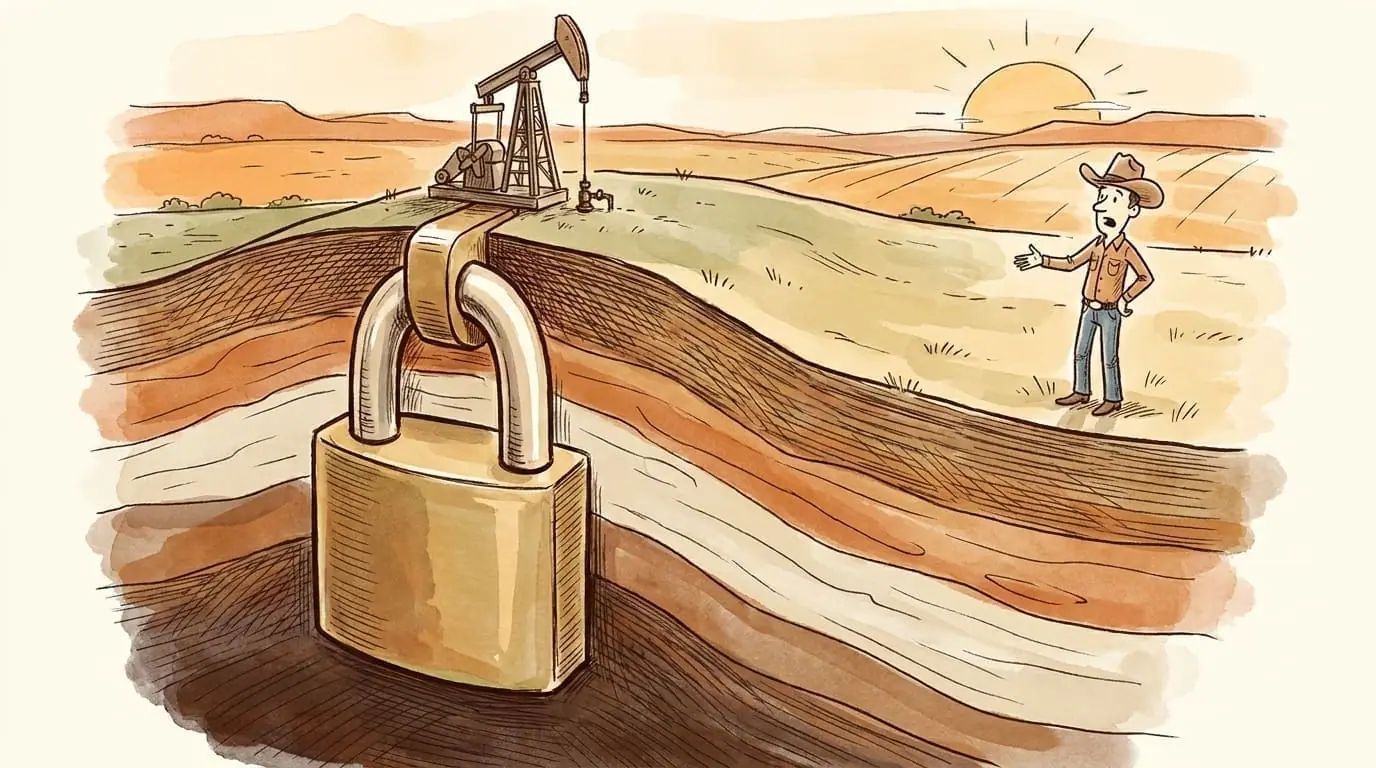
The landman gives you the bad news: None of it. The entire 1,000 acres, from the surface all the way to the center of the earth, is held by that single, lonely well.
We see this exact scenario play out every single week at our office. A family assumes that because a well only drains a small area, the rest of their land automatically reverts back to them. That assumption costs Texas mineral owners millions of dollars every year.
Unless you negotiated specific, aggressive protections into your lease before you signed it, the operator probably owns the rights to your entire mineral estate indefinitely. Let’s look at why this happens and what actually controls your acreage.
The Problem With the Standard Texas Lease
To understand the trap, you have to understand what a Texas oil and gas lease actually is. It is not a rental agreement.
According to the Texas Real Estate Research Center, an oil and gas lease in Texas is actually a mineral deed. When you sign it, you are literally conveying a portion of your mineral interests to the oil company for a specific amount of time.
That time period is dictated by the habendum clause. It usually states the lease will last for a primary term (like three or five years) and “as long thereafter as oil or gas is produced in paying quantities.”
If you lease 1,000 acres, and the operator drills one well on a 40-acre corner of that land that produces even a tiny amount of oil, they have met the requirement. The lease enters its secondary term. All 1,000 acres are now “Held By Production” (HBP).
The operator has zero financial incentive to drill the other 960 acres. They already control them. They don’t have to pay you another lease bonus. They can just sit on the rights, perhaps hoping to sell the lease to a larger company later. Meanwhile, your family is stuck with a single well generating a modest check, unable to monetize the rest of your land.
This is the very definition of The “Zombie Lease” Problem.
The Pugh Clause: A Partial Solution
Years ago, mineral owners realized they were getting squeezed by standard leases. The industry eventually developed the :Pugh clause.
In modern horizontal drilling, operators often combine multiple different tracts of land to create a single production unit. This is called pooling. If you own 100 acres, the operator might take 20 of those acres and pool them with 600 acres from your neighbors to form a unit.
Without a Pugh clause, production from that unit holds your entire 100-acre tract, even though 80 acres are completely outside the unit boundaries.
As noted by Houston Harbaugh, a Pugh clause fixes this specific problem. It severs the lease at the end of the primary term. Any acreage outside of a pooled unit is released and surrendered back to you. You are free to lease those 80 acres to someone else.
But a Pugh clause only works if pooling is involved. If the operator doesn’t pool your land—if they just drill a lease well entirely on your property—the Pugh clause does nothing. The single well still holds everything.
The Retained-Acreage Clause: Drawing the Box
To truly protect your un-drilled land, you need a :retained-acreage clause.
This clause acts like a snapshot taken at the end of your primary term. It forces the operator to draw a literal box around each producing well. The size of that box is negotiated in the lease. Anything outside the box is released back to you, regardless of whether pooling occurred or not.
In the old days of vertical wells, this was straightforward. The lease might say the operator retains 40 acres around an oil well and 160 acres around a gas well.
Horizontal drilling completely broke this math.
A horizontal wellbore can stretch for two miles underground. A 40-acre box makes no sense for a well that long. So, modern retained-acreage clauses have to rely on complex formulas based on the length of the lateral wellbore.
And this is exactly where operators and landowners end up in court.
The 5,000-Foot Trap
Let’s look at a real Texas legal battle that shows just how easily these clauses break down.
In a recent case out of Loving County, Texas (MRC Permian Co. v. Point Energy Partners), detailed in a JD Supra analysis, four identical leases covered about 4,000 acres. The landowner was smart. They negotiated a retained-acreage clause.
The clause stated that for every horizontal well drilled, the operator would retain 176 acres. But there was a catch. If the wellbore extended more than 5,000 feet horizontally “in the producing formation,” the operator got to keep double that amount: 352 acres.
The operator drilled two wells. They claimed both wells exceeded 5,000 feet. Therefore, they argued they held 704 total acres (352 × 2).
The landowner looked at the state drilling records and disagreed. They pointed out that while the total length of the wellbore was long, the actual portion resting horizontally inside the specific producing shale formation was less than 5,000 feet. By the landowner’s math, the operator only got to keep 352 total acres (176 × 2).
A competitor offered the landowner a new, highly lucrative lease on the disputed 352 acres. The whole thing ended up in a massive lawsuit.
This case highlights a frustrating truth for mineral owners. Even when you hire a lawyer and draft what you think is a foolproof retained-acreage clause, operators will use the ambiguity of downhole engineering to stretch their claim as far as possible. If the lease language says “in the producing formation,” does that include the curve of the wellbore as it enters the rock? Does it only count the perforated pipe?
These tiny wording differences dictate who controls hundreds of acres of Texas land.
Don’t Forget the Deep Rights
Releasing the surface acreage is only half the battle. You also have to think vertically.
The Permian Basin and the Eagle Ford are layered like a cake. You might have the Wolfcamp formation at 8,000 feet and the Bone Spring formation above it.
If an operator drills a well into the shallowest formation, a standard lease lets them hold the rights to every formation below it, all the way down to the earth’s core. They can sit on those deep rights for fifty years without ever spending a dime to drill them.
To prevent this, you need a :depth severance clause.
A strong depth severance clause states that at the end of the primary term, the lease terminates for all depths 100 feet below the deepest producing formation. If they drill a well to 6,000 feet, you get everything from 6,100 feet down released back to you.
Without both horizontal and vertical severance protections, operators will legally hoard your family’s un-drilled reserves. They use your un-drilled rock to pad their balance sheets and increase their company valuation, while you receive absolutely no economic benefit from it.
Dealing With the Reality of Your Lease
We talk to families constantly who are living with the consequences of leases signed by their parents or grandparents in the 1980s or 1990s.
Those old leases almost never have horizontal Pugh clauses. They rarely have depth severances. The original signers had no idea that horizontal fracturing would exist, let alone that a single well pad could theoretically hold thousands of acres in perpetuity.
If you own Producing vs. Non-Producing Minerals that are trapped under an old, poorly structured lease, the reality is difficult. You cannot force the operator to drill. You cannot cancel the lease as long as the existing well produces in paying quantities.
This is the exact point where many families step back and re-evaluate their options.
When you own 1,000 acres, but it’s held by one marginal well and the operator has no plans to develop the rest, the value of that asset is heavily depressed. You are exposed to the commodity price risk of oil and gas, but your upside is capped because you are locked out of future lease bonuses or new development.
Selling a portion of those mineral rights is one valid way to break the stalemate.
We buy mineral rights because we have a different time horizon than most individual owners. A family office like ours can afford to hold a trapped asset for thirty years, waiting out the slow depletion of a zombie well until the lease finally breaks. A family looking to fund a retirement, put kids through college, or diversify their inheritance usually doesn’t have the luxury of waiting three decades for a legal mechanism to trigger.
Selling isn’t the right choice for everyone. Sometimes holding on is the best financial move, especially if you have inside knowledge that a new operator is buying up the old wells in your area with intent to drill.
But having options brings peace of mind. Knowing what your current lease actually allows—and what the open market will pay for those rights today—puts the power back in your hands.
If you are looking at your family’s lease documents and wondering just how much acreage is actually trapped, or if you simply want to know what your minerals are worth in today’s market, it is worth a conversation. You should at least know your options.
:pugh-clause
A lease provision that terminates the lease on any of your acreage that falls outside of a pooled unit at the end of the primary term. It prevents an operator from holding a massive tract of land by only pooling a tiny fraction of it into a neighboring well.
:retained-acreage-clause
A lease clause that designates exactly how much acreage an operator gets to keep around each producing well at the end of the primary term. Unlike a Pugh clause, it triggers whether the land is pooled or not, forcing the operator to release all undeveloped acreage back to the mineral owner.
:depth-severance
A clause that releases your deep mineral rights back to you at the end of the primary term. It usually severs the lease at a specific depth, such as 100 feet below the deepest producing well, preventing an operator from holding your deep formations hostage while only producing from shallow zones.