
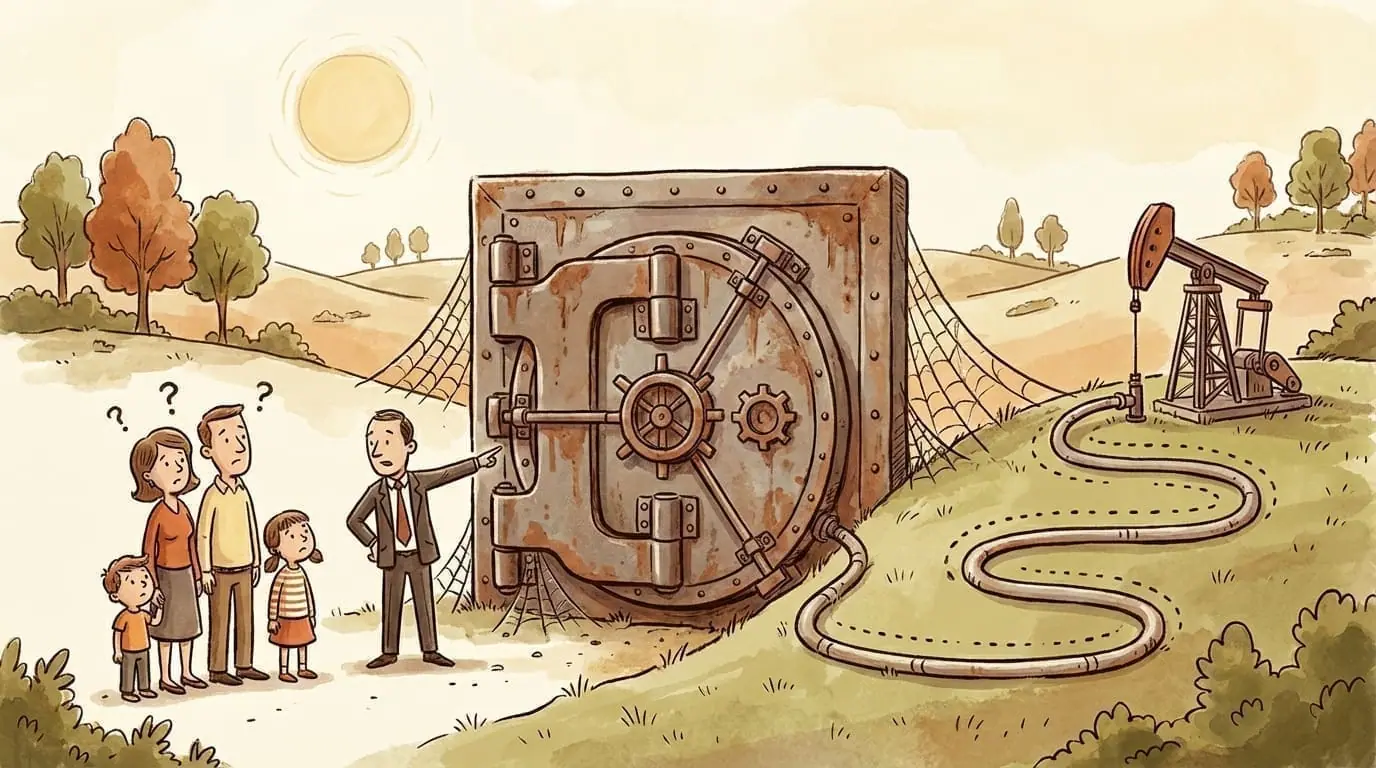
Finding out an oil or gas company drilled a producing well on your family’s land should be a good day. It usually means a royalty check is coming in the mail. But for thousands of families in Southwest Virginia, that discovery was followed by a strange and infuriating reality: the gas was flowing, the operator was selling it, but the family’s share of the money was being intercepted by the state government and dumped into a giant vault.
It wasn’t a tax. It wasn’t a penalty. It was a bureaucratic waiting room known as an :escrow account.
For more than two decades, the Commonwealth of Virginia forced operators to withhold 100% of disputed royalty money from specific types of gas wells. We have looked at deals across Texas, Oklahoma, and the broader United States, and the Virginia coalbed methane situation remains one of the most glaring examples of The Royalty Black Hole: Why Your Checks Stopped (But the Well Didn’t). Millions of dollars belonging to regular people were effectively frozen because the state didn’t know who actually owned the gas.
If your family owns land or mineral rights in places like Buchanan or Dickenson County, you might already know the pain of this system. If you recently inherited property there, you are likely staring down a confusing maze of state board petitions and title disputes.
Let’s break down exactly how this happened, the major court battles that tried to fix it, and the reality families still face when trying to get their money back.
The “Miner’s Curse” Turns a Profit
To understand why Virginia started holding money hostage, you have to understand the geology of :coalbed methane (CBM).
Coal forms over millions of years from decaying plant matter. During that massive geological squeeze, methane gas is produced. Because coal is porous, the gas clings to it. For over a century of Appalachian coal mining, this gas was completely worthless. Worse, it was deadly. Miners called it the “miner’s curse” because it was highly explosive. Coal companies spent small fortunes drilling ventilation shafts just to vent the methane into the atmosphere so their miners wouldn’t be killed.
Then, the 1970s energy crisis hit, and the natural gas industry realized they could actually capture this gas and sell it. By the 1990s, coalbed methane had transformed from a fatal nuisance into a highly valuable energy source.
But there was a massive legal problem. Who owned it?
In Southwest Virginia, surface land and minerals were often split apart in the late 1800s. A farmer might sell the rights to “all the coal in, upon, and underlying” his tract to a mining corporation while keeping the surface land and the rest of the minerals for his family. When CBM became valuable a century later, the coal companies claimed they owned the gas because it was trapped inside their coal. The families claimed they owned it because it wasn’t coal—it was a gas, and they owned everything that wasn’t coal.
The 1990 Virginia Gas and Oil Act
The state of Virginia wanted the gas drilled. They didn’t want production stalling out while thousands of families and coal companies dragged each other to court.
So, the legislature created a workaround. Under Virginia Code § 45.2-1622, if there were conflicting claims to the ownership of coalbed methane, the Virginia Gas and Oil Board would step in. They would issue an order pooling all the interests together so the well could be drilled.
But instead of paying the royalties to the families or the coal companies, the state mandated that the operator deposit the proceeds into an escrow account. Specifically, the operator had to dump one-eighth of all proceeds (the royalty) plus any excess from participating operators directly into this state-managed fund.
The money would sit there, collecting a tiny bit of interest, until the claimants either signed an agreement with each other or a judge handed down a final decision on who owned the gas.
In theory, it was a temporary placeholder. In reality, it became a 25-year trap. Coal companies had no incentive to hand over the money, and regular families rarely had the legal war chests required to fight massive mining corporations in court just to prove they owned the gas.
The Landmark Case: Harrison-Wyatt, LLC v. Ratliff
The dam finally cracked in 2004.
The Ratliff family owned the surface and minerals on tracts of land in Buchanan County, but the coal rights had been sold off through :severance deeds way back in 1887. The successor to those coal rights, Harrison-Wyatt LLC, claimed they owned the coalbed methane. The family sued.
The case went all the way to the Supreme Court of Virginia. In Harrison-Wyatt, LLC v. Ratliff, the court had to literally pull out 19th-century encyclopedias to figure out what the word “coal” meant to the people who signed those original deeds.
The court looked at the science. Methane isn’t chemically bonded to coal. It is held there by weak physical forces and is released when pressure drops. Because it is a distinct substance and just a “by-product” of the coalification process, the court ruled that granting someone the coal rights did not automatically give them the CBM.
The Ratliff family won. The court declared that the surface and gas owners retain the rights to the coalbed methane.
You would think this massive Supreme Court victory would instantly empty the state escrow accounts and send checks flooding into the mailboxes of Virginia families. It didn’t.
The Class Action Failure
Even after the Ratliff decision proved that gas owners had the legal right to their CBM, the Virginia Gas and Oil Board wouldn’t just cut checks to everyone. The law still required a specific court order, an arbitration ruling, or a signed agreement for each individual tract of land before the escrowed money could be released.
Families were outraged. Their money was sitting right there, the Supreme Court had already said they owned it, but the bureaucratic hurdles were too high. Many of the original landowners had passed away decades ago. Land had been divided among dozens of cousins. Figuring out exactly who owned what percentage of the gas was a nightmare of title research.
Tired of fighting individually, gas owners tried to band together. They filed class-action lawsuits against major operators like EQT Production Company and CNX Gas Company, demanding the release of their royalties.
But the legal system crushed that effort, too. In 2014, the Fourth Circuit Court of Appeals vacated the class certification. The court ruled that determining who actually owned the gas was simply too complicated to handle as a massive group. They cited the dynamic nature of gas estates, old conveyances, and massive heirship and intestacy issues. We see this constantly in our business—The Probate Trap destroys timelines. The court basically said: “Every single deed is different, and we can’t figure out who the true heirs are in a single lawsuit. You have to fight this out one by one.”
For a lot of families, that ruling felt like a death blow. Proving title and hiring a lawyer to release $15,000 from an escrow account often cost more than $15,000 in legal fees. So, the money just sat there.
The 2015 Legislative “Fix”
By 2015, the political pressure was boiling over. Tens of millions of dollars were stuck in the state’s escrow accounts.
The Virginia General Assembly finally stepped in and passed House Bill 2058. This law completely flipped the burden of proof. Instead of making the family fight to get the money out, the new law required operators of previously pooled CBM wells to proactively request the release of escrowed funds to the gas title claimants.
If the coal company thought they still had a valid claim, they had to be the ones to halt the release by providing evidence of a pending legal proceeding or an agreement. For new wells pooled after July 1, 2015, the operator was ordered to pay royalties directly to the gas claimant unless the coal owner actively blocked it.
It was a huge legislative victory. Money finally started trickling out of the government vault and into the bank accounts of the families who owned the gas.
The Bureaucratic Hangover
While HB 2058 changed the rules, it didn’t eliminate the red tape. If your family has CBM interests in Virginia today, you are likely still dealing with the fallout.
The Virginia Gas and Oil Board still requires strict documentation before they will disburse funds. Operators have to file detailed petitions outlining the accounting of all the deposited money. Families still have to prove they actually hold clear title to the gas. If your grandfather owned the land and died without a clear will, or if a deed from 1942 has a typo, your funds can easily remain locked up.
Operators will not do the heavy lifting of clearing your title for you. If there is a dispute among your cousins about who owns what fraction, the state will happily keep your money in escrow until you sort it out yourselves.
Knowing Your Options
We talk to mineral owners every week who are exhausted by the friction of owning Producing vs. Non-Producing Minerals. In places like Virginia, that friction is multiplied by decades of confusing legislation, conflicting coal claims, and endless board petitions.
You generally have a few paths forward.
You can hire an attorney to untangle the title, file the correct affidavits with the county, and petition the Board to release your funds and put you into “pay status.” If the escrowed amount is large enough, and the future drilling potential is strong, this is absolutely the right move. The math makes sense, and keeping the asset in the family is a great outcome.
But we also see the other side of the coin. We see families where the mineral interest has been sliced so thin across four generations that their share of the escrow is only a few thousand dollars. The legal fees to release it would eclipse the payout. In those situations, the emotional weight of managing the paperwork simply outpaces the financial reward.
Selling your gas rights is one valid option to bypass the administrative headache. When a group like ours buys an interest, we take on the burden of clearing the title, fighting the state board, and waiting on the operators. The family gets a clean break and a lump sum, and we take on the legal friction.
Whether you decide to fight for every penny in that escrow account, or you decide you’d rather walk away and let someone else deal with the paperwork, the most important thing is acting with clear information. Don’t let operators or bureaucratic boards dictate your financial timeline. Figure out what your ownership is actually worth in today’s market. Have the conversation. Because the only thing worse than the state holding your money hostage is simply giving up and letting them keep it.
:coalbed-methane
A type of natural gas that is extracted from coal beds. Unlike traditional natural gas that sits in porous rock reservoirs, coalbed methane physically adheres to the solid coal itself and is released when the pressure in the coal seam is reduced by pumping out groundwater.
:escrow-account
A financial arrangement where a third party holds and regulates payment of the funds required for two parties involved in a given transaction. In the context of Virginia minerals, it was a state-managed bank account where gas royalties were deposited by law until ownership disputes between coal and gas owners were legally resolved.
:severance-deeds
A legal document that splits the ownership of the surface land from the minerals beneath it, or splits different types of minerals from each other. In Appalachia, it was very common in the late 1800s to use these deeds to sell off only the coal rights to a mining company while the original farmer kept the surface and the rights to oil and gas.