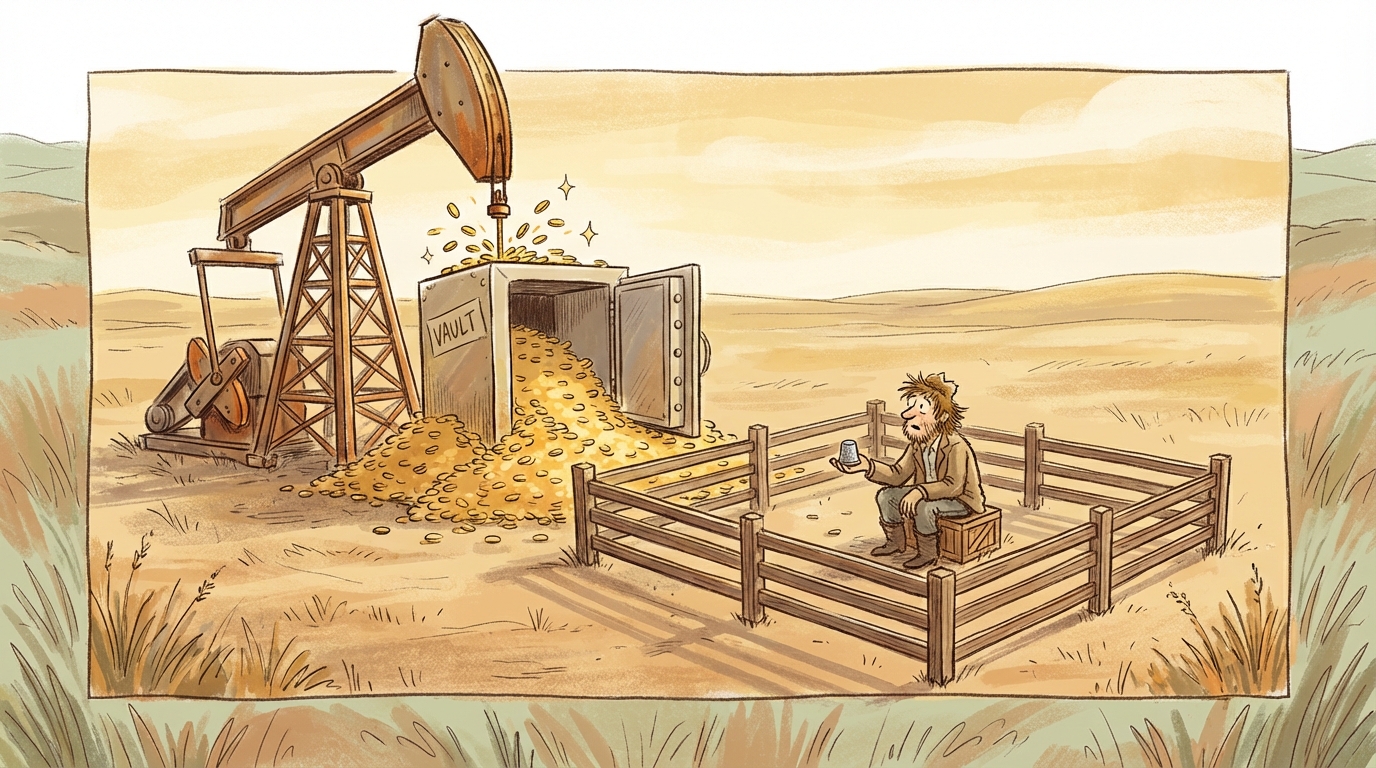
Saying no to an oil and gas lease usually feels like a safe bet. You own the dirt, or you own the rights underneath it. If you do not like the terms the landman offered, you decline. You keep your rights, and the oil company moves on.
That is how normal property negotiations work. But mineral rights are rarely normal, and in Nebraska, saying no does not stop the drilling. It just puts you in a penalty box.
We review mineral deals across the country every single week. We see a lot of aggressive statutes designed to keep operators drilling when a few holdout owners refuse to sign. Some states dock your pay. Some states charge a modest fee. Nebraska chose a different path. They created a sliding scale of financial punishment that can swallow your revenue for the entire productive life of a well.
Let’s look at the actual math behind Nebraska’s approach to unleased mineral owners, because the numbers are staggering.
The Mechanism of Compulsory Pooling
To understand the penalty, you first have to understand the rule that triggers it.
When an energy company wants to drill a well, they need to secure a certain amount of acreage to form a drilling unit. Often, they lease 80 or 90 percent of the tracts they need. But there are always holdouts. Sometimes it is a family that hates the oil industry. Sometimes it is an owner who thinks the bonus offer is too low. Often, it is just someone who inherited the rights, moved away, and throws all the legal mail in the trash.
The state does not want a single holdout to prevent the other owners from developing their minerals. So, they allow a process called :forced pooling. If the operator tries to lease you in good faith and you refuse, they can ask the Nebraska Oil and Gas Conservation Commission to pool your interests anyway.
We discussed the emotional toll of this in our piece on the involuntary partnership nobody agreed to. The state forces you into business with an operator you specifically chose not to sign with.
That is annoying. The financial reality of Nebraska Revised Statute 57-909 is much worse.
The Penalty Tiers
Drilling an oil well is expensive and risky. The state recognizes that the operator is putting millions of dollars on the line. If you are an unleased owner who gets force-pooled, you are essentially getting a free ride on their capital risk.
To level the playing field, Nebraska law allows the operator to recover your share of the drilling costs out of your share of the production. But they do not just recover the actual cost. They recover a multiple of that cost to compensate for the risk they took.
The penalty depends entirely on how deep the well goes. The deeper the hole, the higher the risk, and the steeper your penalty.
If the well is shallow, meaning under 5,000 feet, the operator gets to hold back your money until they recover 300 percent of your share of the :intangible drilling costs. These are the costs for staking, site preparation, and the actual act of drilling. For the tangible equipment, things like the wellhead, casing, and tubing, they recover 200 percent.
If the well hits the middle tier, between 5,000 and 6,500 feet, the penalties jump. The intangible cost recovery hits 400 percent. The equipment recovery hits 300 percent.
Then we get to the deep wells. For any well drilled 6,500 feet or deeper, the gloves come off. The statute authorizes the operator to recover 500 percent of both the intangible drilling expenses and the tangible equipment costs.
Five times the cost.
Plus, they get to recover 100 percent of your share of the operating costs while the well runs, along with a “reasonable rate of interest” on the unpaid balance.
What This Looks Like in Practice
Let’s put some rough numbers to this so you can see how it plays out for a family.
Assume an operator drills a deep well that costs $8 million. You own a fractional interest in the unit that equates to 1 percent of the total acreage. Your “share” of the actual drilling cost is $80,000.
Because you did not lease, the operator force-pools you under the deep-well provision. They apply the 500 percent multiplier. Your $80,000 share just became a $400,000 debt attached to your mineral interest.
You do not have to write them a check for $400,000. Instead, the operator simply keeps your share of the oil revenue until your share generates $400,000 worth of profit. Given the natural decline curves of oil wells, it might take a decade for your 1 percent interest to produce that much money. By the time the penalty is finally paid off, the well is likely barely trickling. We cover the math of aging production in our guide on what happens to your royalties when the well depletes.
The One-Eighth Lifeline
There is a small cushion built into the Nebraska law.
The state does not want you to starve while you pay off this massive artificial debt. Statute 57-909 dictates that an unleased owner is treated as two different things simultaneously.
You are treated as a lessor for a one-eighth interest. That means 12.5 percent of your total ownership is treated like a standard royalty. It is free of costs, and it is free of the penalty. You will get a check for this amount right away.
The remaining seven-eighths of your interest is treated as a :working interest. This is the portion that gets slammed with the 500 percent penalty. All the revenue generated by this seven-eighths piece goes straight to the operator to pay down the massive risk multiple.
Essentially, by refusing to sign a lease, you forced yourself into a 12.5 percent royalty deal until the well pays out at five times its original cost. For context, many negotiated leases in modern plays offer 15, 18, or even 20 percent royalties without any cost penalties attached to the rest of the interest. Other states handle this differently. You can see how Alabama caps their forced pooling metrics in our breakdown of the 3/16 safety valve. Nebraska offers no such relief.
The Burden of Inaction
We talk to mineral owners every day who are frustrated with energy companies. They hate the lowball lease offers. They hate the confusing paperwork. Sometimes they just throw the lease packets in a drawer and hope the landman stops calling.
In Texas, ignoring the mail might just mean your minerals sit undeveloped. In Nebraska, ignoring the mail is an active financial decision. It is a choice to accept a 12.5 percent royalty and a 500 percent cost penalty on the balance of your rights.
I want to be clear that the operators are not necessarily acting maliciously here. The law was designed this way on purpose. Drilling deep wells in Nebraska is highly speculative. Energy companies simply will not deploy capital if they have to carry the financial weight of unleased owners without a massive premium for taking the risk. The 500 percent number is shocking, but it is the exact tool the legislature built to ensure oil keeps flowing out of the ground.
Weighing Your Options
If you find yourself holding a lease offer in Nebraska, or if you just received a notice of a pooling hearing from the conservation commission, you have to look at the math objectively.
Participating in the well is an option, but it requires writing a massive check upfront to cover your actual share of the drilling costs. Very few families have $80,000 in liquid cash sitting around to bet on a wildcat well.
Signing the lease is the most common route. You negotiate the best royalty and bonus you can get, and you wash your hands of the drilling risk entirely.
But sometimes the well is already drilled. Sometimes the pooling order is already in place, and you are staring down a multi-hundred-thousand-dollar penalty balance on your check stub.
This is a scenario where selling the mineral rights becomes a very practical conversation. When a family office or an investment group buys mineral rights, they buy the future revenue. They also buy the penalty. We have evaluated tracts carrying heavy pooling penalties. The valuation requires running complex decline curves to figure out exactly when, or if, that 500 percent debt will clear and the full interest will revert to a paying status.
Selling allows you to trade a heavily penalized, decades-long payout structure for immediate capital. It shifts the burden of tracking the payout balance, fighting with the operator over accounting errors, and worrying about well depletion onto the buyer.
It is a big decision. Family land carries weight, and letting go of it is never just about the math. But watching an operator keep the lion’s share of your production for ten years to pay off a statutory penalty carries its own kind of emotional weight.
You deserve to know what your minerals are actually worth, penalty and all. Having the facts gives you options, and having options brings peace of mind. Even if you just want to understand how deep your well is and which penalty tier you are stuck in, it is always worth a conversation. Do not let the statute make the choice for you.
:forced-pooling
A legal mechanism used by states to compel unleased mineral owners to join a drilling unit. It prevents a small minority of holdout owners from blocking the development of a shared reservoir, but it often comes with strict financial penalties for those who are forced in.
:intangible-drilling-costs
The expenses of drilling a well that have no salvage value. This includes the labor to drill, the fuel to run the rigs, site preparation, and testing. These costs usually make up the bulk of the upfront capital required to sink a new well.
:working-interest
An ownership stake in an oil and gas lease that grants the right to explore and drill, but also carries the obligation to pay for the costs of drilling and daily operations. Unlike a royalty interest, a working interest owner loses money if the well is a financial failure.