
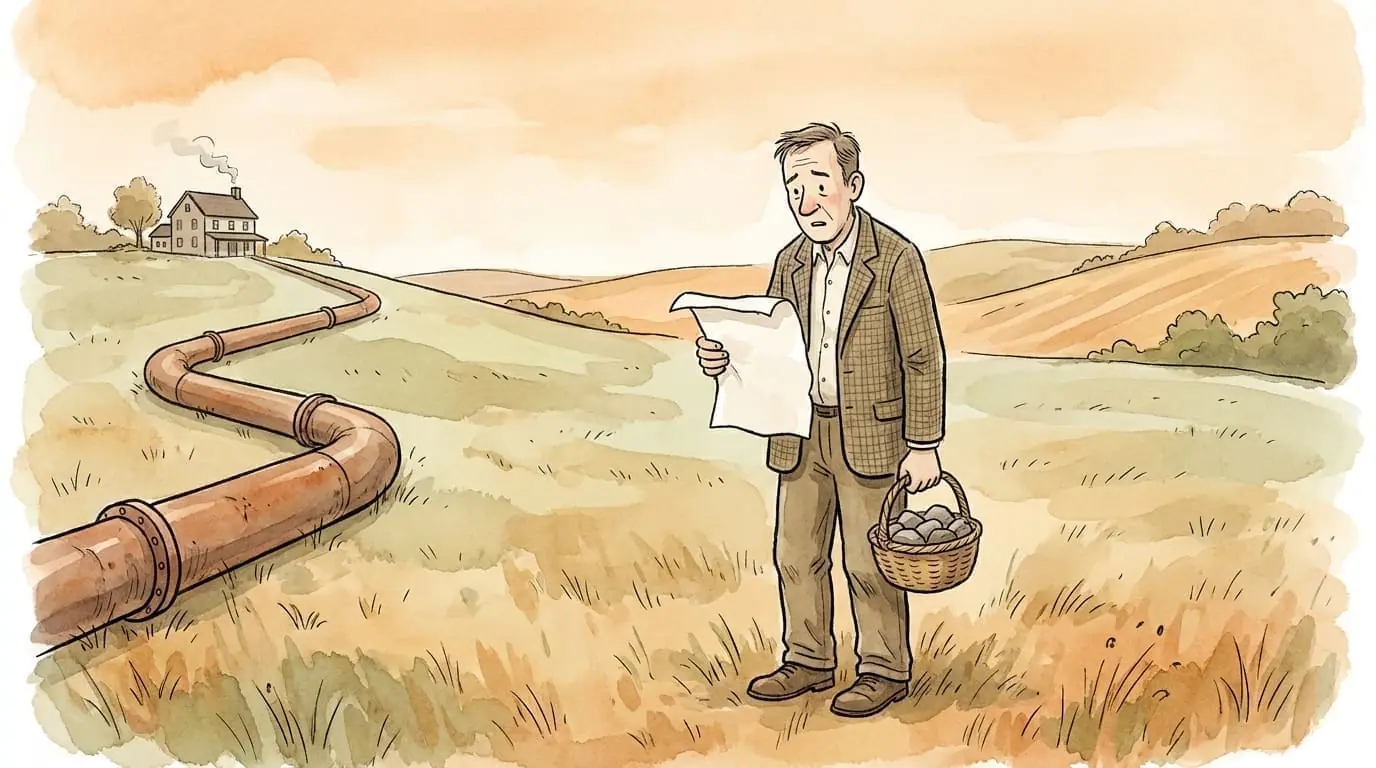
You find an old deed in a shoebox. It belonged to your great-grandfather. It says he sold the surface of his farm in Lycoming County but reserved “all minerals.” Naturally, you assume your family owns the lucrative natural gas beneath that land.
Most people would. But if that land is in Pennsylvania, you are probably in for a harsh surprise.
We see this exact scenario play out constantly. Families think they are sitting on a Marcellus Shale fortune. Then a landman runs the title and breaks the news. Under Pennsylvania law, a reservation of “minerals” almost never includes oil or natural gas.
This legal quirk is called the Dunham Rule. It has been breaking hearts and confusing heirs for over a century. Let us talk about why it exists, how it works, and what it means if you are holding onto an old family deed.
The 1882 Case That Started It All
The story starts in 1882. The Pennsylvania Supreme Court heard a dispute called Dunham and Shortt v. Kirkpatrick. The conflict centered on a timber tract. The sellers had reserved “all timber and earth, and all mineral” when they sold the land. A few years later, oil was discovered. The sellers wanted the oil rights. The buyer said no.
The court sided with the buyer. Their reasoning was incredibly practical. They decided that property deeds should not be interpreted by scientists or geologists. They should be interpreted by ordinary people.
In the 1800s, ordinary people thought of minerals as metallic substances you could mine with a pickaxe. Think coal, iron, or copper. They did not think of liquid oil or invisible gas as minerals. So the court created a strict legal presumption. Unless a deed specifically mentions oil and gas, the word “minerals” just means solid minerals. The oil and gas pass right along with the surface of the land.
It helps to step back and look at how unusual this is. If you buy land in Texas, the word “minerals” almost always includes oil and gas. Texas courts decided long ago that hydrocarbons are clearly part of the mineral estate. The same is true in most major producing states.
Pennsylvania stands alone in its stubbornness. Because the state’s legal foundation was built on coal and timber long before the modern oil industry existed, their laws reflect an 1800s worldview. We operate out of Texas. When we first started looking at Appalachian deals years ago, this rule caught our attention immediately. It is a completely different rulebook.
A Century of Fighting
You might think people would accept the rule and move on. They did not. For the next hundred years, lawyers kept trying to find loopholes.
The Pennsylvania Supreme Court dealt with this again in 1960. The case was Highland v. Commonwealth. It involved a massive tract of land in Clearfield County. The original owner died heavily in debt. His executors had to sell off his real estate piece by piece. In some deeds, they conveyed “all the coal, coal oil, fire clay and other minerals.” In other transactions, they sold the “surface only.”
Decades later, a massive fight erupted over who owned the natural gas under those tracts. The court looked right back to the Dunham Rule. They reiterated that unless natural gas is specifically mentioned, a reservation of “minerals” does not include it. The word simply was not intended by the parties to include natural gas.
Why Marcellus Shale Is No Different
Fast forward to the modern era. The Marcellus and Utica Shale booms changed the math completely. Suddenly, rural land in Susquehanna and Bradford counties was worth millions. Predictably, people started fighting over those old deeds again.
In 2013, a family named Butler went to court. They owned the surface of a 244-acre farm. An 1881 deed had reserved half the “minerals and Petroleum Oils” for the previous owner. The heirs of that previous owner claimed the reservation included the Marcellus shale gas.
They brought a clever argument. They pointed out that shale is a solid rock formation. It is not like a traditional free-flowing gas reservoir. They argued it was more like a coal vein.
The Pennsylvania Supreme Court shut that down. In Butler v. Charles Powers Estate, the court reaffirmed the century-old Dunham Rule. They refused to get bogged down in geology. The court stated clearly that natural gas extracted from shale is not a mineral. It does not matter how the gas is trapped in the rock. The old layperson understanding still applies.
The rulings just keep coming. Just recently, the Pennsylvania Superior Court dealt with this exact issue again. According to a breakdown by Houston Harbaugh, the 2024 Comerford case involved a 1958 deed that transferred “all of the mineral and surface rights.” A later buyer tried to claim the oil and gas based on that 1958 document.
The court gave the exact same answer. A conveyance of “minerals” does not transfer oil and gas. The buyer who relied on that deed ended up with nothing but the solid minerals. The oil and gas rights stayed right where they were.
The Exact Words That Trip People Up
Deeds from the late 1800s and early 1900s are notoriously messy. They were often written by farmers or small-town clerks who used whatever language was popular that week.
You will see phrases like “all minerals of every kind and character.” You will see “all subsurface rights and minerals.” To a modern reader, “subsurface rights” sounds like it covers everything underground. But Pennsylvania courts are incredibly strict. If the word “gas” or “oil” is missing, the presumption remains against the person trying to claim it.
Rebutting this presumption is brutal. You have to provide “clear and convincing evidence” that the parties back in 1880 actually intended to include gas. How do you prove what two dead men were thinking 140 years ago? You usually cannot. Unless there are old letters, journals, or prior contracts explicitly discussing the gas rights, your case is dead on arrival.
What Happens When This Hits Your Family
So how does this actually play out in real life? It usually goes like this.
An operator approaches you. They offer you a lease. You sign it and maybe even get a few royalty checks. You start planning for college tuition or a comfortable retirement.
Then the operator’s title attorneys dig deeper into the 150-year history of the property. They find an old deed with a vague mineral reservation. The lawyers get nervous. They flag your account. The operator sends you a formal letter stating there is a competing claim. They place your royalties into :suspense. Your checks stop arriving.
This is where the real headache begins. You now have to prove you actually own what you thought you owned.
Fixing this requires heavy :title curative work. Sometimes you just need to track down the other heirs and have them sign a quitclaim deed. But finding the great-great-grandchildren of someone who died in 1890 is incredibly difficult. If they refuse to sign, or if you simply cannot find them, you have to file a :quiet title action in court.
Litigation takes time. It costs real money. Your royalties stay frozen the entire time. I have watched families spend years paying legal fees just to get a judge to confirm what the Dunham Rule already states.
We broke down similar state-specific traps in our piece on The Fine Print That Eats Your Check: A Guide to Mineral Laws. Every state has its legal oddities. Pennsylvania just happens to have one of the oldest and most rigid.
Untangling the Mess
If you find yourself holding a problematic deed, the first step is locating the actual original document. Not a tax receipt. Not a lease from 1950. You need the original deed that severed the surface from the subsurface.
Read the reservation clause carefully. Look for the exact words. If it says “excepting and reserving all coal and other minerals”, you have a Dunham Rule problem. If it says “reserving all oil, gas, and minerals”, you are generally safe.
The next step is understanding the chain of title. You need to know exactly who owned the surface when that deed was signed. Because if the mineral reservation failed to capture the gas, the gas passed to the surface owner. You have to track that surface ownership forward through time to see who owns it today.
This is where many families hit a wall. Tracking title from 1890 to 2026 involves reading dozens of wills, probate records, and handwritten deeds. It is not a weekend project.
Knowing Your Options
Dealing with Pennsylvania title issues is exhausting. We understand the emotional weight attached to family land. You want to honor your grandparents. You also want the financial benefit they intended for you.
But sometimes the legal reality overshadows the financial benefit. A quiet title action might cost $15,000 to $30,000. If your royalty interest is small, the math simply does not work. You could spend more on lawyers than the gas will ever produce.
I regularly talk to folks who are stuck in these disputes. They are tired of the paperwork and the endless legal bills. They just want out.
If you are caught in one of these messes, you have a few options. You can hire an attorney and fight it out in court. That is a completely valid choice if you have the resources and patience. Just make sure you understand the costs upfront.
Another option is to step back and get a clear picture of what the asset is actually worth. You might be surprised to learn that some buyers are willing to purchase your rights even with a cloudy title. Good buyers know how to handle these title issues. They have the legal teams to clear the chain of title, track down the heirs, and unfreeze the royalties.
Selling is not for everyone. We never push anyone to make a decision they are uncomfortable with. But transferring that legal burden to someone else can be a massive relief. It replaces years of uncertainty with immediate peace of mind. Some families choose to keep the rights and fund the legal battle themselves. Both paths are perfectly fine.
The only bad choice is ignoring the problem and letting your money sit in suspense forever. If you are refusing to sign paperwork or ignoring operator notices because the title is confusing, you are hurting yourself. We wrote about The Pennsylvania Holdout Trap: When Refusing to Lease Means Getting Drained for Free. Doing nothing is rarely a good strategy in the energy business.
If you are holding an old deed and wondering what it actually covers, it is at least worth a conversation to know your options. Knowing exactly what you own is the first step to making a smart decision for your family.
:suspense-status
When an operator puts your account in suspense, they hold your royalty money in a separate internal account instead of paying you. This happens when there is a dispute over who actually owns the rights. They will not release the funds until the title is completely cleared.
:title-curative
This is the legal and administrative process of fixing a broken chain of title. It involves tracking down missing heirs, filing affidavits, and recording quitclaim deeds to prove exactly who owns the property rights today.
:quiet-title-action
A quiet title action is a formal lawsuit filed to establish definitive ownership of a piece of property. A judge reviews the evidence and issues a binding order that “quiets” any competing claims, giving you a clean and legally recognized title.