
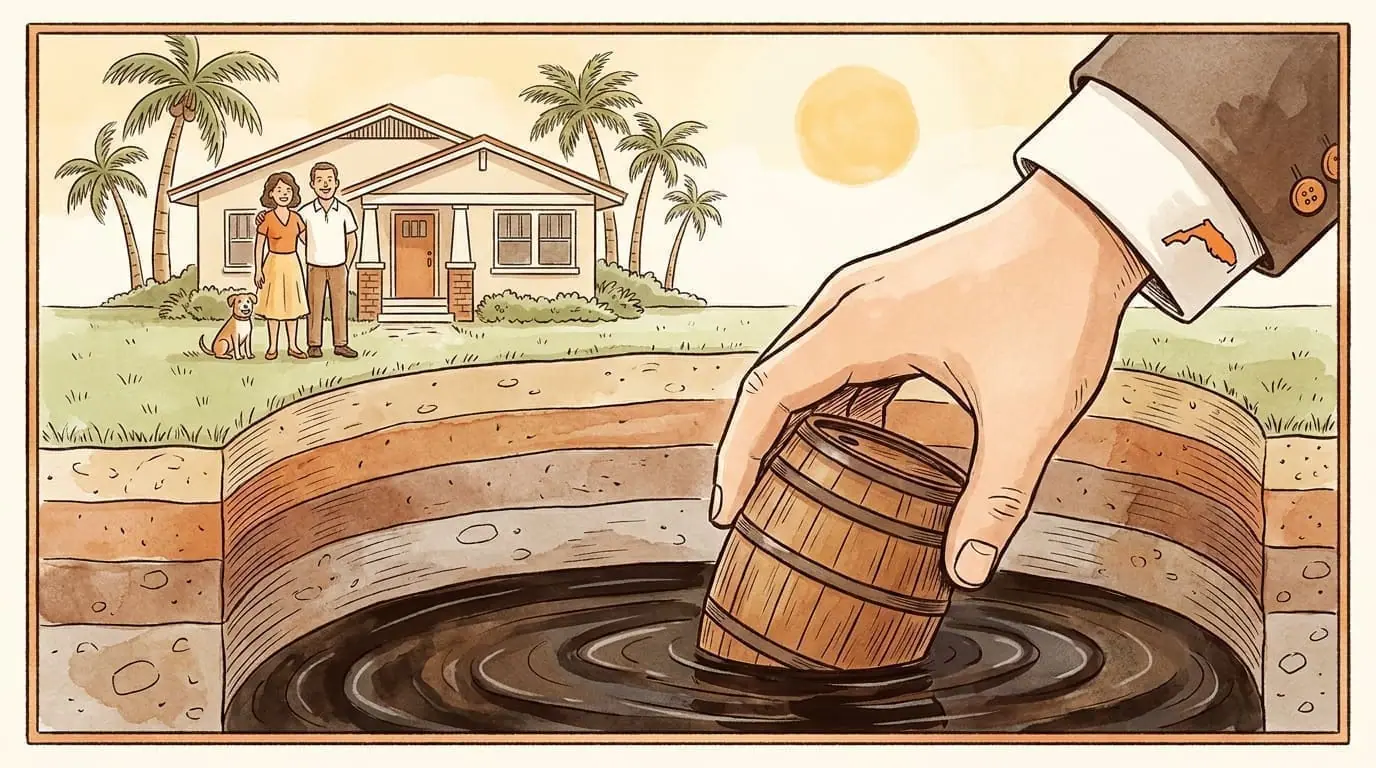
Most Florida families never think to ask whether they own the oil beneath their property. You buy the house, receive a warranty deed, pay the property taxes, and assume everything from the roofline down to the center of the earth belongs to you. That is how real estate is supposed to work.
But property ownership is rarely that simple. We look at deeds every single day. We trace ownership histories back over a century. The look of surprise on a landowner’s face when they realize someone else owns the dirt beneath their boots is always the same.
In Florida, that “someone else” is very often the state government.
There is a legal mechanism hiding in thousands of chains of title across the state. It dictates that when a local government or state agency originally sold a piece of land, they did not sell all of it. They kept a massive share of the underlying resources for themselves.
If you own land in Florida, especially property that was once state-owned or sits in an area with a history of phosphate mining or oil exploration, you need to understand exactly what your deed actually covers. Having blind spots in your ownership can cause massive headaches when you go to sell the property or pass it down to your kids.
Let us walk through how this works, why it exists, and what you can actually do about it.
The 75/50 Split
The root of this issue comes down to a specific piece of legislation. Under F.S. 270.11, whenever the Board of Trustees of the Internal Improvement Trust Fund, a water management district, or any other state agency executes a contract or deed for the sale of land, they are required by law to hold something back.
This is called a :statutory reservation.
Specifically, the law requires the government to reserve an undivided three-fourths interest in all the phosphate, minerals, and metals that might be under the land. They also reserve an undivided one-half interest in all the petroleum.
Think about those numbers for a second. If someone discovers a valuable mineral deposit beneath your property, the state of Florida automatically owns 75% of it. If an energy company discovers oil, the state owns 50% of it.
The rationale behind this law makes sense from the government’s perspective. Florida has a massive history of phosphate mining, particularly in the central part of the state known as the Bone Valley. Phosphate is a critical ingredient in global fertilizer production. In the early 1900s, state legislators realized they were selling off vast tracts of land for pennies on the dollar, only for private companies to turn around and make millions mining the phosphate beneath it.
To stop giving away the state’s natural wealth, they implemented this mandatory reservation. When they sold the surface, they kept the deep value. We have written before about how The State Is Your Secret Mineral Partner, and Florida is a perfect example of this dynamic playing out in real time.
The 20-Acre Illusion
This is where things get genuinely confusing for the average homeowner.
If the state owns half the oil under your house, does that mean they can send an oil company to set up a drilling rig in your front yard?
The short answer is no. But the reason why is widely misunderstood.
Subsection 3 of F.S. 270.11 addresses smaller properties. It states that the :right of entry for the government to explore for minerals or petroleum is automatically released for any parcel of property that is, or ever has been, a contiguous tract of less than 20 acres under the same ownership.
This was a pragmatic move by lawmakers. A modern drilling rig or mining operation requires a significant footprint. You simply cannot mine phosphate or drill an oil well on a quarter-acre suburban lot without destroying the neighborhood. Knowing this, the state decided to release its legal right to physically enter the surface of small tracts. They did this to prevent mass panic among home buyers and to stop banks from refusing to issue mortgages due to title defects.
But here is the catch. People read that the state lost its right of entry and assume the state lost its minerals. That is entirely false.
Losing the right to step foot on the surface is not the same thing as giving back the underground ownership. A Florida homeowner on a half-acre lot may have absolute, unquestioned control over the surface of their property. The state cannot touch their grass. But the state still quietly retains 50% of any oil discovered underneath it.
How can they extract it without touching the surface? Modern horizontal drilling. An energy company can set up a rig miles away, drill down, and steer the drill bit horizontally directly under your subdivision. They do not need your surface. They just need your subsurface. And because the state owns half of that subsurface petroleum, the state gets the royalty check. You get nothing from that half.
The “Wait It Out” Myth
A lot of families assume that if a deed is old enough, these weird government clauses eventually just expire.
In many areas of real estate law, that is actually true. Florida has a system called the :Marketable Record Title Act. The general idea is that if an old property claim or restriction has not been mentioned in the property records for 30 years, it is automatically extinguished. This prevents land titles from being permanently clogged by century-old disputes.
But the government does not play by the same rules it sets for everyone else.
Under F.S. 704.05, the rights and interests that can be extinguished by marketable record title do not apply to interests reserved or held by the state or its agencies.
You cannot simply wait out the state of Florida. It does not matter if the original land sale happened in 1911. If the state reserved the minerals back then, they still own them today. The clock never runs out on the government.
This creates a hidden reality beneath millions of acres of Florida real estate. We see this exact same phenomenon across different states, where old ownership structures dictate modern realities. It is similar to the issues we covered in our piece on The Invisible Estate: Who Owns the Minerals Under Your Road?. Ownership often fractures in ways the surface owner never suspects.
The Taxation Reality
You might be wondering how property taxes work in this scenario. If the state owns part of the value of your property, who pays the taxes on it?
Florida law is highly specific about this. Under F.S. 193.481, when subsurface rights like oil, gas, and minerals are separated from the surface ownership, those subsurface rights are treated as an entirely separate interest in real property. They are subject to separate taxation.
When the state owns the subsurface rights, they obviously do not pay property taxes to themselves. The county appraiser simply assesses your surface property based on its surface value—your house, your yard, your driveway.
But this statute becomes highly relevant if you ever decide to buy those mineral rights back from the state. The moment those minerals transfer into private hands, they become taxable real property. Understanding this is a vital part of managing family assets. You never want to take ownership of an asset without understanding the carrying costs attached to it.
How to Fix the Chain of Title
If you find out your property is subject to this government reservation, you are not entirely stuck. Florida law provides a mechanism to clean up your title.
According to F.S. 270.11(2), the Board of Trustees of the Internal Improvement Trust Fund has the discretion to sell or release any reserved interest for a particular parcel of land. A local government or water management district can do the same thing.
This is not an automatic process. You have to ask them to do it.
The law requires the landowner to file a formal petition or application, accompanied by a “statement of reason” justifying why the state should sell or release the interest. The Department of Environmental Protection handles the administrative side of these requests.
What counts as a good reason? Often, homeowners just want clear title to satisfy a nervous mortgage lender or a title insurance underwriter. Sometimes a developer is trying to consolidate land for a new project and needs the title to be pristine.
When you submit the petition, the state will evaluate the land. If you own a quarter-acre lot in Orlando, the state knows the mineral rights are essentially worthless because nobody is ever going to drill there. They will typically release the reservation for a nominal administrative fee.
But if you own 500 acres of rural land near existing phosphate mines or oil fields, the state’s reaction will be very different. They know exactly what those minerals are worth. They will likely refuse to just release the reservation. Instead, they might offer to sell the interest to you based on an independent appraisal of the mineral value.
Why This Matters for Your Family
Most people find out about these mineral reservations at the absolute worst possible time.
They find out when they are trying to sell the family farm to fund their retirement. Or they find out when a parent passes away and the kids are trying to settle the estate. A title company runs a deep search, flags the 1940 deed where the state retained the minerals, and suddenly the whole real estate transaction grinds to a halt while lawyers try to figure out what it means.
Selling land is an emotional process. It is heavy. It usually involves inheritance, family history, and a lot of uncertainty about the future. The last thing you need during that process is a surprise title defect.
We have met hundreds of families dealing with inherited property. The ones who navigate it best are the ones who gather the facts early. They don’t guess about what they own. They pull the deeds. They read the fine print. They understand the math behind their assets.
If you own land in Florida, take an afternoon to review your title policy or your original deed. Look for any mention of “statutory reservations” or “Chapter 270.” If you see it, look at the size of your tract. Remember that if you are under 20 acres, the state cannot enter your land, but they still own a share of what is beneath it.
If your title is encumbered, you have a choice to make. You can ignore it and let the next generation deal with it. Or you can engage the petition process to consolidate your ownership.
There is no single right answer for everyone. It depends entirely on your location, your acreage, and your family’s long-term goals for the property. But having options requires knowing exactly what you own and what it is worth. If you are sitting on a complex piece of property and wondering how these hidden ownership layers affect its actual value, it is usually worth a conversation with someone who looks at this kind of math every day. Getting a clear valuation is the best way to turn confusion into peace of mind.
:statutory-reservation
A legal requirement where the government automatically retains a portion of the mineral or energy rights when it sells public land to a private buyer. In Florida, this ensures the state continues to profit from natural resources even after the surface is developed.
:right-of-entry
The legal authority for a mineral owner to physically come onto the surface of a property to drill, mine, or extract resources. Without this right, the mineral owner cannot disturb the surface and must use alternative methods like horizontal drilling from a neighboring property.
:marketable-record-title
A legal concept designed to clear up old land disputes by invalidating claims or defects that haven’t shown up in public records for a specific period, usually 30 years. However, most states, including Florida, explicitly exempt government-owned interests from being erased this way.