
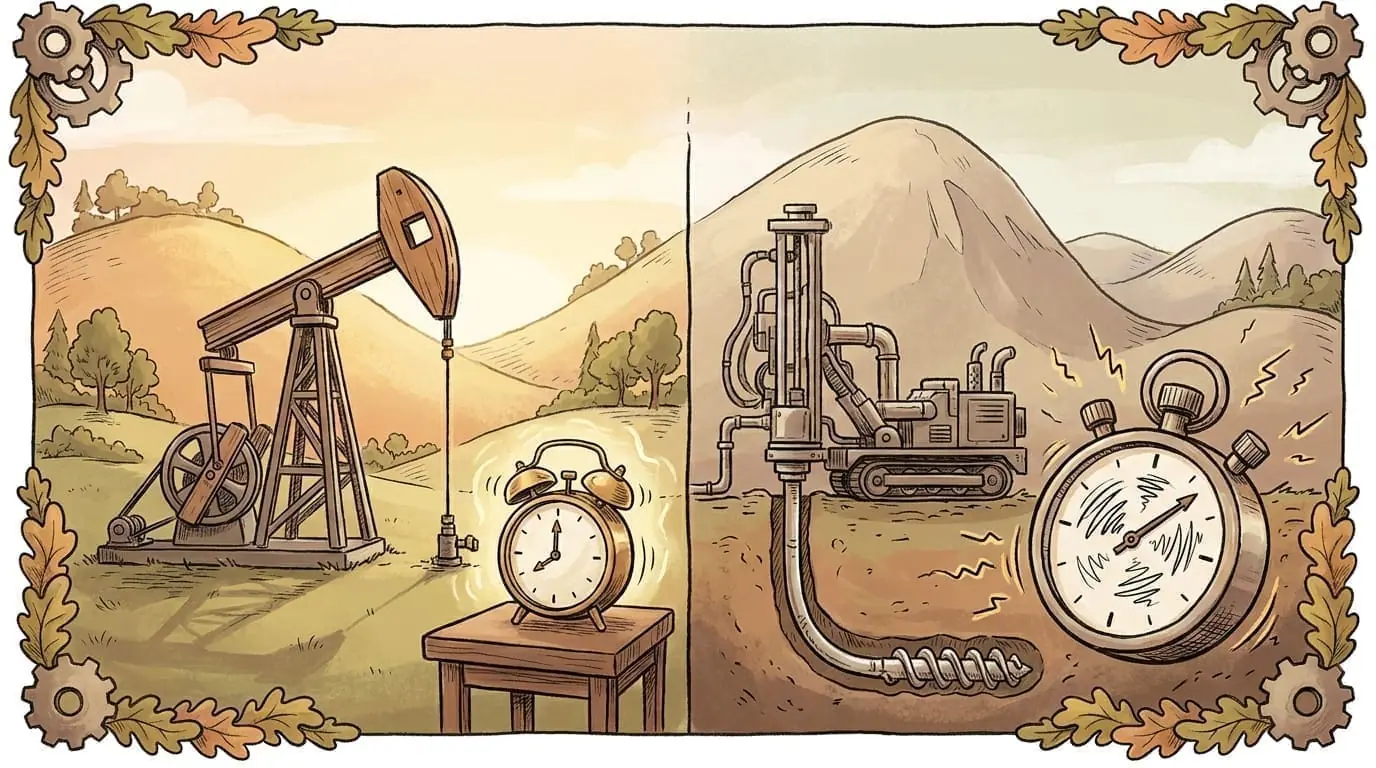
Late royalty payments occur for various reasons, including administrative errors, missing tax forms, and title defects. The mineral owner bears the immediate financial consequence when a payment is missed. West Virginia law provides statutory remedies to enforce timely royalty payments. The state applies different payment timelines and penalties depending on whether the gas comes from a conventional vertical well or a horizontal well. Knowing which statutory regime applies dictates exactly when a payment is legally late and what documentation is required to prove it.
The new vertical well penalty
Older conventional vertical wells produce smaller volumes of gas than modern shale wells. Because the individual royalty checks generated by these wells are often small, operators have historically faced little financial pressure to resolve payment delays quickly.
Under W.Va. Code 36-4-9C, a new penalty applies to conventional vertical oil, natural gas, and natural gas liquids wells. For royalty payment disputes filed with a court of competent jurisdiction on or after July 1, 2025, an operator failing to pay a royalty within six months of the due date is subject to a statutory penalty.
The penalty is three times the market value of the unpaid royalty. The prevailing party in the dispute may also recover reasonable attorney fees and court costs.
If an operator owes a mineral owner $2,000 from a conventional vertical well and holds the funds for more than six months past the due date without a legal justification, liability increases to $6,000 plus potential legal costs. This statute applies to the lessee, the operator, or their successors and assigns.
Two major exceptions apply. Treble damages are not triggered if the lease or another written agreement establishes a different timeline. The penalty is also void if a :bona fide dispute exists between the parties. A genuine disagreement over mineral ownership or the percentage owned provides the operator with a legal defense against the penalty.
The horizontal well timeline
Modern horizontal wells targeting the Marcellus and Utica shales operate under different payment deadlines. These wells require large capital investment, involve dozens of different mineral tracts in a single unit, and generate complex division orders. The legislature established a separate payment timeline to address the administrative requirements of horizontal drilling while still mandating prompt payment.
Under W.Va. Code 37C-1-3, an operator must tender regular production payments within 120 days of the :first date of sale of oil, natural gas, or natural gas liquids. Following that initial 120-day window, all subsequent payments are due within 60 days of each additional sale.
The penalty for missing these deadlines is a mandatory interest charge. The operator must pay the prime rate plus two percent, compounded quarterly until the payment is made. The statute defines the prime rate as the rate published in the Wall Street Journal on the day of the sale, reflecting the base rate on corporate loans posted by at least 75 percent of the nation’s 30 largest banks.
If a well begins selling gas in January, the first payment is due by approximately May. Missing that deadline triggers the prime-plus-two-percent interest on the unpaid balance.
As with the vertical well statute, the horizontal well law includes specific exceptions. Operators can suspend payments without incurring the interest penalty if the delay stems from a lack of record title in the interest owner, a legal dispute concerning the interest, or a missing or unlocatable owner. If an estate was never probated in the county where the well is located, the operator has legal grounds to hold the funds without paying interest while the title is fixed.
The $100 accumulation rule
West Virginia law allows operators to minimize the cost of mailing very small payments. Under W.Va. Code 37C-1-2, an operator can accumulate proceeds from a horizontal well until the balance owed to an interest owner exceeds $100. They are not required to mail a check for $14.
The operator cannot hold small balances indefinitely. The law requires them to remit accumulated proceeds at least once annually, regardless of the balance. They are also required to pay out any accumulated balance immediately or as soon as practicable if the well ceases production or if the payment responsibility transfers to another party.
Determining the well type
The state’s dual penalty framework requires you to know exactly what type of well is producing your minerals. You cannot rely on assumptions based on the county or the operator’s name.
Under W.Va. Code 37C-1-1, an operator sending a payment for a horizontal well must include specific information on the check stub or attached statement. This paperwork must show the well name and the state-issued :American Petroleum Institute number.
This API number allows you to search the West Virginia Department of Environmental Protection database to confirm whether the well permit was issued for a conventional vertical well or a horizontal shale well. We explain the mechanics of mapping these wells and finding your exact interest in our guide on How to Calculate Your Horizontal Royalty Decimal Using State Plat Maps.
The reporting statute also requires the operator to show exactly how the payment was calculated. The statement must detail the month and year of production, total volumes produced and sold, price received per unit, gross value of the proceeds, your specific decimal interest, and the aggregate amounts of all deductions. Reviewing a previous month’s statement provides the baseline data needed to estimate current holdings if a check is missing. We outline how to interpret these line items in The Code on the Check Stub: How to Read Your Royalty Statement.
Building your paper trail
If a well is producing and you are not receiving payment, the burden of uncovering the problem falls on you. Operators process high volumes of checks and generally do not audit individual accounts simply because a payment fails to trigger.
You start by submitting a written request to the operator’s owner relations department. Ask the operator to confirm the API numbers of the wells associated with your owner number and request a ledger of all suspended funds tied to your name or your family’s estate.
If funds are being held, ask for the exact reason. If the operator claims a lack of record title, ask for the specific title requirement they need satisfied. If they cite a legal dispute, ask for the case number or the names of the conflicting claimants. Obtaining written documentation establishes whether the operator is legally protected from West Virginia’s late penalties or if they are negligent in processing the payments.
The cost of holding future upside
Resolving payment delays requires monitoring production data, interpreting state statutes, tracking 120-day windows, and communicating with division order analysts regarding title defects. This administrative friction comes with mineral ownership.
Retaining a mineral interest means keeping the right to future production and subsequent drilling on your tract. It also means accepting the corresponding risks. Production from existing wells will inevitably decline. Commodity prices will fluctuate. The burden of ensuring correct payment remains with the owner.
Some owners choose to manage the asset, track wells, handle estate paperwork, and hold operators accountable. For others, the administrative requirements become a burden. The checks are unpredictable, the tax reporting is tedious, and the legal rules governing the payments change depending on the type of wellbore.
Selling a mineral interest transfers the future drilling uncertainty, natural production decline, and administrative requirements to a buyer in exchange for upfront capital.
An interest generating $5,000 a year might receive a $30,000 offer. If an offer equals ten or fifteen years of royalty income paid upfront, the decision changes. That capital can be used to diversify a portfolio, pay off a mortgage, fund a retirement account, or simplify an estate before it passes to the next generation. Selling transfers the commodity risk to the buyer.
Knowing the numbers
Evaluating this option requires knowing what a buyer is willing to pay. Two mineral owners in the same West Virginia county can receive completely different valuations. One tract might be located in a fully developed Marcellus unit with steep production declines and no room for new wells. Another tract five miles away might have multiple permitted Utica wells waiting to be drilled. Generic county price estimates fail to account for these property-specific details.
An accurate valuation requires an exact review of the legal description, lease terms, current decimal interest, and surrounding regulatory activity. Double Fraction Minerals reviews title, assesses production history, and examines the operator’s future development plans to explain how your acreage translates into a specific financial offer.
Finding out what a buyer will pay does not require a commitment to sell. You might decide the future royalty checks are worth keeping, or you might realize you can extract years of value from the asset immediately.
Owners can also pursue partial sales. An owner with 50 net mineral acres can sell 25 acres for immediate cash while retaining the remaining 25 acres to participate in future drilling. Partial sales allow owners to liquidate a portion of the asset while keeping the rest in the family. Evaluating options requires exact figures based on your specific mineral tract.
:first-sale
The date the operator first sells oil, natural gas, or natural gas liquids produced from the well to a purchaser. In West Virginia horizontal wells, this date triggers the 120-day statutory clock for the operator to issue the initial royalty payment to the interest owners.
:bona-fide-dispute
A legitimate, good-faith disagreement between parties over a legal or factual issue. In mineral law, this usually involves conflicting claims over who owns a specific tract or what percentage they own, which gives the operator a legal justification to hold royalty funds without penalty until the title is resolved.
:api-number
A unique identifying code assigned to every oil and gas well in the United States. West Virginia requires operators to print this state-issued number on your payment statement so you can track the specific well’s production, location, and permit status in the state database.