
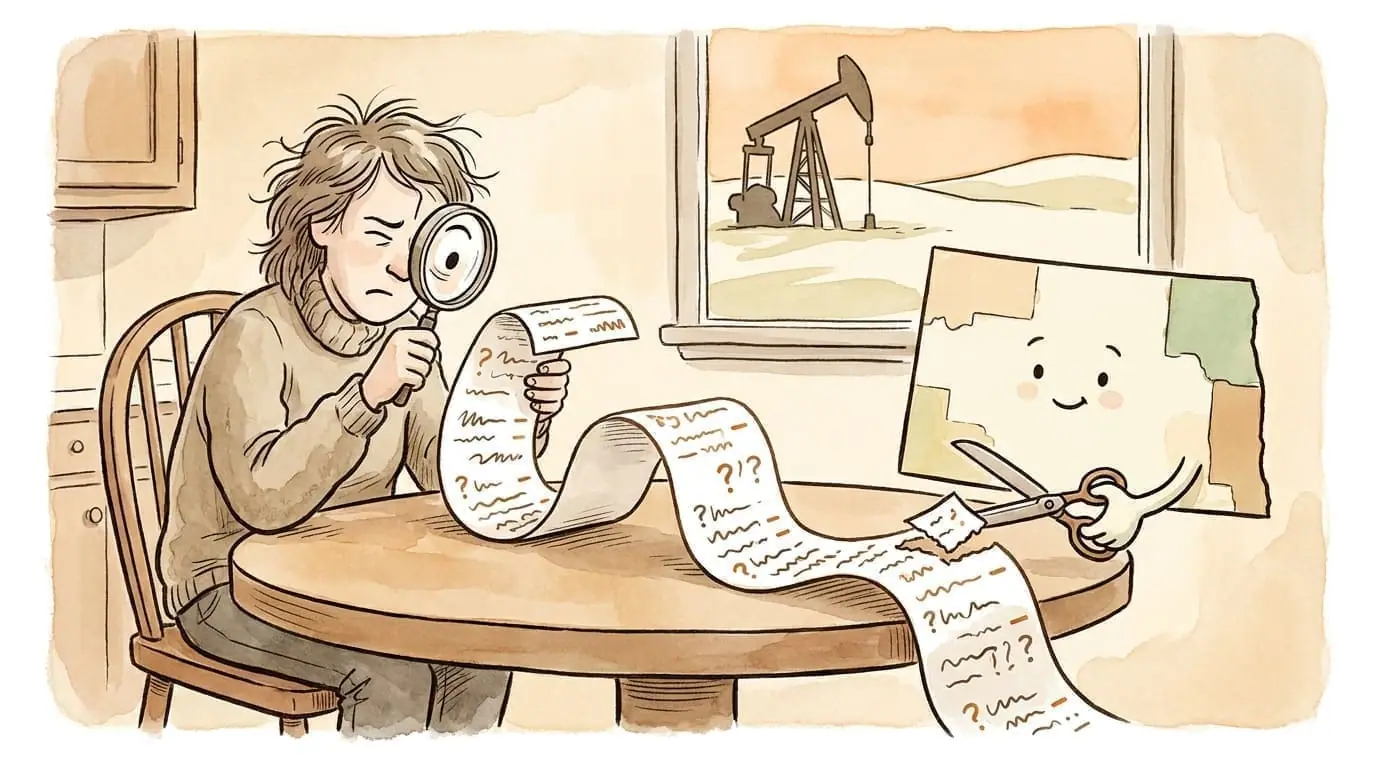
Most out-of-state North Dakota mineral owners open their royalty check and immediately feel like something is wrong. The numbers never quite match the production volume. There are line items that look like a foreign language. And a chunk of the money is missing before the check even hits the mailbox.
We see this all the time. Families inherit a fraction of a well in McKenzie or Williams County. They don’t live in North Dakota. They try to do the math on their kitchen table, and they quickly realize the oil business up north operates by its own set of rules.
If you own minerals in the Bakken, you are paying taxes and fees. Some are mandated by the state. Others are taken by the oil operator.
Let’s walk through exactly where your money is going, what the state laws actually say, and why your North Dakota check is probably smaller than you think it should be.
The 1.75% Nonresident Withholding Tax
If you don’t live in North Dakota, the state wants its cut upfront.
Under North Dakota law, income tax must be withheld from oil and gas royalty payments made to out-of-state individuals and entities. The state doesn’t trust that nonresidents will remember to file a North Dakota return just because they own a fractional mineral interest there. So, they force the oil companies to act as tax collectors.
According to the North Dakota Office of State Tax Commissioner, the withholding rate is a flat 1.75%.
How did they get that specific number? They take the highest marginal individual income tax rate, which is 2.50%, and reduce it by 0.75%. The resulting 1.75% is applied directly to the :gross amount of your royalty payment.
The operator or distributor (who the state calls the “remitter”) is legally required to pull this money from your check and send it directly to Bismarck. At the end of the year, you will see this amount reported in Box 2 of your federal or state-only Form 1099-MISC.
There are a few exceptions. If your well produces hardly anything and the remitter’s statewide production was less than 350,000 barrels of oil in the prior year, they are exempt from withholding it. You also won’t see withholding if your quarterly payments are under $600. But for the vast majority of active Bakken mineral owners, that 1.75% is coming out every single month.
This isn’t a scam. It is standard state tax policy. But it is just the first reason your net check shrinks.
The Hidden Tax: Post-Production Deductions
The state withholding tax is 1.75%. That is annoying, but it is a rounding error compared to what the oil company might be taking.
This brings us to :post-production deductions. These are the costs incurred to gather, process, compress, and transport oil and gas after it leaves the ground but before it reaches a buyer.
Decades ago, oil was mostly sold right at the wellhead. The operator pumped it, sold it into a truck or a local pipe, and paid you a royalty on that price. Today, oil and gas in North Dakota is heavily processed and transported massive distances to get better market prices. The infrastructure required to do this—especially the systems built to capture natural gas and stop flaring—is wildly expensive.
Oil companies believe you should share those costs.
North Dakota courts agree with them.
As ProPublica recently detailed, the North Dakota Supreme Court has repeatedly sided with the oil and gas industry on this issue. In major rulings in 2009 and 2021, the court determined that companies are well within their rights to deduct these post-production costs from your royalty check, unless your lease explicitly forbids it.
If your grandfather signed a standard lease in 1978, it almost certainly does not forbid it.
The financial impact here is massive. Industry estimates suggest North Dakota companies owed private mineral owners roughly $4.6 billion in 2023 before deductions. After deductions? Hundreds of millions of dollars were legally skimmed off the top to cover transportation, processing, and gathering.
I talk to mineral owners in Texas and Oklahoma who also deal with deductions, but North Dakota is uniquely tough on royalty owners. State courts in places like West Virginia and Colorado have ruled that it is the oil company’s job to make the product “marketable” on their own dime. In those states, deductions are heavily restricted.
In North Dakota, the default rule favors the operator. We explored this broader environment in our piece on North Dakota: Quiet Money in a Mature Basin. The bottom line is that unless you have a highly negotiated, modern lease with a strict “no deductions” clause, your operator is taking a significant cut of your gas value before you see a penny. Sometimes, those deductions eat up half the value of the gas.
The 18% Late Penalty: When the Operator Owes You
North Dakota law isn’t entirely stacked against the mineral owner. There is one specific statute that provides incredible leverage if you know how to use it.
Oil companies are notorious for suspending payments. Maybe there is a minor title defect. Maybe an heir died and the estate wasn’t probated in North Dakota. Maybe the operator simply messed up their accounting. Whatever the reason, they will freeze your account and sit on your money.
But they can’t sit on it for free.
Under North Dakota Century Code 47-16-39.1, if an operator fails to pay your royalties within 150 days after the oil or gas is marketed, they must pay you 18% annual interest on the unpaid balance.
Let that sink in. Eighteen percent.
You cannot find a risk-free return like that anywhere in the financial markets. The Department of Mineral Resources notes that this penalty exists to force operators to resolve title disputes and distribute funds quickly. We wrote a deep dive on how this works in The 18% Payday: How North Dakota’s Suspense Statute Turns Late Royalties Into High-Interest Debt.
If you recently cleared up a probate issue and the operator owes you three years of back pay, do not just accept a check for the base royalties. Demand the statutory interest. They will rarely volunteer it. You have to ask, and sometimes you have to threaten legal action, but it is your money.
The Check Stub Requirements
Trying to verify if your operator is calculating taxes and deductions correctly is impossible if they hand you a garbage check stub.
For years, operators would send statements with vague line items, missing volumes, and obscure tax codes. You literally could not do the math to check their work. North Dakota finally got tired of this and passed strict laws about what must be on that piece of paper.
Under NDCC 38-08-06.3, an operator must provide an information statement accompanying your payment. It has to detail the volume produced, the price received, the specific deductions taken, and the taxes withheld.
If they fail to include the information prescribed by the state? It is a Class B misdemeanor.
Yes, a criminal offense. We covered this aggressive stance in “Your Check Stub Is a Crime Scene” — North Dakota Makes Bad Royalty Statements a Class B Misdemeanor. You have the right to transparent accounting. If your statement is just a summary that says “Net Pay,” push back.
The 20-Year Trap: Losing Your Minerals entirely
This is the part that breaks my heart the most when talking to families.
You can worry all day about the 1.75% tax withholding and the pipeline deductions. But if you aren’t paying attention, you could lose the entire asset to the person who owns the surface dirt above your minerals.
North Dakota has a Dormant Mineral Act. If a mineral interest goes completely unused for 20 years, it is deemed abandoned. “Unused” means no leasing, no production, no pooling orders, and no legal filings.
When those 20 years pass, the title to those minerals automatically vests in the surface owner. Your family’s asset just vanishes.
The surface owner must publish a notice in the newspaper before claiming them. But let’s be honest. If you live in a suburb of Atlanta, you are not reading the county newspaper in rural North Dakota. You will never see the notice.
The only way to proactively protect your dormant minerals is to record a :statement of claim in the county recorder’s office where the minerals are located. It is a simple document that puts the county—and the surface owner—on notice that you are alive, you know what you own, and you intend to keep it.
If you inherited minerals that aren’t currently producing, and you aren’t absolutely certain someone has filed something on them in the last two decades, you need to call a North Dakota attorney or landman tomorrow.
The Emotional Weight of Holding
Owning North Dakota minerals out of state is a part-time job. You are managing tax withholdings across state lines. You are auditing check stubs for over-deductions. You are tracking 20-year abandonment clocks to make sure the surface owner doesn’t steal your inheritance. You are fighting operators for 18% statutory interest when they inevitably suspend your account.
It is exhausting.
I talk to folks every week who feel a deep obligation to keep the land because their grandfather bought it in the 1950s. They feel like selling it would be betraying his legacy. But Grandpa bought it as an investment to take care of his family. He didn’t buy it so his grandchildren could spend their weekends fighting an oil company’s accounting department over compression fees.
Sometimes, the smartest financial move is simply knowing what the asset is worth today.
You don’t have to sell. You might just want a baseline valuation to understand how much money is tied up in the ground, compared to what it could do for you in a retirement account or paying off a mortgage. Good buyers exist in this market—groups that understand North Dakota title, respect the families they buy from, and pay fair prices.
Selling is just one valid option among many. But having options is how you achieve peace of mind. If you are tired of watching deductions eat your checks, or you just want to know what your North Dakota minerals could sell for in today’s market, it is at least worth a conversation.
Know your math. Know your laws. And never let an operator keep money that belongs to your family.
:gross-amount
The total monetary value of the oil or gas produced from your well before any taxes, transportation fees, or processing deductions are subtracted. This is the starting number on your check stub, not the final amount you receive in the mail.
:post-production-deductions
The specific costs an oil and gas company incurs to gather, treat, compress, transport, and market the hydrocarbons after they are brought to the surface. In North Dakota, companies are legally allowed to subtract a portion of these costs directly from your royalty payment unless your lease expressly prohibits it.
:statement-of-claim
A legal document recorded in the county courthouse that publicly declares your active ownership of a mineral interest. In North Dakota, filing this document prevents your mineral rights from being declared legally abandoned and automatically transferred to the surface owner after twenty years of inactivity.