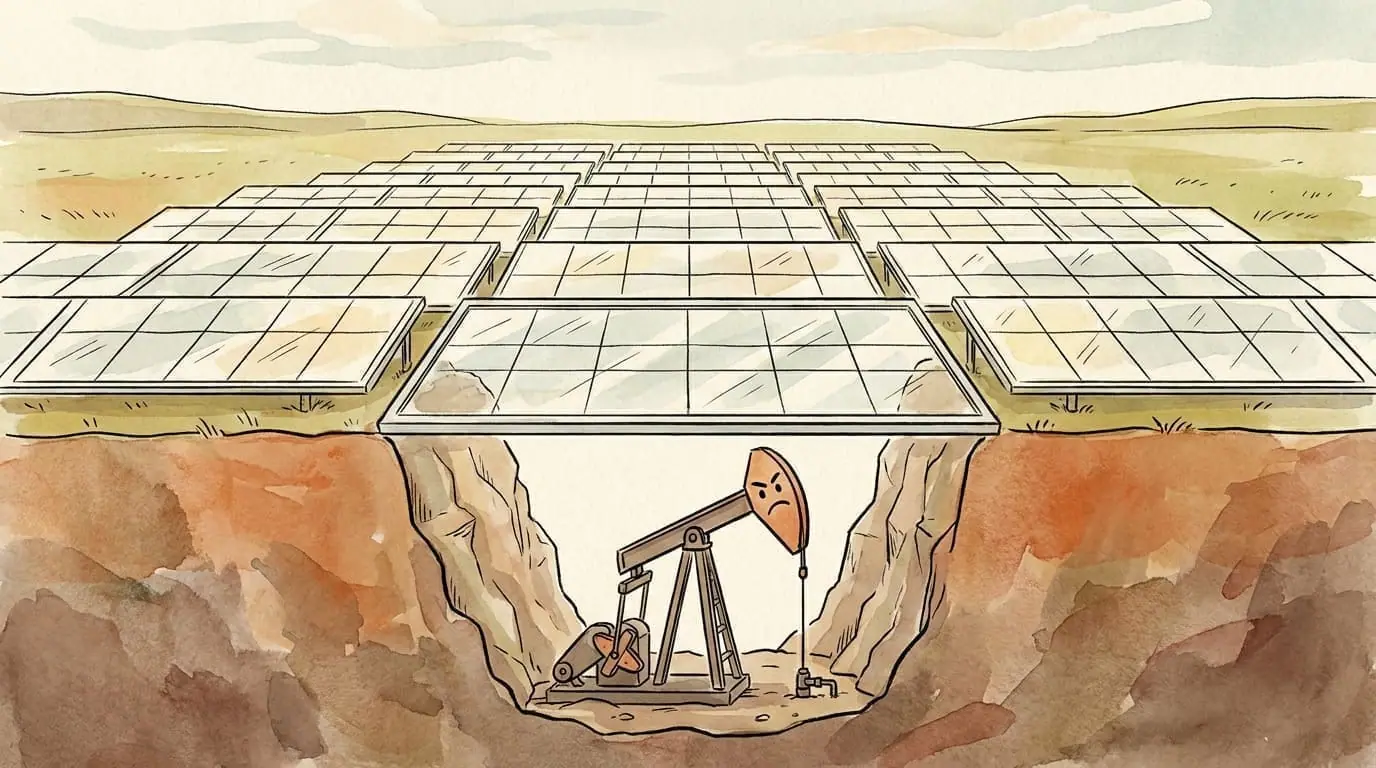
Drive through Oklahoma or Texas right now, and you will see the horizon changing. Large-scale solar and wind projects are eating up thousands of contiguous acres. For a surface owner, a massive renewable energy lease is often a life-changing payday.
But if you are a :severed mineral owner holding the rights under that same dirt, that sea of glass and steel looks very different. It looks like a 50-year concrete lid on your family’s asset.
We look at maps and review titles every single day. The collision between old property laws and the new energy transition is no longer a future theory. It is happening right now. Out-of-state families are waking up to find their oil and gas rights functionally trapped beneath solar farms.
The legal battles are already starting. If you own dormant minerals in the Mid-Continent, you need to understand exactly how renewable surface development can quietly erase the value of your underground asset.
The Old Rule Meets the New Reality
For over a century, the rules of property ownership in oil and gas country were simple. The mineral estate was considered the “dominant estate.” This meant that if an oil operator wanted to drill a well, they had the right to use as much of the surface as reasonably necessary to access those minerals. The surface owner just had to deal with the rig, the roads, and the noise.
Then came the :accommodation doctrine.
As surface lands became more valuable for farming, housing, and eventually commercial development, courts decided that mineral owners could not just bulldoze a path without consequence. The doctrine says that both the surface owner and the mineral owner have a duty to accommodate each other’s reasonable use of the land. If the mineral owner can drill from a less obtrusive location without spending a fortune, they have to do it.
That balance works fine when the surface use is a wheat field or a scattered housing subdivision. An oil company can just drill a horizontal well from a pad on the edge of the property.
But a 300-acre commercial solar facility is not a wheat field. It is a completely fenced, high-security grid of fragile panels and high-voltage transmission lines. You cannot put a drilling rig in the middle of it. And solar developers know this.
The Precedent That Should Scare Dormant Mineral Owners
If you want to know exactly how courts are handling this collision, look at the landmark 2020 Texas case, Lyle v. Midway Solar LLC. While it played out in Texas, oil and gas attorneys across Oklahoma and the Mid-Continent treat it as a massive warning sign.
The facts of the case are remarkably common. The Lyle family owned an undivided 27.5% of the mineral estate under a 315-acre tract in Pecos County. They derived their ownership from a 1948 deed. Like many modern mineral owners, they did not own the surface. And, critically, their minerals were dormant. They had not leased their rights, they had no drilling contracts, and they had no immediate plans to develop the oil and gas.
In 2015, the surface owner entered into a lease with Midway Solar. The lease allowed Midway to build a massive solar energy facility with options to renew for up to 55 years. Midway eventually covered 215 acres of the property, which was about 70% of the surface land right above the Lyles’ mineral estate.
Midway did leave two small “designated drill sites” open. One was an 80-acre tract at the north end, and the other was a 17-acre strip at the south end. The Lyles had absolutely no input on where these drill sites were located.
When the Lyles realized 70% of their property was paved over, they sued. They claimed Midway and the surface owner had breached the terms of the original deed by denying them reasonable access to their minerals. They argued the massive solar facility destroyed the value of their mineral estate and asked the court to order the panels removed.
The court ruled against the mineral owners.
The judges decided that the accommodation doctrine applied, but the Lyles’ lawsuit was entirely premature. Why? Because the Lyles were not actively attempting to develop their minerals. They had no current lease and no active drilling plans. The court essentially said that until the mineral owners actually seek to extract the oil and gas, they cannot claim damages for a blocked surface.
If you own Producing vs. Non-Producing Minerals, this ruling is a massive reality check. If you sit on dormant minerals and wait for an oil company to knock on your door, a solar company might just pave over your land first. And according to the courts, you cannot do anything about it until you actually try to drill.
The Weapon of Choice: Subordination Agreements
Solar developers do not want to risk a future lawsuit from an angry mineral owner. They want clean, unencumbered title so they can secure financing from major banks to build their projects. To get that, they use specific legal contracts.
You might get a piece of mail asking you to sign a “Waiver of Surface Rights” or a “Subordination Agreement.”
As explained on the Mineral Rights Podcast, a subordination agreement is a legal contract that outlines how one party’s rights will take priority over another’s. In the context of green energy, the agreement is between the surface developer and the mineral owner. By signing it, the mineral owner explicitly agrees to let the solar farm take priority, essentially promising never to disrupt the solar panels to drill for oil.
Banks funding solar projects love subordination agreements. Oil operators hate them.
If you sign away your surface rights, you are fundamentally altering the value of your minerals. An oil company looking to lease your land will look at the title. If they see a signed subordination agreement and a 50-year solar lease, they will run the math. If they cannot physically access the minerals without spending millions on complex directional drilling from miles away, they will simply lease the next section over. Your minerals become economically stranded.
The Oklahoma Reality and the Fog of Distance
This dynamic is playing out aggressively in Oklahoma right now. Wind and solar companies are locking down massive tracts of surface land. Surface owners are eager to sign because the steady, decades-long payout from a solar lease is incredibly lucrative.
The problem falls squarely on the out-of-state descendants who inherited the severed minerals beneath those tracts.
We talk to families every week who inherited rights from their grandparents. They live in California or Florida, and they have never set foot in Oklahoma. They just collect the occasional royalty check from older wells, or they hold onto dormant tracts hoping for a future boom. Many do not even realize a solar farm is being built until the concrete is poured.
Sometimes, developers get sloppy. In the Midway Solar case mentioned earlier, the solar company actually went out and got surface waivers from twenty individuals on adjoining properties. Not a single one of those people actually owned mineral rights under the tract where the panels were built. They just signed the paperwork. The developer recorded those faulty waivers in the public records, creating a massive title cloud for the actual owners.
If you are a distant heir, you are at a severe disadvantage. You do not drive past the property. You do not see the surveying crews. You are completely reliant on the mail to know what is happening to your family’s legacy. If you miss a notice, or if you simply ignore a thick envelope full of legal jargon, you might be letting a 50-year blockade settle over your property.
Calculating the True Cost of “Wait and See”
Holding mineral rights is often framed as a waiting game. You hold the dirt, you wait for the technology to improve, and you wait for oil prices to rise.
But when surface development enters the picture, waiting becomes incredibly risky. Let’s look at the actual math of a stranded asset.
Imagine you own a nice block of unleased minerals. An oil operator decides to drill a new multi-well pad in your section. Usually, this means you get a lease bonus check and a steady stream of royalty income for the next decade.
But if a solar developer gets there first and secures a 50-year lease from the surface owner, the oil operator’s logistics become a nightmare. If they cannot put a pad on the surface, they have to drill from far outside the section boundary. That requires longer horizontal laterals, more expensive drilling technology, and higher risk of failure. Most operators simply will not bother. They have thousands of other acres to drill where they do not have to fight a solar company for access.
Your minerals are still there underground. You still technically own them. But if no one can afford to reach them, their actual market value drops near zero.
Finding Your Exit Strategy
This is the exact point where family members start to feel the heavy burden of inherited land. You did not ask to be dropped into a complex legal fight between renewable energy developers and the old oil and gas rules.
When families realize their minerals are in the path of heavy surface development, they generally have three choices.
First, you can fight. You can hire a local landman to monitor the surface activity, retain a local energy attorney to review any waiver agreements, and threaten litigation if a solar developer blocks your access. This is expensive, stressful, and as the Texas courts showed, you might not even win unless you are actively trying to drill a well yourself.
Second, you can hold on and do nothing. You can refuse to sign any waivers, let the solar farm get built anyway, and hope that in 2075, when the solar lease expires, an oil company might still be interested in drilling. For most families, freezing an asset for two generations is not an appealing financial strategy.
Third, you can find a buyer who understands the exact nature of the risk and is willing to take it off your hands.
Selling is absolutely a massive decision, especially when the asset has been in your family for generations. We strongly recommend that families take the time to read through guides like So You Inherited Mineral Rights: A Survival Guide for the Next Generation before making any moves.
But there is real value in knowing your options. Buyers who operate in these basins know how to price the risk of surface conflicts. They have the legal teams to negotiate with solar developers. They have the capital to hold the asset for decades if necessary.
Transferring that headache to someone equipped to handle it is often the most logical way to extract the remaining value from the land today. It turns a dormant, highly threatened asset into liquid capital that your family can actually use.
You do not have to make a decision today. But you should absolutely know what you own, what is happening on the surface above it, and what your options are before a developer makes the decision for you. It is always worth a quiet conversation just to see where you stand.
:severed-mineral-owner
A person or entity that owns the underground oil, gas, and mineral rights to a property, but does not own the surface land above it. This separation happens when a previous owner sells the surface but keeps the minerals for themselves.
:accommodation-doctrine
A legal rule that requires a mineral owner to accommodate an existing surface use (like a farm or a building) if there is a reasonable alternative way to extract the minerals. It prevents oil companies from needlessly destroying the surface owner’s property.