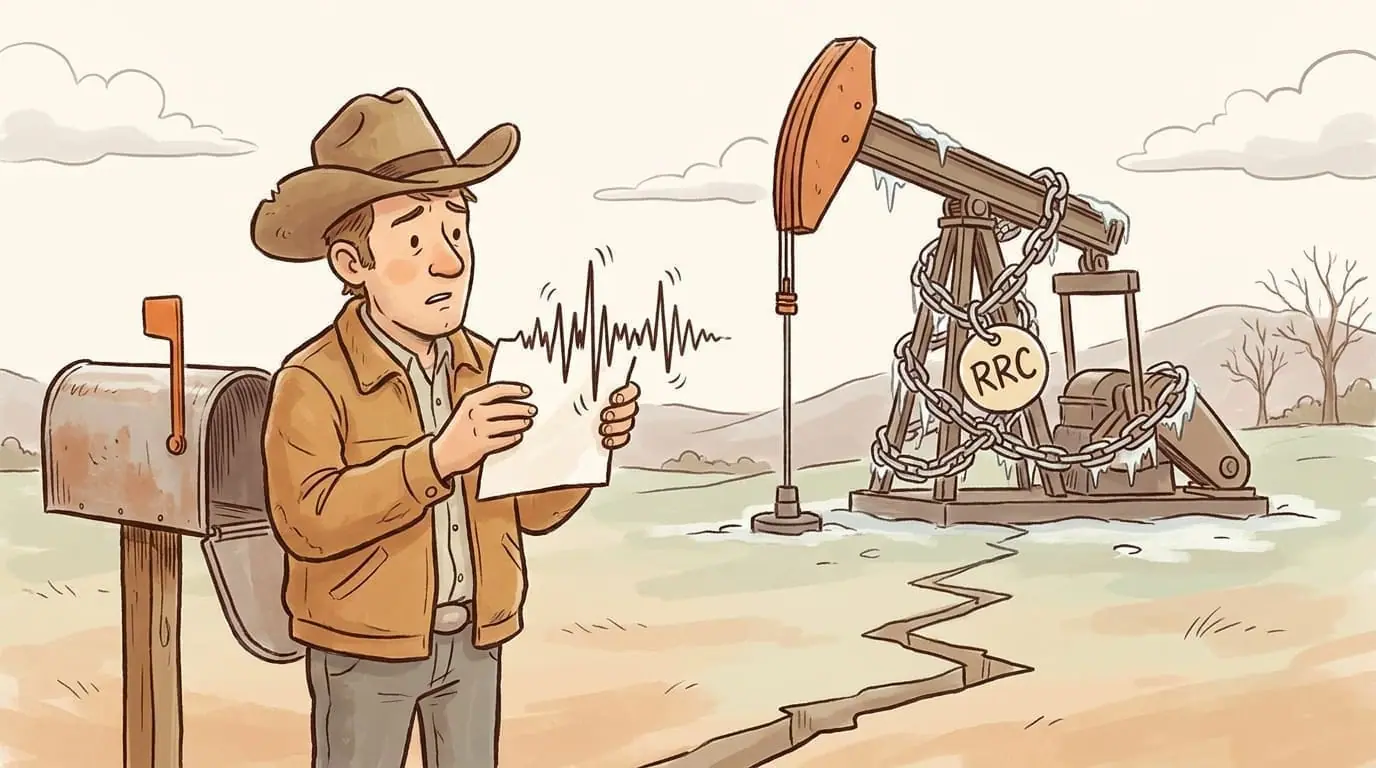
You open the envelope expecting your normal royalty check. Last month the well paid out $4,200. You tear the paper open and see a zero. Or maybe the check just never arrives at all.
When this happens, most mineral owners assume the oil simply ran out. The natural lifespan of a well always comes to an end. We covered the common administrative reasons for frozen accounts in The Royalty Black Hole: Why Your Checks Stopped (But the Well Didn’t), where paperwork errors or title disputes stop your money.
But there is a new reason your high-performing wells are suddenly going dark in West Texas. The oil is still down there. The operator still wants to pump it. The well is in perfect working order. The problem is happening fifty miles away from your family’s land.
The state of Texas is intentionally turning off the tap. They are doing it because of earthquakes. And if you own minerals in the Permian Basin, you need to understand exactly how environmental regulations tied to seismicity can turn your producing asset into a stranded one overnight.
To understand why an earthquake stops your royalty check, you have to look past the crude oil. You have to look at the water.
Most people think oil extraction is primarily about oil. It is actually a water management business. When operators drill down into the deep rock of the Permian Basin, they do not just find black gold. They find toxic, salty brine. We call this :produced water.
The numbers are staggering. In the Permian, an active well often pulls up four to eight barrels of water for every single barrel of oil. That fluid is ancient, heavy, and loaded with salts and trace chemicals. According to a report highlighted by the Texas Tribune, Texas operators generated roughly 3.9 billion barrels of produced water in 2022 alone.
All that liquid has to go somewhere. You cannot just dump billions of barrels of contaminated brine onto the West Texas dirt. You cannot put it in the local river. The only economically viable solution for operators is to pump it back deep underground into dedicated Saltwater Disposal wells. These are separate facilities entirely from your oil well.
This is where the physics become a massive problem.
When you inject millions of gallons of water into deep geologic strata day after day, you increase the pressure inside those rock formations. Imagine a dry sponge absorbing water until it simply cannot take another drop. The rock is the sponge. When the pressure gets too high, the fluid searches for a release valve. It finds deep, ancient fault lines. The fluid lubricates those faults and the added pressure causes them to slip.
The result is an earthquake.
For a long time, Texas didn’t have much seismic activity. That changed rapidly over the last few years. The earth beneath West Texas started shaking with alarming frequency. In late 2023, the U.S. Geological Survey recorded a 5.2 magnitude earthquake in the Permian region. It tied for the fourth strongest seismic event in Texas history. Other quakes measuring 5.4 and 4.4 magnitude have rattled communities that never historically worried about fault lines.
The Railroad Commission of Texas is the agency that regulates oil and gas in the state. They have the authority to manage saltwater disposal well activity. When the ground started shaking, the RRC had to act. They traced the seismic activity directly back to the deep injection of wastewater.
The RRC’s response was swift and heavy-handed. They began creating specific geographic zones called :Seismic Response Areas. If your land falls inside or near one of these zones, your royalty checks are sitting directly in the regulatory crosshairs.
Let’s look at the Northern Culberson-Reeves response area as a prime example. The RRC identified an unprecedented frequency of earthquakes happening in this specific pocket of Texas. Between September and October 2021, the area experienced six earthquakes measuring over 4.0 in magnitude.
The Railroad Commission determined that deep injection into strata below the Wolfcamp Formation was the likely culprit. By late 2023, after another cluster of severe quakes, the RRC brought down the hammer. They suspended all disposal well permits injecting oil and gas waste into deep strata within the boundaries of that area. They completely suspended 23 deep disposal wells, effective January 2024.
They did similar things in the Stanton and Gardendale areas. Operators in these regions were suddenly hit with massive disposal volume curtailments. In some places, they were forced to drop their disposal volumes by 68 percent compared to previous years.
This brings us to the trap for the mineral owner.
You do not own the disposal well. You own the mineral rights under the producing oil well. But the two are inextricably linked by pipeline and basic economics.
When the RRC shuts down the local disposal well, the operator of your oil well loses their garbage can. They are still pulling up five barrels of toxic water for every barrel of crude. But now they are legally prohibited from putting that water into the ground nearby.
The operator cannot just hit pause on the water and keep pumping the oil. They come out of the ground together. If the operator cannot dispose of the water, they have absolutely no choice but to :shut in the producing oil well.
They physically turn off the valves. The oil stops flowing. The water stops flowing. And your royalty checks immediately drop to zero.
This is the seismicity squeeze. Your family’s well is suffering from regulatory whiplash caused by an environmental issue miles away. The operator is not punishing you. The oil has not dried up. The system has simply bottlenecked.
You might ask why the operator doesn’t just clean the water or move it somewhere else.
Some operators do try to truck the water out of the seismic response areas to disposal wells in other counties. But trucking water is incredibly expensive. A fleet of tanker trucks running 24 hours a day destroys the profit margin of the oil well. If oil is sitting at $75 a barrel, and it costs the operator $85 a barrel to truck the associated water away, they will shut the well in. The math demands it.
Other folks wonder about recycling. The oil and gas industry does recycle produced water to use in hydraulic fracturing. It makes sense to reuse the water to frack new wells instead of buying fresh groundwater. But the scale is totally mismatched. The amount of water needed to frack a new well is just a tiny fraction of the billions of barrels of produced water coming out of the ground every year. Treating that heavy brine for actual desalination or agricultural use is still far too expensive to be commercially viable on a massive scale.
I genuinely don’t know if the smaller, independent operators will survive this specific water bottleneck. Major corporations like Chevron or ExxonMobil have the balance sheets to build massive pipeline networks to transport water hundreds of miles away from fault lines. A small Texas operator running ten wells does not have a billion dollars for infrastructure. When the state takes away their local disposal well, they are paralyzed.
And the regulations are only getting stricter.
Starting in June 2025, the permitting process for disposal wells across the Permian Basin will undergo a massive overhaul. According to industry analysis from B3 Insight, the RRC is expanding the area of review for new disposal wells from a quarter-mile up to a two-mile radius.
Operators will have to prove their injection pressures will not fracture the surrounding rock. They will face strict daily volume limits based on reservoir pressure. If there are old, unplugged “orphan” wells anywhere within two miles of a proposed disposal site, the RRC will automatically penalize the operator’s permitted injection pressure.
These rules make perfect sense from a safety and geological standpoint. Nobody wants 5.4 magnitude earthquakes cracking the foundations of homes in Midland. The state has to protect the surface and the subsurface integrity.
But for mineral owners, these rules introduce a layer of profound uncertainty. We often talk about the difference in value between Producing vs. Non-Producing Minerals. A producing well is cash flow. It is a tangible financial asset. But what happens when a producing well is legally forced into non-producing status for years because of regional water constraints?
It leaves families holding the bag. You still own the minerals. You still have to manage the estate. But the income vanishes, and you have zero control over when it comes back. You cannot call the Railroad Commission and demand they reopen a fault line. You cannot force an operator to lose money trucking water across the state. You just have to wait.
We have sat across the table from families who relied on those monthly checks to pay property taxes or cover medical bills. The sudden loss of income is terrifying. When you inherit a producing well, you inherit the assumption that the money will keep flowing until the earth gives up its last drop of crude. Very few people warn you about the regulatory chokeholds.
If you own minerals in the Permian Basin, water management is the most important factor in The Future of the Permian Basin. You need to look at your well locations. You need to know if you are sitting inside a Seismic Response Area like Gardendale or Culberson-Reeves.
We watch these regulatory shifts constantly because we buy minerals. We factor in the cost of water disposal. We calculate the likelihood of a shut-in. A family office like ours can afford to buy a well, watch it get shut in for three years while the operator builds a new water pipeline, and wait for the revenue to return. We have the time horizon to absorb that regulatory risk.
Individual families often do not. Waiting three years for a check to restart is simply not an option for an estate trying to settle probate or a retiree managing monthly cash flow.
Selling mineral rights is a deeply personal decision. It usually involves family history and emotional weight. But it is also a financial calculation. Sometimes, the smartest move you can make is transferring the regulatory risk to someone else. You let a buyer take on the headache of Railroad Commission limits, disposal volume penalties, and seismic response plans. You take the capital upfront and secure your peace of mind.
We will never tell a family they have to sell. We believe in helping mineral owners understand exactly what is happening under their dirt so they can make their own choices. If your checks have dropped, or if you are worried about your operator’s ability to handle the new 2025 water regulations, it is at least worth a conversation.
Knowing what your assets are actually worth in the current regulatory environment gives you power. It gives you options. And in a market where a distant earthquake can stop your income cold, having options is the most valuable thing you can own.
:produced-water
The toxic, heavy brine that is pumped out of the ground alongside crude oil and natural gas. It is heavily contaminated with salt and minerals and must be permanently disposed of deep underground to prevent environmental damage.
:shut-in
When an operator physically closes the valves on a well to stop the flow of oil and gas. This is often temporary, done because of low market prices, necessary maintenance, or sudden regulatory restrictions on water disposal.
:seismic-response-area
A specific geographic zone designated by the Texas Railroad Commission where earthquake activity has spiked. Inside these zones, the state strictly limits or completely bans the injection of wastewater to prevent further ground shifting.