
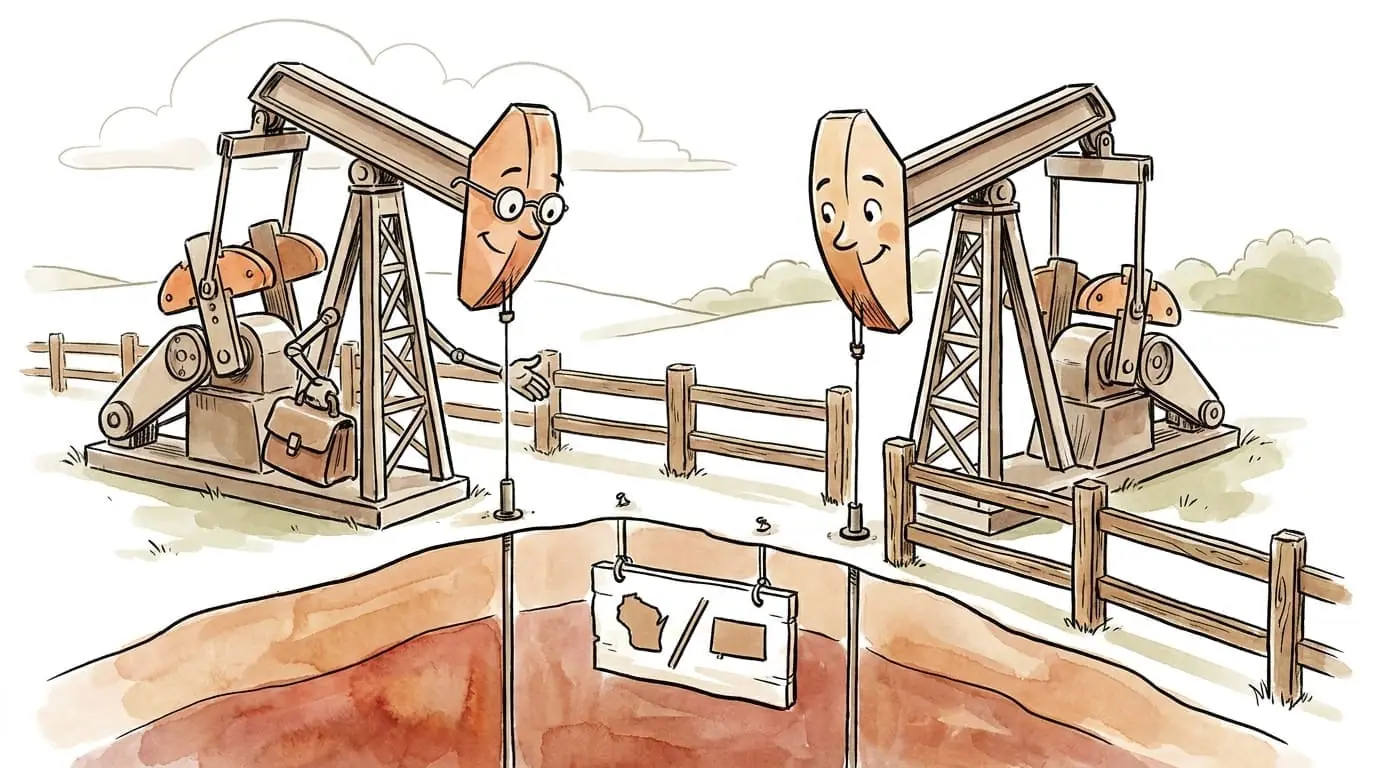
Families inheriting mineral rights in the Williston Basin often expect to deal with North Dakota or Montana. They pull up a map, find the legal description, and realize their grandparents left them acreage just across the state line in Harding County, South Dakota.
South Dakota shares the Williston Basin and consistently produces commercial crude, but it operates under a distinct regulatory and geological environment. The rules governing your royalty checks, the taxes withheld from your revenue, and the way operators drill are specific to the state. Assuming a Harding County interest will behave like a Mountrail County interest is a fast way to misread your check stub and misunderstand what you own.
Understanding these differences matters because mineral ownership is a financial position. You are holding a depleting commodity asset in a highly regulated state. Knowing how the South Dakota system works makes it easier to evaluate whether holding that asset makes sense for your family today.
The Red River formation and the geological reality
While the Bakken shale gets the headlines up north, Harding County oil production relies heavily on the Red River formation.
This is a deep, older carbonate rock formation. Producing oil from the Red River often involves conventional vertical drilling and secondary recovery methods rather than the massive horizontal multi-stage fracturing seen in North Dakota.
Because the rock behaves differently, operators frequently group wells into :enhanced recovery units. They inject water or gas back into the reservoir to maintain pressure and push remaining oil toward producing wells. The South Dakota Department of Agriculture and Natural Resources maintains specific maps for Harding County Enhanced Recovery Units, distinct from standard oil and gas field maps.
This geological reality impacts your royalty check. Enhanced recovery extends the life of a field, but it also means the production profile is older and more mature. A mature waterflood unit might produce a steady but low volume of oil for decades. The operator must spend money treating and injecting water, maintaining old wellbores, and powering pump jacks. As those operating expenses rise relative to the amount of oil produced, the economic margin shrinks.
How South Dakota handles pooling and unitization
South Dakota streamlines oil and gas development through administrative rules that can surprise out-of-state owners.
Before 2012, many routine operator requests required a formal hearing. Under current state law, actions like establishing new fields, forced pooling, and unitization only require a contested case hearing before the Board of Minerals and Environment if a party formally objects after public notice. If no one objects, the department Secretary issues the order administratively.
This framework, governed by Administrative Rules of South Dakota 74:12:09, allows operators to move quickly. Recent dockets from the Board of Minerals and Environment show how routine this administrative approval has become.
In June 2024, Wadi Petroleum requested an exception to statewide spacing for its South Dakota Federal 1-7 well in Section 7, Township 8 South, Range 1 East. Because no person intervened, the department approved the request administratively just one month later.
In 2023, Gulf Exploration filed multiple applications for exception locations, including the Sunrise 1-28, Enigma 1-3, and Avalanche 1-16 wells. All were approved administratively without a hearing.
Operators also use this streamlined process to manage the water injection required for Red River production. Continental Resources received administrative approval in 2022 to inject into several Harding County wells, including locations in Township 21 North, Range 3 East and Range 4 East. Citation Oil and Gas Corp received similar approval for its 8-27H Clarkson well in the West Buffalo ‘B’ Red River Unit in 2023.
For a mineral owner, this means spacing exceptions, injection permits, and pooling orders can become finalized quietly if you are not monitoring the state publications.
Operator enforcement and your risk
Owning minerals means your income relies entirely on the competence and financial health of the operator. South Dakota does enforce its rules when operators fail, and those enforcement actions can immediately impact your royalty revenue.
In April 2024, the department issued a Notice of Violation against Thomas Sunde regarding five wells. The state petitioned the board to revoke multiple drilling permits. During an October 2024 enforcement hearing, the board approved the revocation of six permits and ordered the forfeiture of the operator’s surety bond.
When the state revokes permits and seizes bonds, production stops. For the royalty owner, the revenue drops to zero, and the minerals become tied up in a distressed field until a new operator decides the wells are worth taking over. This highlights a structural reality of mineral ownership. You carry the financial risk of operator failure without having any operational control.
The South Dakota tax bite
Before your operator calculates your decimal interest, the State of South Dakota takes its share.
The South Dakota Department of Revenue administers specific taxes on oil and gas production. When you review your revenue statement, you will likely see deductions related to two specific statutes.
The first is the Energy Minerals Severance Tax, governed by South Dakota Codified Law 10-39A. The state levies this tax on the taxable value of the energy minerals extracted. The second is the Conservation Tax on Severance of Energy Minerals, governed by SDCL 10-39B.
Operators file the returns and remit both taxes to the state, but the two are treated differently on your check. The 4.5% severance tax is imposed on the owner or operator, and statements commonly show your proportional share withheld. The 2.4-mill conservation tax is the operator’s alone: SDCL 10-39B-2 says the operator may not pass it on to the mineral owner, so a conservation-tax line on a royalty stub is worth questioning. If you own a small fractional interest in an older Red River unit, the severance tax and the operator’s post-production deductions can together consume a noticeable percentage of the gross value of the oil.
Learning how to read your royalty statement requires understanding which deductions are legally mandated state taxes and which are operator expenses. You cannot negotiate away a state severance tax, but understanding its impact helps you project what the interest will yield in the future.
Reframing the hold versus sell decision
Many families hold Harding County minerals simply because a grandparent bought them decades ago. The default assumption is that keeping the minerals is the safest financial choice.
That assumption ignores the mechanics of oil production. Minerals do not function like a stock index fund that generally grows over time. Oil and gas interests are tied to depleting reservoirs. Every barrel of crude pumped out of the Red River formation is a barrel that can never be sold again. As a well ages, it follows a strict :decline curve. The volume of oil drops, the water production often increases, and the operating costs rise. Eventually, the well reaches a point where it costs more to operate than it generates in revenue, and it gets shut in.
Holding a mineral interest means you accept all of the future risk. You accept the risk that oil prices drop. You accept the risk that the operator neglects the field or faces regulatory enforcement. You accept the risk that the wells simply run dry faster than anticipated. In exchange for taking those risks, you receive monthly or quarterly royalty checks.
Selling all or part of a mineral interest changes that equation. A sale converts uncertain future income into a known amount of capital today.
If a Harding County interest currently generates $3,000 a year, and someone offers $75,000 for it, that offer equals 25 years of today’s royalty income paid upfront. The family can take that capital and buy real estate, pay off debt, fund a trust, or diversify into broad market index funds.
There is real economic weight in transferring commodity risk, drilling risk, and decline risk to a buyer. A buyer has the capital to wait decades for a return and the technical expertise to manage the asset. For a family spread across the country, concentrating wealth in a single South Dakota county carries a concentration risk that a financial planner would typically advise against.
Why you need a tract-level evaluation
You cannot make an informed financial decision by guessing what an asset is worth. Generic county averages or rules of thumb fail completely in oil and gas.
Two mineral owners in Harding County can receive dramatically different valuations for perfectly logical reasons. One owner might have a high royalty rate leased under an active, well-capitalized operator with near-term development plans. Another owner a few miles away might hold a small fractional interest under an old, water-logged unit managed by an operator nearing insolvency.
The true value of a South Dakota mineral interest depends on the exact legal description, the specific net mineral acres owned, the terms of the existing lease, the division order decimal, the production history of the specific wells, and the current buyer appetite for the Red River formation.
You do not have to sell your minerals to benefit from understanding their value. Getting a clear, mathematically sound valuation provides necessary information. You might review the number and decide the future upside is worth keeping. You might review it and realize you are being offered more than you could expect to collect in royalty checks over the next thirty years.
You also have the ability to restructure the asset rather than making an all-or-nothing choice. A family owning 80 net mineral acres in South Dakota might decide to sell 40 acres to create immediate liquidity while retaining the other 40 acres to capture any future drilling upside.
Mineral rights often carry deep family history, and transitioning them out of the estate can feel heavy. Preserving family wealth does not require preserving the exact asset that created it. Converting a concentrated, depleting mineral position into diversified capital can be a responsible way to manage a family legacy.
You cannot know whether holding or selling makes sense until you know the math. Knowing what an experienced buyer would truly pay for your specific interest makes the decision purely objective. It allows you to look at the exact figures, consider your family’s financial goals, and choose the path that makes the most sense today.
:enhanced-recovery-units
A designated area where an operator injects water, gas, or chemicals into a reservoir to increase the pressure and sweep remaining oil toward producing wellbores. This is common in older fields where natural pressure has dropped.
:decline-curve
The mathematical projection of how a well’s production will drop over time. All oil and gas wells produce less as they age, and engineers use decline curves to estimate how much extractable oil remains in the ground.