
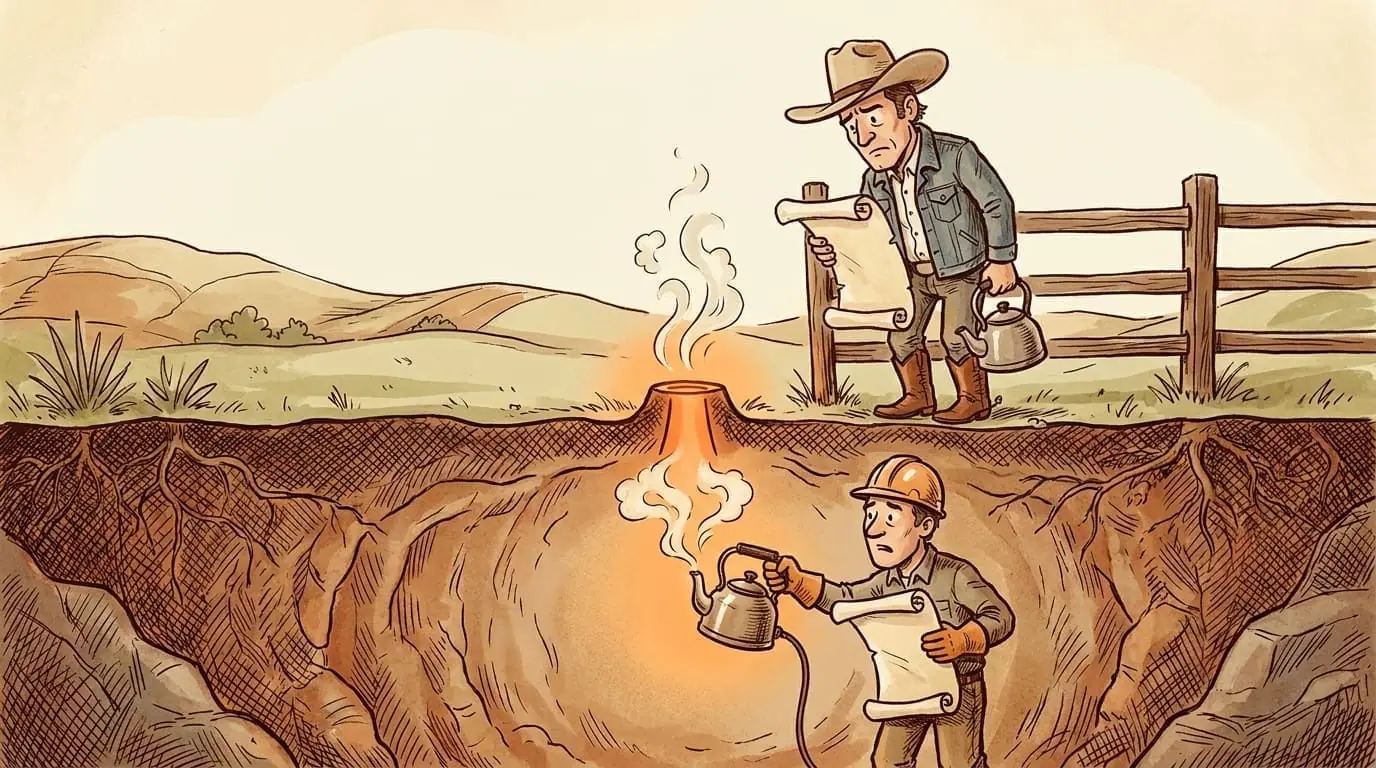
Texas property law relies on a division of the earth into distinct layers. One party can own the surface rights, including the topsoil, grass, and trees. A separate party can own the rights to the oil, natural gas, and hard rock minerals located below ground. This historical arrangement created wealth for families who sold their farmland decades ago but legally severed and kept the subsurface rights. Now, the geothermal energy industry is testing the boundaries of those old deeds. Geothermal extraction raises a basic legal question regarding what belongs to the surface owner and what belongs to the mineral owner.
The nature of the resource
Geothermal energy differs from physical substances like crude oil or natural gas. It consists of thermal energy trapped in underground rock formations. A 2025 University of Illinois Law Review article by Gabriel Eckstein outlines the property problem created by this physical reality. Eckstein notes that the top 10,000 meters of the Earth hold 50,000 times more heat energy than all global oil and natural gas resources combined. [https://scholarship.law.tamu.edu/facscholar/2200/]
Heat is an incorporeal and uncontainable natural resource. It exists purely as a physical condition of the rock.
This physical reality creates a legal problem. When a landowner from 1950 sold the surface and retained all oil, gas, and other minerals, it remained unclear whether they also retained the heat inside those minerals. If an operator pumps cold water down a well to absorb heat and brings it back up to generate electricity, the legal ownership of that harvested heat comes into question. Without clear ownership rules, public and commercial investment in geothermal energy would stall. Investors systematically avoid funding energy projects if the underlying title is defective.
The Texas legislative answer
Texas resolved this legal ambiguity in 2023 with Senate Bill 785. The legislature added Section 141.004 to the Texas Natural Resources Code. [https://tcss.legis.texas.gov/resources/NR/htm/NR.141.htm] The statute establishes a statutory default rule. Unless a conveyance, deed, or lease expressly dictates otherwise, geothermal energy and its associated resources legally belong to the surface owner.
Under this framework, a family holding a :severed estate does not own the geothermal energy contained within their rock. Control of the heat belongs to the surface owner.
The Texas legislature included statutory provisions to protect existing oil and gas rights. The statute specifies that it does not apply to minerals dissolved in groundwater or hot brines. If a geothermal operator extracts hot water to produce lithium or other trace elements, the mineral owner retains a legal claim to those specific extracted substances. The law also establishes that the new rule does not alter existing law regarding oil, gas, or general mineral extraction. It preserves the legal rights of the :dominant estate.
Technology convergence in the rock
The ownership split is clear in property records, but the physical reality of drilling complicates matters. Geothermal energy is viable in Texas because it utilizes the primary tools of the oil and gas industry. The Department of Energy recently launched the Geothermal Energy from Oil and Gas Demonstrated Engineering initiative. [https://www.energy.gov/hgeo/geothermal/geothermal-energy-oil-and-gas-demonstrated-engineering] This federal program provides an initial $10 million to help the geothermal industry adopt extraction technology from the oil and gas sector. The consortium expects to issue competitive solicitations of up to $155 million over four years to merge conventional oilfield operations with geothermal extraction methods.
Modern geothermal projects rely heavily on horizontal drilling and advanced reservoir engineering. They use the drilling rigs and steel casing standard to oil and gas companies, along with similar fracturing techniques. Operators target the same geological depths and often work within the same petroleum basins.
Because the physical extraction processes are similar, the Railroad Commission of Texas regulates both industries. When an operator intends to drill an :injection well for geothermal energy, they must submit an application to the Railroad Commission. [https://www.rrc.texas.gov/oil-and-gas/applications-and-permits/injection-storage-permits/geothermal/] The application requires detailed structure maps identifying the top and bottom of the proposed zones. The geothermal operator must also submit well logs and historical seismicity data.
The state requires strict completion standards for closed loop systems. Operators must backfill the annular space with impervious bentonite to protect freshwater aquifers from contamination. If a wellbore passes through undesirable groundwater, the operator must physically isolate the fresh water zones using cement plugs. The regulatory permitting process for a geothermal well closely mirrors the traditional process for an oil and gas well.
The coming subsurface conflict
This overlapping operational framework creates a title issue for Texas families holding mineral rights. A mineral owner might execute a lease with a company that intends to drill for oil in a specific formation. Simultaneously, the surface owner might execute a lease with a separate company that intends to extract heat from that exact same formation. Both operators plan to drill horizontal wells, and both must apply for permits from the Railroad Commission.
The families who drafted the original mineral severances did not anticipate this dual development scenario. We have written about the complexity of producing vs. non-producing minerals before. A family might own 100 percent of the oil beneath a ranch. The surface owner, who likely assumed all profitable rights were gone, now holds a legally distinct thermal asset.
If a geothermal operator builds a closed loop system to harvest heat, their infrastructure will occupy physical space in the subsurface. This physical occupation could interfere with future oil and gas development. While the mineral estate remains dominant in Texas, asserting that legal dominance against an active geothermal project will require litigation. Resolving legal disputes between two operators trying to exploit two different resources in the same space will delay development timelines and freeze royalty payouts.
The financial reality of mineral ownership
Geothermal energy introduces an additional variable into mineral ownership. Owning severed minerals means carrying overlapping risks. The owner faces commodity price risk when the global oil market fluctuates. They face geological risk if the rock does not produce at expected volumes. They face timing risk if an operator waits a decade to drill. Now, owners face the operational risk that a competing surface operator might complicate an existing or future oil and gas lease.
Holding minerals involves retaining future upside while accepting these variables. Selling minerals transfers these variables to a buyer, converting future uncertainty into a fixed amount of capital today.
Upon closing the sale, the buyer assumes the commodity price risk and the operator risk. They also assume the risk of declining production, along with the burden of potential interference from surface geothermal projects that might impact oil and gas development.
Trading an uncertain future income stream for cash is a common financial strategy. If an interest currently generates $3,000 per year and a buyer offers $75,000 for it, that offer equals roughly 25 years of today’s royalty income paid upfront. Existing wells will eventually deplete. Additional wells might increase future income, but operators might never drill them. The capital received today has its own earning potential. It can be invested in index funds or applied toward existing debt. It can also be used to purchase traditional real estate through a tax deferred mechanism. We outline the mechanics of real estate trades in our guide on The 1031 Exchange Secret: Trading Your Minerals for Traditional Real Estate Tax-Free.
The attractiveness of a trade depends on the probability of future development and how the owner weighs immediate certainty against potential future gains.
Empathy and family history
Selling minerals inherited from a parent or grandparent involves historical factors distinct from selling a stock. Owners routinely view the property as a physical connection to their family legacy.
However, preserving family wealth does not require preserving the specific asset that created it. Converting a concentrated, single commodity asset into diversified investments can support long term goals. As mineral interests pass through generations, they regularly become smaller and increasingly fragmented. This fragmentation makes them difficult to administer. Exchanging a fractional royalty interest for liquid capital provides a direct mechanism to settle an estate or fund a family need.
Valuation as information
A mineral owner cannot determine whether holding or selling makes sense without knowing the value of the asset. Generic price per acre estimates provide insufficient data for financial decisions. Two mineral owners in the same county can receive different offers based on localized geology. One tract might sit over thick, oil saturated rock with an operator planning a multi well pad. Another tract five miles away might sit over thinner rock with zero planned development.
Determining the precise value requires examining the exact legal description. It involves analyzing the net mineral acres, the royalty rate, the title history, and the production curves of nearby wells. Valuations also require calculating the precise decimal interest and evaluating the specific operator’s track record in the basin.
Commissioning a valuation does not commit an owner to a sale. Assigning a firm number to an asset that has existed in a family for decades without a defined price provides baseline financial information.
An owner might review the valuation and conclude the potential upside justifies retaining the minerals. Alternatively, the owner might realize the offer exceeds their expected lifetime income from royalty checks. Both outcomes provide actionable data.
The transaction structure is rarely all or nothing. An owner with 40 net mineral acres can sell 10 acres and keep 30. They can sell the producing tracts and retain the unleased tracts. Partial sales allow an owner to secure immediate capital and reduce exposure to market fluctuations. It also allows them to retain a portion of the future upside. We discussed this concept in our piece about The All-or-Nothing Myth: Selling Partial Rights. This flexibility applies directly to estate planning.
The emergence of geothermal energy alters the dynamics of the subsurface. Texas law is adapting as operations overlap. Navigating this environment requires understanding the exact assets you own and identifying what the market is willing to pay for them. A detailed valuation provides the information needed to evaluate those options and treat a legacy asset as a concrete financial decision.
:severed-estate
A legal situation where ownership of the surface of the land is separated from ownership of the underground minerals. One party owns the surface rights, while a separate party owns the rights to extract the oil and natural gas below.
:dominant-estate
In Texas property law, the mineral estate holds priority over the surface estate. The owner of the minerals holds the legal right to use as much of the surface as is reasonably necessary to access and produce the underground oil and gas.
:injection-well
A well used to pump fluids deep underground into porous rock formations. Operators use these wells to dispose of wastewater produced during oil extraction or to circulate water for geothermal energy projects.