
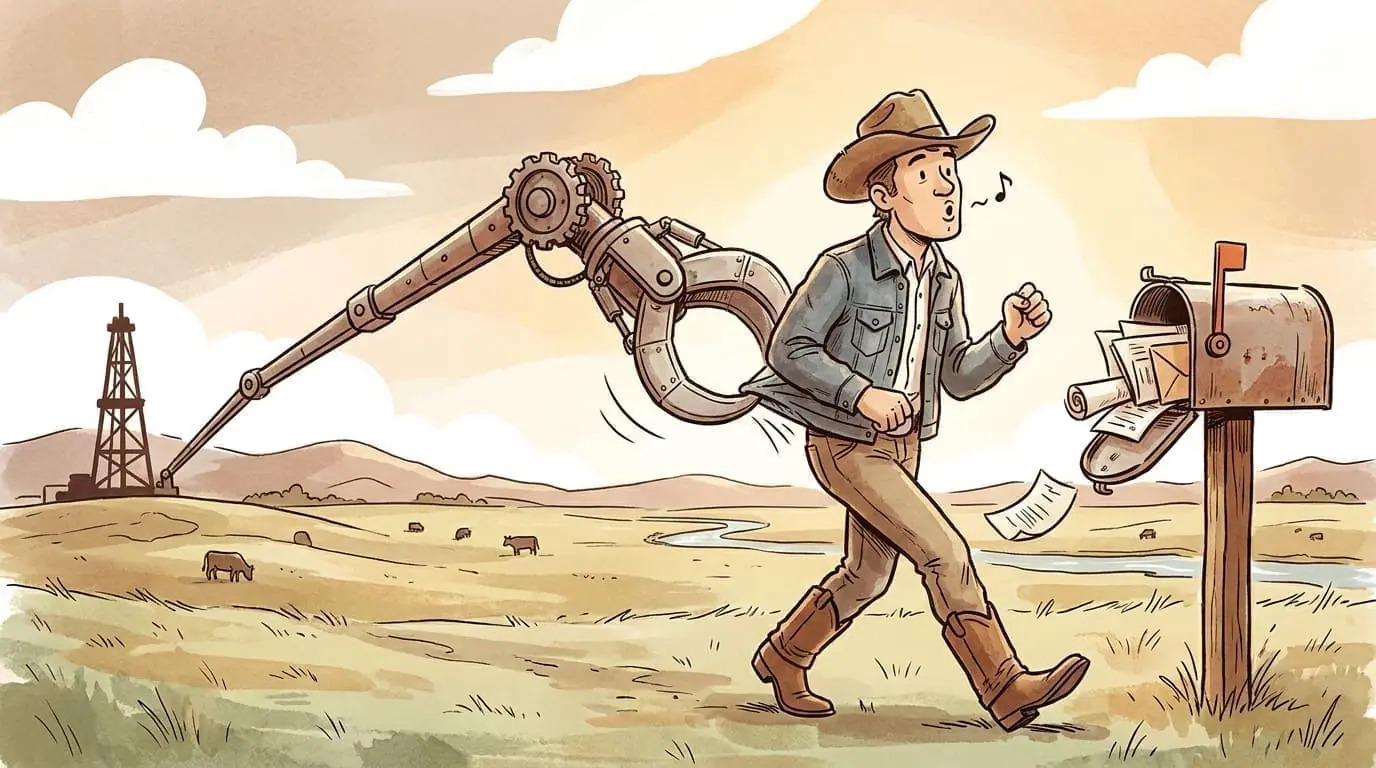
You walk out to the mailbox and find a certified letter. Inside is a thick stack of legal documents from an oil and gas operator you might never have heard of. The packet mentions your family’s land in Roosevelt or Richland County. It uses heavy words like “election,” “non-consent,” and the “Montana Board of Oil and Gas Conservation.”
If you are like most mineral owners, your first instinct is to toss it on the kitchen counter and deal with it later. Maybe you assume that if you don’t sign anything, they can’t touch your minerals. Maybe you think holding out will force the operator to come back with a better lease bonus.
In some states, that logic holds up. In Montana, it is a very expensive mistake.
We talk to families every week who own fractional mineral interests in the eastern Montana Bakken and Three Forks formations. They often believe their silence is a shield. It isn’t. Under Montana law, your silence is simply an election to be heavily penalized.
Let’s break down exactly how Montana handles holdouts, why the rules recently became much stricter, and why you can’t afford to ignore that certified letter.
The Problem with Fragmented Ownership
To understand why the law works the way it does, you have to look at the dirt. Or rather, what is beneath it.
Oil and gas operators do not drill wells randomly. The state requires them to organize land into a :spacing unit. A spacing unit is a designated block of land that one or more wells can efficiently drain without causing physical waste or stepping on the rights of neighboring tracts.
In the early days of vertical drilling, a spacing unit might have been 40 or 80 acres. But modern horizontal drilling in the Bakken is different. Operators drill down two miles, then turn sideways and drill another two miles laterally. Because of this massive footprint, drilling units in the Bakken are typically 1,280 acres, which equals two full square miles of land.
Here is where the math gets messy. We previously wrote about how net and gross minerals actually work, but the short version is that over generations, mineral ownership fractures. A 1,280-acre spacing unit in eastern Montana might have fifty or a hundred different mineral owners. Some own 100 acres. Some own a fraction of a single acre.
If an operator wants to drill a multi-million dollar horizontal well, they need the right to extract the oil from that unit. But requiring them to get a signed lease from every single fractional owner is practically impossible. Someone is always missing. Someone is always holding out. Someone is always tangled up in probate.
If one person owning a tiny fraction of an acre could veto a well, no wells would ever get drilled. To fix this, Montana uses a legal mechanism called involuntary pooling—better known in the industry as :forced pooling.
The 50% Threshold
In Montana, an operator does not need everyone’s permission to drill. They just need a majority.
If the operator can successfully lease or secure agreements from the owners of more than 50% of the mineral interests in a spacing unit, they have the leverage they need. They can take their proposed well to the Montana Board of Oil and Gas Conservation (BOGC) and request a pooling order.
Once the BOGC issues that order, the remaining minority owners are legally swept into the project. The operator is granted the right to extract the oil and gas under your land, regardless of whether you signed a lease.
You are now officially part of the well. But because you didn’t sign a lease, the state decides how you get paid. And the state’s terms are almost certainly worse than what you could have negotiated yourself.
The 200% Penalty Box
When the BOGC issues a pooling order, you are classified as a “non-consenting owner.” This classification triggers a specific financial mechanism designed to protect the operator who is taking all the financial risk to drill the well.
Drilling a Bakken well easily costs $8 million to $10 million. If you own a piece of the unit, you technically owe a piece of that cost. But since you didn’t agree to participate, the operator has to front your share of the money. To compensate them for carrying your financial weight, Montana law allows the operator to assess massive risk penalties against your share of the oil.
Here is exactly how you get paid if you are force-pooled as a non-consenting owner:
First, from the very first barrel of oil produced, you receive a 12.5% (1/8th) royalty on your proportionate share. This is the statutory minimum. It is completely cost-free.
But what happens to the other 87.5% (7/8ths) of your share? The operator keeps it. They withhold that money to pay off the costs you didn’t contribute upfront.
Specifically, they will withhold your revenue until they have recovered:
- 100% of your share of surface equipment costs (tanks, piping, separators) and ongoing monthly operating expenses.
- 200% of your share of the actual drilling, completing, staking, and testing costs.
Yes, 200%. It is a double penalty on the most expensive parts of the operation.
Let’s look at some basic math. Imagine your proportionate share of the drilling and completion costs for a new well is $50,000. Because you are non-consenting, the operator will take $100,000 out of your 7/8ths revenue stream before you ever see full payment.
Given how oil wells decline—producing most of their volume in the first two years and then tapering off heavily—it can take many years for your 7/8ths share to pay off a 200% penalty. In marginal wells, it might never pay out at all. You could be stuck receiving just a 12.5% royalty for the entire life of the well, while your neighbors who negotiated good leases might be receiving 18% or 20%.
The 2023 Rule Changes (The 30-Day Clock)
For a long time, the rules around exactly when an operator had to notify you and how they applied the penalty were a bit loose. That changed recently.
In May 2023, the Montana legislature passed House Bill 289, which completely overhauled the notice requirements for forced pooling. These changes took effect on October 1, 2023.
The new law tightens the trap. If an operator wants to assess that 200% risk penalty against you, they must send you a formal notice via certified mail to your last known address.
This notice is that thick packet we talked about earlier. By law, it must contain specific details about the project: the exact location of the well, the depth, the target formation, the estimated costs to drill and complete it, and the anticipated :spud date.
Most importantly, the notice starts a very rigid 30-day clock.
You have exactly 30 days from the time you receive that notice to make an election in writing. If you throw the packet in a drawer, or if you mean to call them but get busy, the law makes your decision for you. Failure to respond within 30 days means you are legally deemed non-consent. The 200% penalty locks in. The train leaves the station without you.
Your Four Options
When that 30-day pooling election packet arrives, you generally have four paths forward. Some are viable. Some are dangerous.
1. Participate in the Well The packet will offer you the option to become a :working interest owner. This means you agree to pay your full share of the $10 million well out of your own pocket upfront. If your share is $60,000, you write them a check for $60,000. If the well is a dry hole, you lose your money. If the well breaks mechanically, they bill you for the repairs.
We strongly advise families against this. Participating in oil wells is for oil companies and specialized funds that can spread their risk across hundreds of wells. For a family relying on a few acres of inherited minerals, the liability is simply too high.
2. Negotiate a Lease Usually, before they send the pooling packet, the operator or a landman will offer you a lease. Even after the packet arrives, you can sometimes still negotiate lease terms before the BOGC hearing.
Leasing gives you a guaranteed bonus payment upfront and a negotiated royalty rate (hopefully higher than the 12.5% statutory minimum). You take zero financial risk for the drilling costs. If you want to keep the asset in your family for the next generation, this is often the standard path. Just make sure you understand the deductions they are writing into your lease.
3. Do Nothing As we discussed, this is the worst option. You get forced-pooled, penalized 200%, and trapped at a 12.5% royalty while the operator uses your oil to pay themselves back.
4. Sell Your Mineral Rights This is the option many people don’t realize they have right up until the deadline.
When you get a pooling notice, it means a well is imminent. That makes your minerals highly valuable to buyers right at that exact moment. By selling, you trade the future uncertainty of the well (will it be good? will oil prices drop? will it take years to pay out?) for a known lump sum of cash today.
We buy minerals across Texas and the US, and we frequently talk to families who decide that managing leasing negotiations, monitoring well production, and dealing with out-of-state operators is just not a burden they want to carry anymore. Knowing if an offer is fair comes down to doing the math on what the well will likely produce versus what a buyer is willing to pay you today to take on the risk.
The Real Cost of Indecision
Eastern Montana is seeing steady development. Counties like Richland, Roosevelt, Fallon, and Sheridan sit on top of highly productive rock. Operators know exactly what they are doing. They have entire teams of attorneys and landmen whose sole job is to clear title, meet statutory requirements, and get wells drilled efficiently.
They are relying on the fact that you might not understand Montana Code 82-11-202. They know that if they mail out 100 packets, a certain percentage of people will just ignore them. That inaction directly improves the operator’s profit margins on the well.
You owe it to your family not to be part of that percentage.
If you inherit family land or mineral rights, you also inherit the responsibility of managing them. When the certified mail arrives, the clock starts. The decisions you make in those 30 days will dictate how much revenue your family sees for the next twenty years.
If you are holding a pooling packet right now and feeling overwhelmed, take a breath. You have options. Whether you decide to hire an attorney to negotiate a lease, or you decide it is time to sell your mineral rights and exit the situation entirely, the most important thing is that you act deliberately.
Your minerals have real value. Knowing exactly what they are worth is the first step toward making a good decision. Take the time to get a valuation. At the very least, know your options before the state makes them for you.
:spacing-unit
A specific geographic area established by state regulators (like the Montana Board of Oil and Gas Conservation) assigned to a well or group of wells. It prevents operators from drilling too close together and ensures all mineral owners within the boundary are accounted for in the production of the well.
:forced-pooling
A legal process used by state regulatory agencies to compel holdout mineral owners to participate in a drilling unit. It prevents a small minority of owners from blocking the development of a well that the majority of owners have already agreed to.
:spud-date
The exact day an operator begins drilling a new well. In the industry, “spudding” a well means the drill bit has officially hit the dirt and the operational clock has started.
:working-interest
An ownership type where you actually participate in the financial risk of drilling. Unlike royalty owners who get a cost-free percentage of the oil, working interest owners must pay their proportionate share of the millions of dollars it costs to drill and operate the well.