
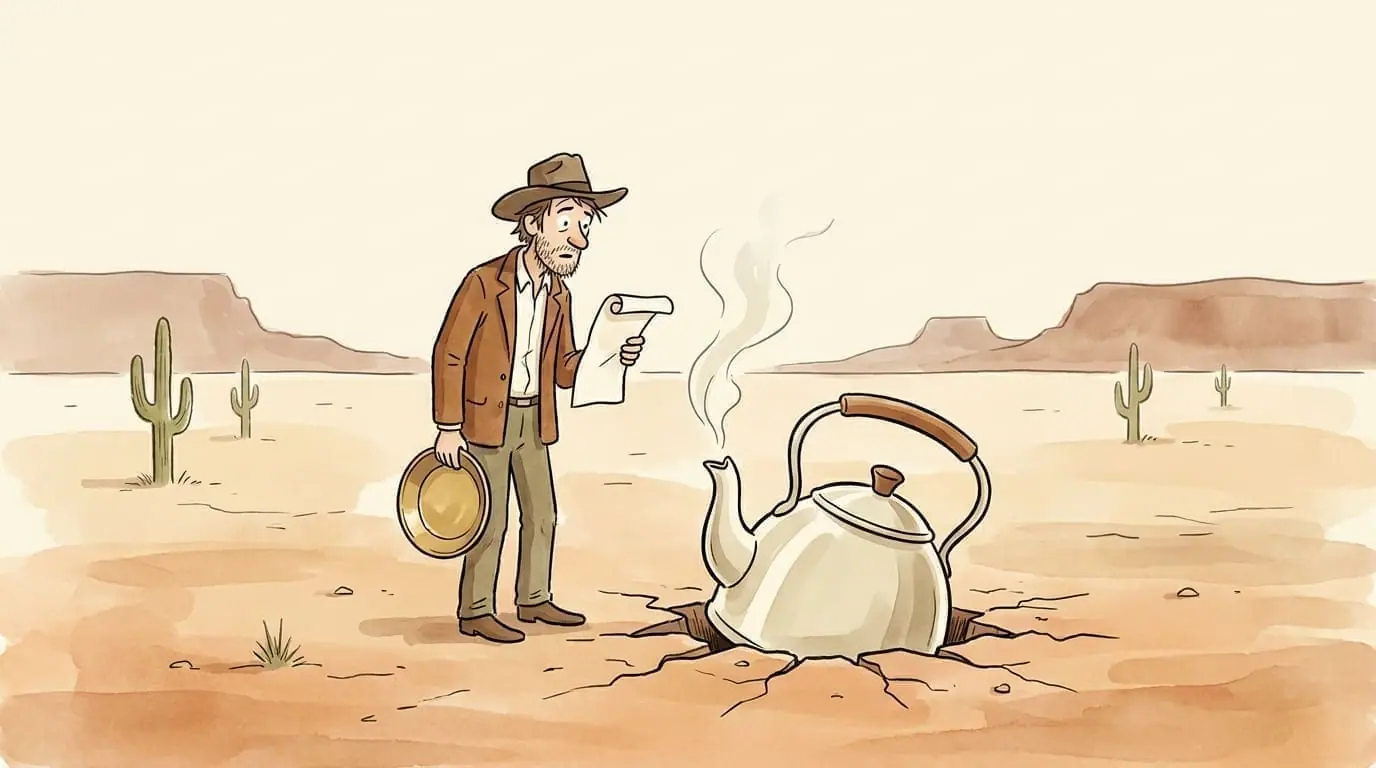
You get a letter in the mail from an energy company. They want to lease your family’s land in Nevada.
Your first thought is probably oil. Maybe gold or silver, considering the state’s mining history. But then you look closer at the paperwork. They aren’t looking for hydrocarbons. They aren’t looking for precious metals.
They are looking for heat.
Geothermal energy is quietly becoming a massive industry in the American West. Nevada is ground zero for this boom. Tech companies need clean, baseload power to run massive data centers, and geothermal plants can provide electricity 24 hours a day, unlike wind or solar.
This sounds like incredible news for families holding old mineral rights in the Nevada desert. But there is a catch. A massive, legally complicated catch that has sparked intense battles over title and ownership.
In Nevada, geothermal resources are not automatically considered “minerals.” The legal rules dictating who owns the heat under the ground are completely different from the rules governing oil, gas, or gold. If your family sold the surface estate decades ago and kept the minerals, you might be holding a piece of paper that gives you absolutely no right to the heat below.
Let’s look at how Nevada handles this bizarre asset class, why older deeds are a ticking time bomb, and what this actually means for your family’s inheritance.
The Problem With Heat
To understand the title trap, you have to understand how the law attempts to classify something you cannot hold in your hand.
Broadly speaking, geothermal energy utilizes the natural heat from the earth. As a recent legal analysis by Davis Graham points out, ownership classification dictates everything. If a developer doesn’t know who owns the resource, they don’t know who to pay.
The federal government classifies geothermal resources as part of the mineral estate. If you are leasing federal land, the heat is a mineral.
Colorado views geothermal resources essentially as water rights. They are administered by the State Engineer.
Nevada does something entirely different.
Under NRS 534A.050, Nevada law is brutally specific: “The owner of real property owns the rights to the underlying geothermal resources unless they have been reserved by or conveyed to another person.”
Nevada treats geothermal energy as an attribute of the surface estate. It belongs to the dirt. It is severable—you can carve it out and sell it separately, just like you would with oil or gas to create a :severed mineral estate. But the default position is that the guy who owns the sagebrush and the dirt also owns the 300-degree heat resting a mile below his boots.
Nevada explicitly defines a geothermal resource as the natural heat of the earth and the energy associated with it, explicitly excluding hydrocarbons and helium.
The 1960s Deed Trap
Here is where the nightmare starts for families.
Let’s say your grandfather owned a ranch in Churchill County back in 1965. He decided to sell the ranch to a neighbor but wanted to keep the subsurface rights just in case somebody ever struck oil.
His attorney drafted a deed that sold the surface but reserved “all oil, gas, coal, and other minerals of every kind and character.”
Grandpa thought he was keeping everything valuable underground. The family has passed this reservation down for three generations. Now, a geothermal developer shows up. Who do they pay?
The surface owner looks at the law and says, “Nevada statute says the surface owner owns the geothermal resource unless specifically reserved. Grandpa didn’t reserve ‘geothermal resources.’ He reserved minerals. Heat is not a mineral. Pay me.”
Your family looks at the deed and says, “Grandpa reserved ‘other minerals of every kind.’ The federal government considers geothermal a mineral. Obviously, he meant to keep the heat. Pay us.”
This exact scenario is playing out across the state. Because geothermal resources weren’t a widely commercialized concept when these older deeds were drafted, the language is horribly ambiguous. Courts are often forced to look at the intent of the parties at the time of the sale. Did a rancher in 1965 contemplate underground steam for electricity generation? Probably not.
If your reservation language does not specifically mention geothermal resources, steam, or heat, you are likely in for a serious title dispute. You might own traditional Producing vs. Non-Producing Minerals, but finding out who owns the heat is a completely different forensic exercise.
Water, Access, and the Developer’s Headache
The complication doesn’t stop at the deed. Extracting geothermal energy is a massive industrial undertaking that requires heavily moving two things: water and equipment.
Even if a court agrees that your family’s old mineral reservation successfully captured the geothermal rights, the developer still has to get the heat out of the ground. They do this by pumping up superheated water, running it through a heat exchanger to spin a turbine, and then pushing that cooled water back into the earth.
This triggers a massive regulatory hurdle regarding water rights. Nevada is the driest state in the nation. Water is guarded fiercely. Generally, using water in Nevada requires an :appropriative right from the state.
However, there is a carve-out that makes modern geothermal development possible. According to OpenEI’s breakdown of Nevada regulations, developers are exempt from standard water appropriation procedures if they operate a closed-loop system. If the water removed from the aquifer is pumped right back into the same reservoir without being consumed, it bypasses the heavy machinery of standard water rights law.
But what if there is a :consumptive use? What if they lose water to evaporation during testing? Then the developer has to deal with the Nevada Division of Water Resources.
Beyond the water, there is the surface footprint. A geothermal plant is not a single pumpjack tucked away in the corner of a pasture. It requires massive drilling rigs, miles of heavy steel piping, cooling towers, power lines, and injection wells.
The developer has to negotiate surface access. If you own the geothermal rights but a hostile farmer owns the surface, the developer is trapped in the middle. The farmer might demand exorbitant compensation to allow the plant on his property. If the surface negotiations fail, your geothermal rights stay stranded underground, completely worthless because nobody can physically reach them.
The Interplay of Different Regimes
You can quickly see how many different parties have their hands in a single Nevada geothermal project.
- The Surface Owner: Controls physical access to the land and likely claims ownership of the heat based on state statute.
- The Mineral Owner: Claims the heat under an old “all other minerals” reservation clause.
- The State Engineer (NDWR): Watches the water like a hawk to ensure the aquifer isn’t being depleted.
- The Division of Minerals (NDOM): Requires drilling permits and regulates the physical wells.
- The Division of Environmental Protection (NDEP): Requires discharge and reinjection permits.
If you are a family holding a partial interest in the subsurface, navigating this is incredibly daunting. You aren’t just waiting for a royalty check in the mail. You are waiting for a developer to successfully herd cats across five different regulatory and legal domains, hoping your specific deed language holds up in a quiet title suit.
We’ve written before about The Invisible Estate: Who Owns the Minerals Under Your Road?, which highlights how easily subsurface rights get lost or misconstrued. Geothermal in Nevada is that problem multiplied by ten.
Figuring Out What You Actually Have
So what do you do if you hold an old mineral deed in a high-activity geothermal area in Nevada?
First, you have to read the actual instrument that severed the surface from the subsurface. You need the exact text. A summary on a tax bill or an old family letter means nothing. You need the recorded deed.
Look for the specific words. Does it say “geothermal”? Does it say “steam”? Does it say “heat”? If it just says “oil, gas, and other minerals,” you need to understand that your ownership of the geothermal resource is highly questionable under Nevada law.
Second, you have to assess the physical reality of the land. Is it near existing transmission lines? Is the surface owner actively farming it, or is it barren desert? A developer will bypass a legally complicated, hostile surface environment and drill somewhere easier. Just because the heat is down there doesn’t mean it will ever be commercialized.
Third, you have to be realistic about the timeline and the cost. Clearing up an ambiguous deed from 1960 usually requires legal action. The developer might initiate a quiet title suit to force a judge to decide who owns the heat. That process can take years. During that time, nobody is getting paid.
Why Families Reconsider
This is the point where a lot of families take a step back.
Inheriting land or mineral rights is supposed to be a blessing. It is supposed to be a legacy. But when that legacy turns into a dense thicket of Nevada water laws, contested deeds, and multi-year holding patterns, the emotional weight gets heavy.
Most people do not want to spend their time fighting with surface owners or parsing the legal differences between a hydrocarbon and a dissolved entrained mineral. They just want to know what their asset is worth and whether it makes sense to keep it.
This is why understanding How Do I Know if a Mineral Offer is Actually Fair? is so important. Valuing a contested geothermal right is incredibly complex. The math involves discounting the risk of a title failure, estimating the massive capital expenditures required to build a power plant, and projecting electricity prices decades into the future.
For some families, holding on and fighting the legal battles makes sense. They have the resources, the patience, and the risk tolerance to wait out the developers and the surface owners.
For others, the uncertainty is simply too much. They look at the tangled web of ownership, the ambiguous deed from their grandfather, and the massive industrial footprint required to make a dime, and they realize they would rather not participate in the gamble.
There are buyers in the market who specialize in taking on exactly this kind of title risk. They buy the ambiguous deeds, they fund the quiet title lawsuits, and they negotiate with the surface owners. They take on the headache so the family doesn’t have to.
If you are sitting on an old Nevada mineral reservation and the letters about geothermal leasing are starting to arrive, do not assume you have hit the jackpot. Do not assume your deed is bulletproof.
Take a breath. Pull the paperwork. Look at the actual facts of Nevada law. Getting a clear, honest valuation of what you own—and what it might cost to defend it—is the only way to make an informed decision. Having options is the best position to be in. It is always worth a conversation to at least know where you stand.
:severed-mineral-estate
A legal situation where the ownership of the underground resources (minerals, and potentially heat) has been separated from the ownership of the surface land. The two estates are owned by different people and can be sold or leased independently.
:appropriative-right
A legal framework used heavily in Western states where water rights are granted based on a “first in time, first in right” basis. You must apply to the state to use the water for a specific, beneficial purpose.
:consumptive-use
Any use of water that removes it from the available supply without returning it. In geothermal, if water flashes to steam and evaporates, that is consumptive. If it is 100% pumped back into the exact same underground aquifer, it is non-consumptive.