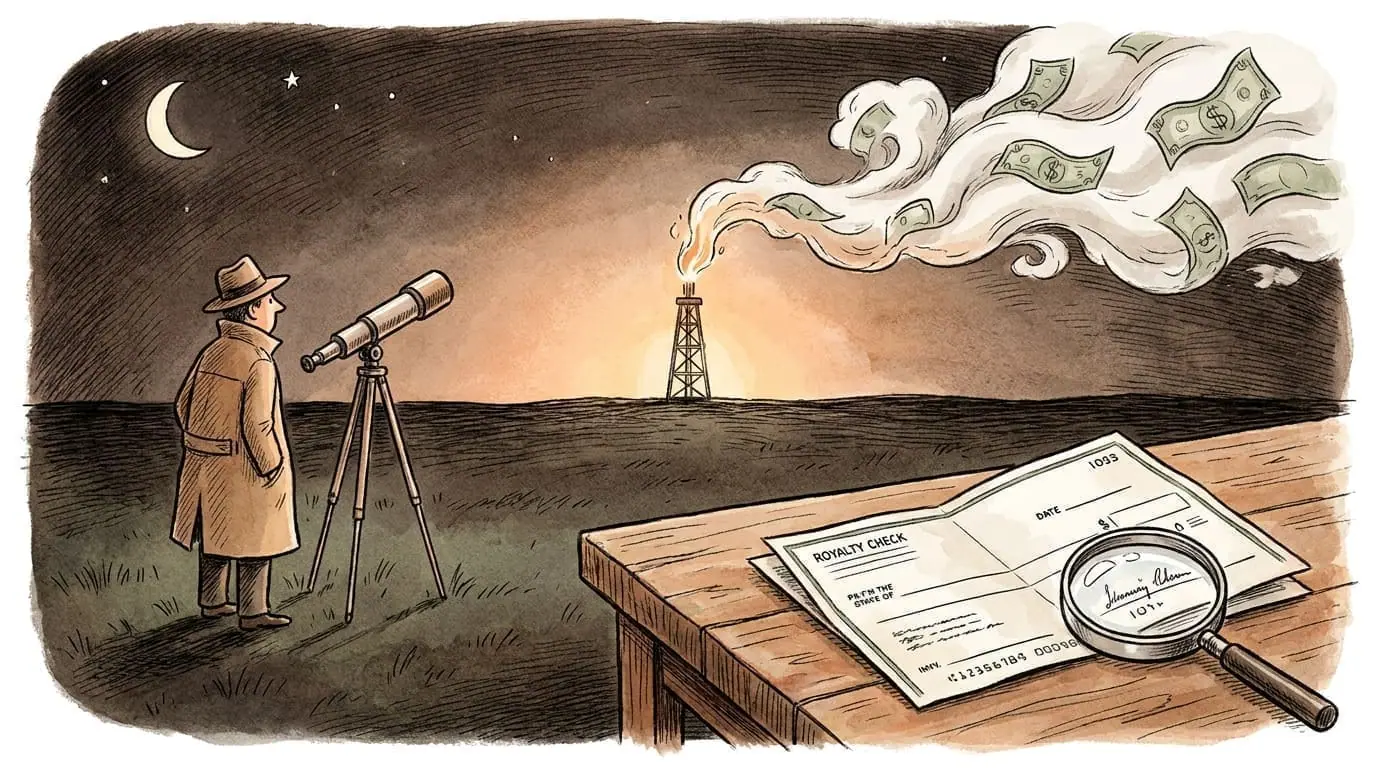
I remember looking at nighttime satellite photos of the United States back in 2013. You could clearly see the bright, sprawling grid of Chicago. You could see New York and the Eastern seaboard. And then, right in the middle of the dark, unpopulated plains of western North Dakota, there was a massive, glowing cluster of light that rivaled a major metropolitan city.
That wasn’t streetlights. That was the Bakken bonfire.
Thousands of oil wells were burning off natural gas right at the wellhead. It was a staggering visual of America’s shale boom. But for the families who owned the mineral rights under those wells, that light wasn’t a symbol of progress. It was their money going up in smoke.
We talk to mineral owners every week who own rights in North Dakota. Many of them inherited these tracts from parents or grandparents who homesteaded the land. They get their royalty checks, they see the oil volumes, and they are usually happy. But when we start looking at the gas column on their statements, things get murky. Sometimes the gas volume is zero. Sometimes it pays a fraction of what the well is actually producing.
When they ask us why, the conversation almost always leads to :flaring.
If you own minerals in the Williston Basin, you need to understand exactly what your operator is doing with your gas, what the state laws require them to do, and whether you are legally owed money for the hydrocarbons they burn.
Why Do They Burn the Gas in the First Place?
To understand the problem, you have to look at the math that drives an oil company.
Operators drill in the Bakken to find oil. Oil is dense, valuable, and easy to throw into a truck or a railcar if a pipeline isn’t handy. But when they pump that oil to the surface, natural gas comes up with it. This is called :associated gas.
Unlike oil, you cannot put natural gas in a truck. It requires a highly pressurized, continuous network of gathering lines to move it from the wellhead to a processing plant. Back in the early 2010s, the drilling happened so fast that the pipeline companies simply couldn’t keep up. The pipes didn’t exist.
So, the operators faced a choice. They could shut the well in and wait years for a pipeline to be built, losing out on millions of dollars of $80-a-barrel oil. Or, they could produce the oil, separate the gas at the surface, light a match, and burn the gas away.
They chose the match.
According to the U.S. Energy Information Administration (EIA), in 2013, more than 30% of all the natural gas produced in North Dakota was flared. That is an astronomical amount of wasted energy and lost royalty revenue.
The Law: Do They Have to Pay You for Flared Gas?
This is where the fine print of North Dakota law comes into play. Mineral owners often assume that if gas comes out of their ground, they get paid for it, regardless of what the operator does with it.
That is not entirely true.
Under North Dakota Century Code Title 38, the state acknowledges that some flaring is necessary. When a well is first completed, operators need to test the flow rates and clear out debris. During this initial period, they are legally allowed to flare the gas without paying royalties on it.
Historically, this royalty-free grace period lasted for the first year of production. After 12 months, the law stated that the operator had to cap the well, connect it to a gas line, or start paying royalties on the flared gas.
But there was a massive loophole. An operator could go to the North Dakota Industrial Commission (NDIC) and request an exemption. They would argue that building a pipeline to the well was “economically infeasible.” For years, the state rubber-stamped these exemptions because they didn’t want to choke off the oil boom. Operators kept pumping oil, they kept burning the gas, and mineral owners received nothing for it.
Eventually, the public and political pressure became too much. The waste was just too visible.
The Crackdown and the Capture Targets
In 2014, the NDIC decided to step in. They issued Order 24665, which established strict gas capture targets for the industry.
Instead of dealing with endless individual exemptions, the state drew a line in the sand. They required operators to capture a certain percentage of their gas, or face severe restrictions on their lucrative oil production. Over the years, that target slowly tightened. The state’s goal eventually hit a mandate to capture 91% of all gas produced.
The industry had to respond. And they did, by pouring billions of dollars into midstream infrastructure. They built gathering lines. More importantly, they built the massive processing plants required to strip the impurities and heavy natural gas liquids (NGLs) out of the raw gas.
You can’t just pump raw Bakken gas into an interstate pipeline to heat homes in Chicago. You have to strip out the ethane, propane, and butane first through a process called :fractionation. As the EIA noted, pipeline capacity to move these liquids out of North Dakota grew from a measly 60,000 barrels per day in 2013 to over 580,000 barrels per day by late 2021. Gas processing capacity jumped from 1 billion cubic feet per day to nearly 4 billion.
Because of this massive buildout, operators are finally hitting their targets. By late 2021, the state’s operators were capturing 92.5% of the gas they produced, reducing flaring to an average of just 7.5%.
So, Are You Being Paid Now?
If flaring has dropped to 7.5%, your gas royalty checks should be looking pretty healthy right now. But what about that remaining 7.5%? It sounds like a small number, but across the entire state, that is hundreds of millions of cubic feet of gas burning every single day.
Is your gas part of that 7.5%? And if it is, are you owed money?
Here is the hard truth: finding out is incredibly difficult for the average family.
If you look at how to read your royalty statement, you will rarely see a line item that says “Flared Gas.” Operators don’t make it easy. If they are flaring gas during a permitted exemption period, that volume simply vanishes from your accounting.
To find out if you are being shorted, you have to do some detective work. You have to go to the NDIC website, pull the public production data for your specific well, and look at the total MCF (thousand cubic feet) of gas produced in a given month. Then, you have to compare that state record to the gross volume listed on your royalty check.
If the state says the well produced 10,000 MCF, but your check only pays you on 6,000 MCF, you have a 4,000 MCF gap.
Then you have to figure out why. Is the well less than a year old? Does the operator have a valid, active exemption from the NDIC? Or are they flaring gas past their legal grace period and just “forgetting” to pay you the royalties?
We have seen cases where operators quietly flared gas for years past the deadline, assuming the fragmented family owners living three states away would never bother to check the state database. And honestly, they are usually right.
This behavior is exactly why the state recently passed legislation making bad royalty statements a class B misdemeanor. The burden of transparency has historically been placed entirely on the shoulders of the mineral owner.
What This Means for Your Family’s Asset
We deal with Bakken minerals constantly. It is an area we know well, and it’s a basin that has matured significantly. We wrote about the transition to Quiet Money in a Mature Basin because the wild west days of 2013 are largely behind us.
But that maturity changes how these assets are valued.
Five or ten years ago, when a buyer evaluated a mineral tract in North Dakota, they assigned almost zero value to the natural gas. The assumption was that it would either be flared or the deductions taken by the midstream companies would eat up the entire check. The asset was valued almost exclusively on its oil potential.
Today, that math is different. With 92.5% of the gas being captured and processed, natural gas and natural gas liquids (NGLs) represent a real, tangible revenue stream for Bakken mineral owners. When we run valuations on these properties now, the gas component absolutely factors into the purchase price.
If you are a family holding onto North Dakota minerals, this is a good thing. Your asset is likely generating a more diversified income stream than it was a decade ago.
But it also introduces a level of complexity that you have to actively manage. You can no longer just glance at the oil price on the evening news and assume your check is correct. You have to monitor the gas capture, watch out for sneaky processing deductions, and make sure you aren’t paying the operator’s bill for that massive new pipeline network they built to meet the state’s targets.
Having Options Brings Peace of Mind
Managing inherited mineral rights is a heavy responsibility, especially when the rules feel tilted in the operator’s favor. You didn’t ask to become an oil and gas auditor. You just want to make sure your family’s land is being treated fairly.
Sometimes, the effort required to police an operator—auditing check stubs, filing inquiries with the NDIC, fighting over flared volumes—just isn’t worth the emotional or financial toll. For some families, holding the asset makes perfect sense. They have the time and the interest to manage it.
For others, the realization that they have to monitor satellite data and state regulatory codes just to ensure they aren’t being shortchanged is the moment they decide to explore a sale.
There is no single right answer. It depends entirely on your family’s situation, your financial goals, and your willingness to manage a complex, highly regulated asset.
But you cannot make a good decision in the dark. You shouldn’t have to guess if your gas is being burned, and you shouldn’t have to guess what your minerals are actually worth on the open market.
There are buyers out there who understand this basin deeply. They know how to value the oil, they know how to value the gas, and they know how to structure a deal that takes the headache off your plate while providing life-changing capital for your family.
Whether you decide to hold your minerals for the next generation or you think it might be time to simplify your life, the first step is always knowing what you own and what it is worth. It is always worth a conversation. At the very least, you owe it to yourself to know your options.
:associated-gas
Natural gas that is produced as a byproduct of drilling for crude oil. Because the operator’s primary goal is the oil, this gas is often viewed as a logistical hurdle rather than a primary asset, which historically led to high rates of it being burned off.
:flaring
The practice of burning off natural gas at the wellhead. Operators do this when they lack the pipeline infrastructure to transport the gas to a processing facility. While some flaring is necessary for safety and testing, chronic flaring represents wasted energy and lost royalty revenue.
:fractionation
The physical process of cooling and separating raw, “wet” natural gas into its individual distinct components, such as ethane, propane, and butane. These separated liquids (NGLs) have their own specific markets and prices, and must be removed before the remaining dry gas (methane) can be shipped to homes and businesses.