
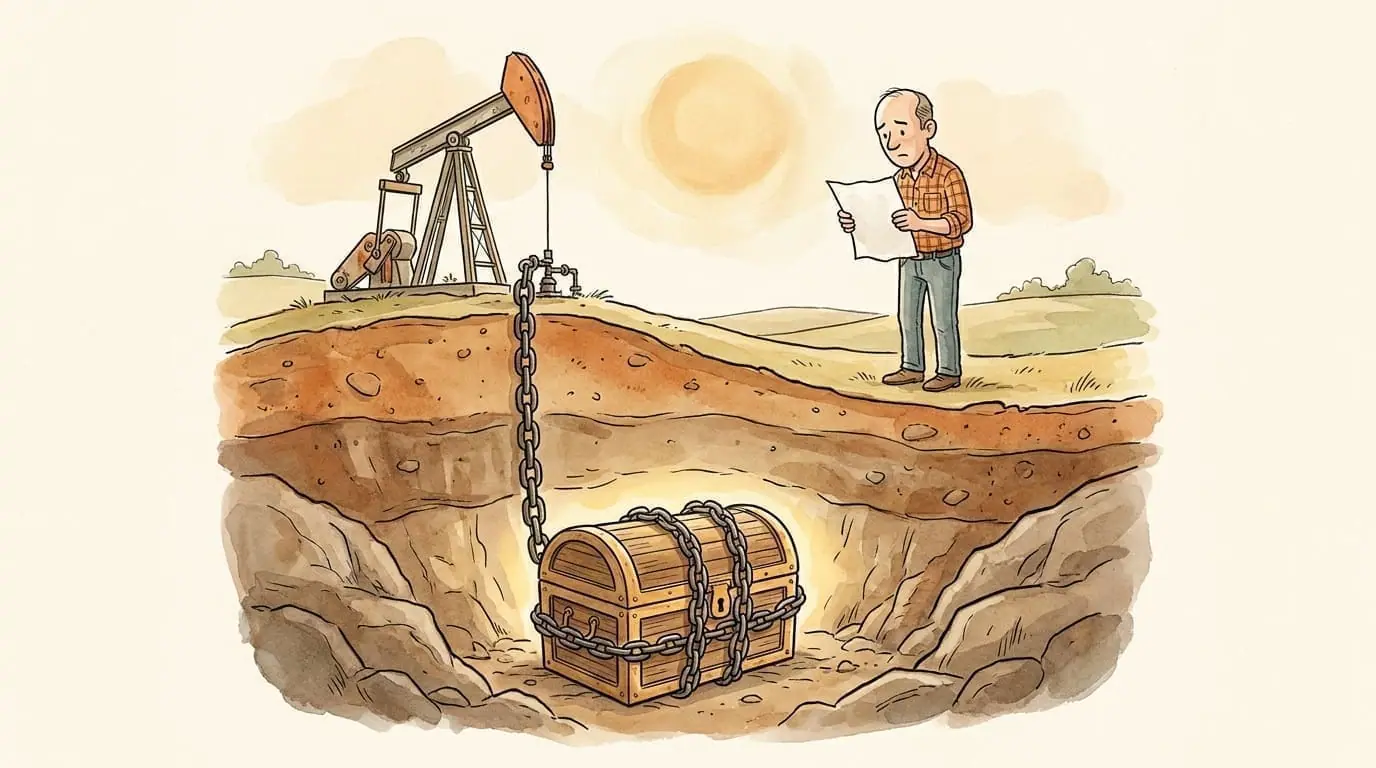
We sit across the table from families all the time who think they just hit the lottery. They own minerals in Oklahoma. Out of nowhere, a landman calls and offers a massive signing bonus to lease their deep rights in the Woodford or SCOOP/STACK plays. The family knows they have an old lease from the 1970s, but it is barely pumping a few barrels a week from a shallow formation. They assume the deep rock is free and clear.
They sign the paperwork. They wait for the check.
Then the landman calls back. The deal is off. That old, barely producing shallow well is part of a 1990s secondary recovery unit. Because of how Oklahoma law works, that old unit is holding every inch of dirt and rock under the property, all the way down to the center of the earth. The deep rights are locked up, and the family gets nothing.
This is a massive headache for Oklahoma mineral owners. It feels entirely unfair. You have valuable rock a mile underground that a modern operator wants to drill, but you are blocked by a guy pumping a few barrels of water and oil near the surface.
We buy minerals. We evaluate these exact titles every week. We see the frustration firsthand. We want to break down exactly how this happens, the specific Oklahoma laws that allow it, and the steps you can actually take if you find yourself stuck behind a statutory wall.
The Problem Starts With Secondary Recovery
To understand the trap, you have to understand how oilfields age. When an operator drills a conventional well, natural pressure pushes the oil up. Eventually, that pressure drops. The oil is still down there, but it needs help getting out.
Operators then turn to :secondary recovery. The most common method is a waterflood. They take some of the older wells and inject water down into the formation. This repressurizes the rock and sweeps the remaining oil toward the producing wells.
Because you cannot control where water goes underground, an operator cannot just waterflood their own 40-acre lease. The water crosses property lines. To make it work, the operator has to combine a bunch of individual leases into one massive, field-wide operation.
Under Oklahoma Statutes § 52-287.3, the state allows this. The Oklahoma Corporation Commission (OCC) has the statutory authority to order unitized operations when waterflooding or pressure maintenance is reasonably necessary and likely to recover substantially more oil. This process fundamentally adjusts the rights of royalty owners, overriding royalty owners, and lessees. The OCC replaces traditional tract-by-tract property lines with a master unitization plan.
How Production and Royalties Get Sliced
When the OCC approves a waterflood unit, your individual lease accounting changes.
Under Oklahoma Statutes § 52-287.4, the unitization plan dictates how production is allocated. You no longer get paid based strictly on the oil pumped from the well on your specific property. Instead, the entire unit is given a production total, and each tract of land gets a specific participation factor. That factor is based on the relative contribution your tract is expected to make to the whole operation.
This statute also contains a very specific limitation that causes all the confusion. A statutory unit is restricted to all or part of a single common source of supply.
That means the OCC order establishing the unit usually only covers the specific shallow formation being waterflooded, like the Oswego Limestone. It does not unitize the deep Woodford shale. It just handles the shallow dirt.
Naturally, a mineral owner reads that and thinks, “Great. The unit is only for the shallow zone. My deep rights are free.”
Unfortunately, that is not how the law applies it. This is where the zombie lease problem kicks in.
The 63% Threshold: You Do Not Have to Agree
Many mineral owners are shocked to learn their land is in a waterflood unit because they never signed an agreement.
A unitization plan does not require unanimous consent. Oklahoma law generally requires written approval from lessees controlling at least 63% of the unit area and royalty owners controlling at least 63% of the normal one-eighth royalty interest.
Once both of those separate thresholds are met, and the OCC enters the necessary findings, the plan can bind nonconsenting interests within the unit. If the majority agrees, the state forces the remaining 37% into the project. If you inherited your minerals decades after this happened, the only record might be a dense OCC order buried in county records.
We see this catch people off guard constantly, very similar to how Oklahoma pooling orders force decisions on owners who do not respond to mail. The state acts, the unit forms, and the clock starts ticking on your rights.
The Legal Wall: Stephens Production Co. v. Tripco
If the statutory unit is legally restricted to the shallow zone, why are your deep rights locked up? The answer lies in how Oklahoma courts interpret old leases alongside new unitization orders.
Mineral owners usually rely on a statutory Pugh clause. A Pugh clause generally says that if an operator establishes a spacing unit, any acreage or depths outside that specific unit are eventually released from the lease.
But secondary recovery units are different.
The most important case on this topic is Stephens Production Co. v. Tripco, Inc.. In that case, Tripco owned an old 1996 lease. Later, Stephens Production and another company took new leases on the same land, believing Tripco’s rights outside a specific Northwest Lawrie Oswego Unit (a secondary recovery unit) had expired. Stephens wanted to drill new horizontal wells and tried to quiet title against Tripco.
The Oklahoma Court of Civil Appeals shut Stephens down. The court ruled that Oklahoma’s statutory Pugh clause governing standard spacing units did not apply to the secondary recovery unit at issue.
Because the statutory Pugh clause did not apply, production from the secondary recovery unit continued to hold the entire older lease under its :habendum clause. The old lease defeated the new leases.
This ruling is the strongest authority for the “wall” mineral owners face today. An old secondary recovery unit can preserve a legacy lease entirely, even though the tract owner strongly believes unused acreage or deeper formations should be released. The shallow waterflood production is technically lease production, and lease production holds the lease.
Does the State Erase Your Lease?
When owners figure this out, they often think the state simply voided their original lease contract. That is not entirely true, and the nuance matters if you want to fight back.
The OCC order does not erase the written lease, but it can modify and communitize important legal rights concerning operations, production allocation and payment. The original lease continues to matter, particularly for royalty rates, habendum language and any negotiated depth clauses.
A secondary-recovery unit is ordinarily confined to a particular common source of supply. But unless the lease contains an effective :depth severance provision, production attributable to the lease may continue the lease as a whole, including rights in deeper formations that are not part of the waterflood unit.
The result depends completely on the original lease language, the specific unit plan, the OCC orders, and your chain of title. Oklahoma decisions clearly recognize that state unitization proceedings can alter existing legal rights, but your contractual obligations continue alongside the regulatory order. If your great-grandfather was shrewd enough to write a strict depth severance into his 1975 lease, the waterflood might not hold the deep rock. If he signed a standard boilerplate form, you are likely locked up.
Finding Your Leverage
When you hit this wall, it feels like the operator holds all the cards. They have a unit holding the deep rights, they are spending almost zero money to keep the waterflood running, and they refuse to release the deep zones just in case they want to drill them a decade from now.
You do not have zero leverage. But you do have to work for it.
First, investigate your own minerals. Do not just take a landman’s word for it when they say a waterflood is blocking your deal. You can search the Oklahoma Corporation Commission Water Flood Unit Records online. You can look up your county, locate the specific unit, and read the actual order that established it. Knowing the facts is your first line of defense.
Second, you can pursue negotiated assignments, farmouts, subleases or depth releases with the existing leasehold owner. You do not necessarily have to hire a litigation team to force anything. Often, if a modern operator wants to drill a deep horizontal well, they will approach the old shallow operator and negotiate a farmout. This allows the new operator to drill the deep well while the old operator takes a cut, and you finally get a royalty check on the new production.
Third, you can investigate whether the lease is actually producing in paying quantities. Oklahoma law requires a lease to be profitable to the operator, not just pumping a trickle of oil to hold the acreage. You can look into whether the operator has complied with accounting duties or if the original unit plan has termination provisions. Cancelling a lease in Oklahoma court over paying quantities is incredibly difficult and fact-specific, but the threat of an audit sometimes brings an operator to the negotiating table.
Making a Clear Decision
Dealing with legacy waterflood units is exhausting. You are fighting decades-old legal precedents, 1970s lease language, and operators who have no incentive to move quickly.
We have watched families spend years and tens of thousands of dollars in legal fees trying to break a legacy lease, only to lose because the Tripco precedent is so firmly established. We have also seen families successfully negotiate farmouts that lead to incredible new wells.
It depends heavily on the specific math of your tract.
If you are dealing with this exact situation, the most practical thing you can do is get a clear, factual picture of what you actually own and what it is worth today. Knowing the true valuation of your minerals, with all the legal baggage attached, gives you options.
Sometimes, passing that legal headache to a buyer who has the capital and time to fight the operator is the most logical financial decision a family can make. Other times, it makes sense to hold on and wait for the shallow operator to eventually plug the unit.
Selling is a permanent decision, and keeping your family land is a big deal. We respect that deeply. But peace of mind comes from knowing you looked at the real numbers and the real laws before making a choice. If you are tired of the runaround and just want to know what your Oklahoma minerals are worth today, it is at least worth a conversation.
:secondary-recovery
A process used after natural pressure in an oil reservoir drops. Operators inject water or gas into the formation to sweep remaining oil toward producing wells. It requires combining multiple leases into a single unit to manage the underground flow.
:habendum-clause
The section of an oil and gas lease that dictates how long the lease lasts. It usually specifies a primary term (e.g., three years) and a secondary term that continues “as long thereafter as oil or gas is produced.”
:depth-severance
A specific clause written into an oil and gas lease that separates shallow rights from deep rights. It forces the operator to release deep formations back to the mineral owner if they only drill and produce from a shallow zone.