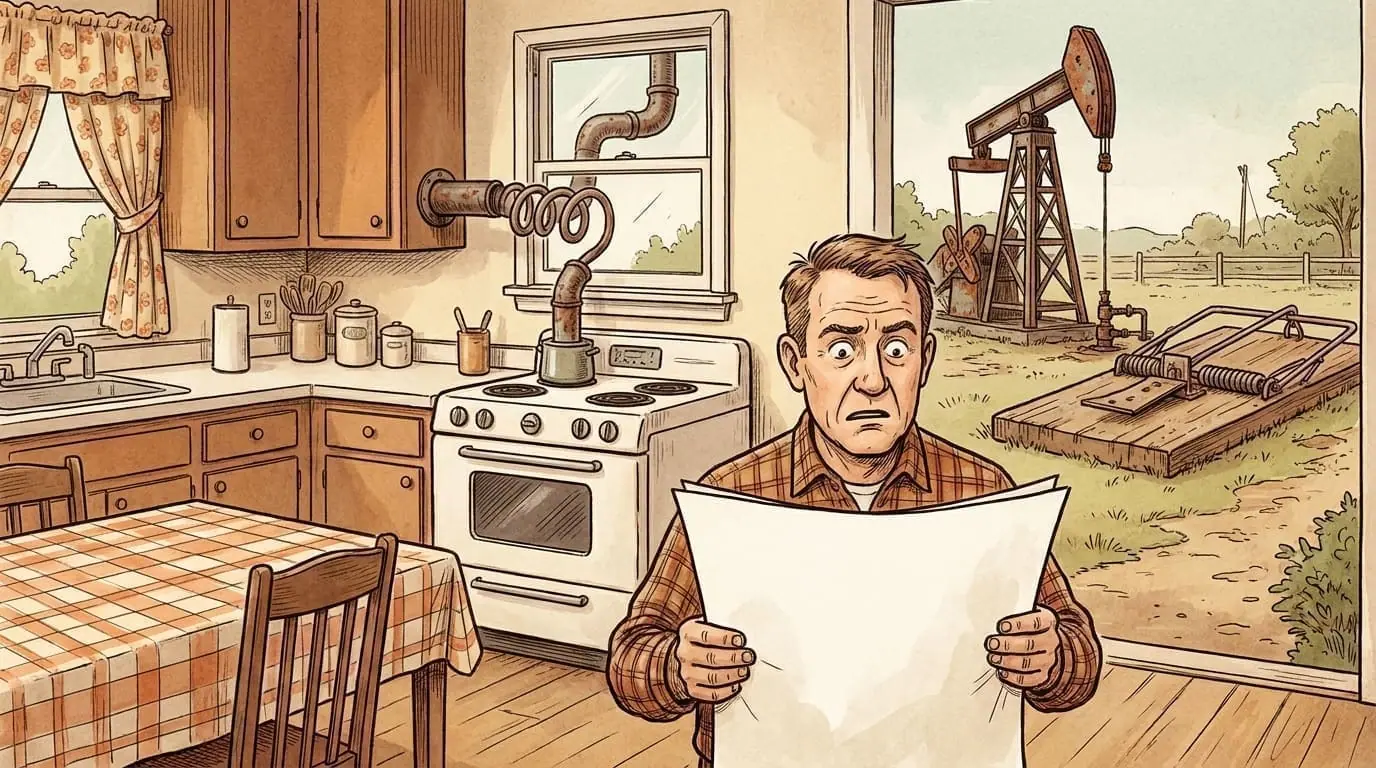
There is a specific kind of pride that comes with a free gas clause. Across the Texas Panhandle and East Texas, thousands of families hold legacy leases negotiated by their parents or grandparents back in the 1950s and 60s. When landmen sat at kitchen tables drafting those agreements, they often threw in a seemingly harmless perk. The landowner was allowed to pipe raw natural gas directly from the wellhead to heat their farmhouse.
It felt like a victory. It was a tangible benefit of owning the land and the minerals below it. For decades, families have used that gas to run heaters, power stoves, and keep the farm running through cold Texas winters.
But oil and gas wells do not live forever.
Right now, many of those older vertical wells are hitting terminal decline. They produce a tiny trickle of gas and a massive amount of saltwater. They barely pay for the electricity required to run the pump jack. The energy companies that own these wells look at their spreadsheets and see a red number. They know the end is near.
When a well stops producing in paying quantities, the operator faces a mathematical reality. They have to clean up the site. This process is called :plugging and abandonment. It is expensive, it is highly regulated, and companies actively try to avoid paying for it.
We see hundreds of deals and review thousands of leases here at Double Fraction. Over the last few years, we have watched operators execute a ruthless legal maneuver to shed these costs. They are weaponizing that beloved free gas clause to dump massive environmental liabilities onto unsuspecting families.
Let’s walk through exactly how this trap works, the staggering costs involved, and how you can protect your family from turning a generational asset into a devastating debt.
The Real Cost of a Dying Well
To understand why an operator wants to get rid of a dying well, you have to look at the math. People often assume that capping a well just means pouring some concrete down a hole and driving away. The reality is far more complicated.
Properly plugging a well involves bringing in a specialized rig. The crew has to pull the old steel casing out of the ground. They have to pump heavy cement into specific zones to protect the groundwater. They have to cut the wellhead off below the plow line and fully restore the surface of the land.
According to a comprehensive study by Resources for the Future, the median cost to plug and reclaim an abandoned well is about $76,000.
That is just the median. The numbers get worse depending on the specific well. The same study found that natural gas wells are 9 percent more expensive to plug than oil wells. Depth also plays a massive role. Each additional 1,000 feet of well depth increases the plugging cost by 20 percent. If your family has an old gas well drilled to 8,000 feet, the cleanup bill can easily exceed $100,000.
You can read more about how operators hold onto older leases to delay these costs in our guide on the zombie lease problem. The short version is simple. The operator wants that liability off their books.
The Phone Call
The trap almost always starts with a phone call or a friendly letter.
A representative from the operating company reaches out to the landowner. The conversation usually sounds like they are doing you a favor. They explain that the old well out in the pasture is no longer economic. They tell you they are preparing to shut it in and plug it.
Then comes the pivot.
They mention that they know you rely on the well for your free heating gas. They say they hate to leave you in the cold. So they offer a solution. Instead of plugging the well and cutting off your gas supply, they offer to just give the well to you. They will sign over the rights. You get to keep your free gas forever, and they will walk away.
To a farmer looking at a winter heating bill, this sounds like a win. You get a free well. You keep your heat. All you have to do is sign a few documents to make it official.
Do not sign those documents.
The Difference Between a Perk and a Liability
We need to clear up a massive misconception right now. Having a free gas clause in your lease does not make you responsible for the well. Simply receiving the gas does not transfer the environmental liability to you.
The danger is not the lease your grandfather signed in 1956. The danger is the paperwork the operator is asking you to sign today.
As the Texas Real Estate Research Center notes in their guidance on lease negotiations, the original lease outlines the privileges and obligations of both parties. Your privilege was the gas. The operator’s obligation was the well.
The operator cannot legally force you to take over the plugging liability just because you use the gas. That is why they need your signature. They need you to voluntarily accept the transfer.
The document they slide across the table is usually a Texas Railroad Commission :Form P-4.
If you read the official RRC instructions for this form, you will see its true purpose. It is a Certificate of Compliance and Transportation Authority. More importantly, it is the state’s official mechanism for transferring operatorship from one party to another.
When you sign a Form P-4 as the receiving operator, you are telling the State of Texas that you are now the legal owner of that wellbore. You are accepting the :working interest. You are no longer just a landowner receiving a royalty or a free perk. You are an oil and gas operator.
With a single signature, you just adopted a $76,000 liability.
The Aftermath of the Trap
We have spoken with families who fell for this maneuver. The stories are heartbreaking.
At first, everything seems fine. The operator leaves. The farmhouse stays warm. The family feels like they secured a permanent resource. But the well is still dying. A few years later, the pressure drops too low to even push gas to the house. The well goes completely dead.
Eventually, the Texas Railroad Commission conducts an inspection. They find an inactive, unplugged well. They look up the operator of record. The corporate name is gone. Your family’s name is on the file.
The state sends a notice requiring the well to be plugged. You call plugging contractors and start getting bids. That is when the reality sets in. The bill is $85,000. The operator who made the millions of dollars off the well over the last fifty years is gone. You are left holding the bag. We have seen families forced to drain their retirement savings or sell off surface acreage just to pay an environmental cleanup crew.
A generational asset turned into a financial nightmare overnight.
What You Should Do
If you have an old well on your property and you receive free gas, you need to understand exactly where you stand.
First, know your rights. You have zero obligation to take over operatorship of a well. If the operator wants to plug it, let them plug it. Yes, you will lose your free gas. You will have to install a propane tank or connect to a local utility. That transition will cost you a few thousand dollars. That is infinitely better than taking on an $80,000 plugging liability.
Second, never sign a Form P-4, an assignment of working interest, or a bill of sale for wellhead equipment without having an oil and gas attorney review it. Operators will dress these documents up to look like routine administrative paperwork. They are not. They are a transfer of financial risk.
If you are curious about what happens when wells reach the end of their life cycle, we recommend reading our guide on what happens to your royalties when the well depletes. It gives you a roadmap of what to expect as production winds down.
Knowing Your Options
Situations like this highlight the heavy burden that comes with inheriting and managing mineral rights.
We talk to landowners every day who feel overwhelmed by the paperwork, the legal threats, and the constant vigilance required to deal with oil companies. Keeping a family asset shouldn’t feel like a part-time job or a full-time worry. The emotional weight of holding onto a legacy property is real. We respect that deeply.
But sometimes, the best way to protect your family is to step out of the game before the liabilities hit.
Many families do not realize that they can sell their mineral rights while the wells are still active, completely removing themselves from future legal traps. When you sell to an experienced buyer, you transfer the entire asset. You take your capital upfront. The buyer takes on the burden of tracking the production, auditing the checks, and dealing with operators trying to pull fast ones.
You trade uncertainty for peace of mind.
You might decide to hold onto your minerals forever. That is a completely valid choice. But making that choice requires knowing exactly what you own, what it is worth, and what risks are hiding in the fine print.
Getting a professional valuation costs you nothing. Understanding the true market value of your minerals simply gives you leverage. It gives you options. Whether you want to navigate the complexities of legacy leases yourself or let someone else take the reins, knowing where you stand is always worth a conversation.
:form-p-4
The Texas Railroad Commission’s official form for designating an operator or transferring operatorship of an oil or gas well. Signing this form as the receiver legally transfers the regulatory responsibility and plugging liability of the well to you.
:working-interest
The ownership stake in an oil and gas lease that grants the right to explore, drill, and produce. Unlike a royalty interest, a working interest owner is responsible for paying all the costs of drilling, operating, and eventually plugging the well.
:plugging-and-abandonment
The highly regulated process of safely closing a depleted well. It requires heavy equipment to pull casing, pump cement into the wellbore to protect groundwater, and restore the surface land to its original condition.