
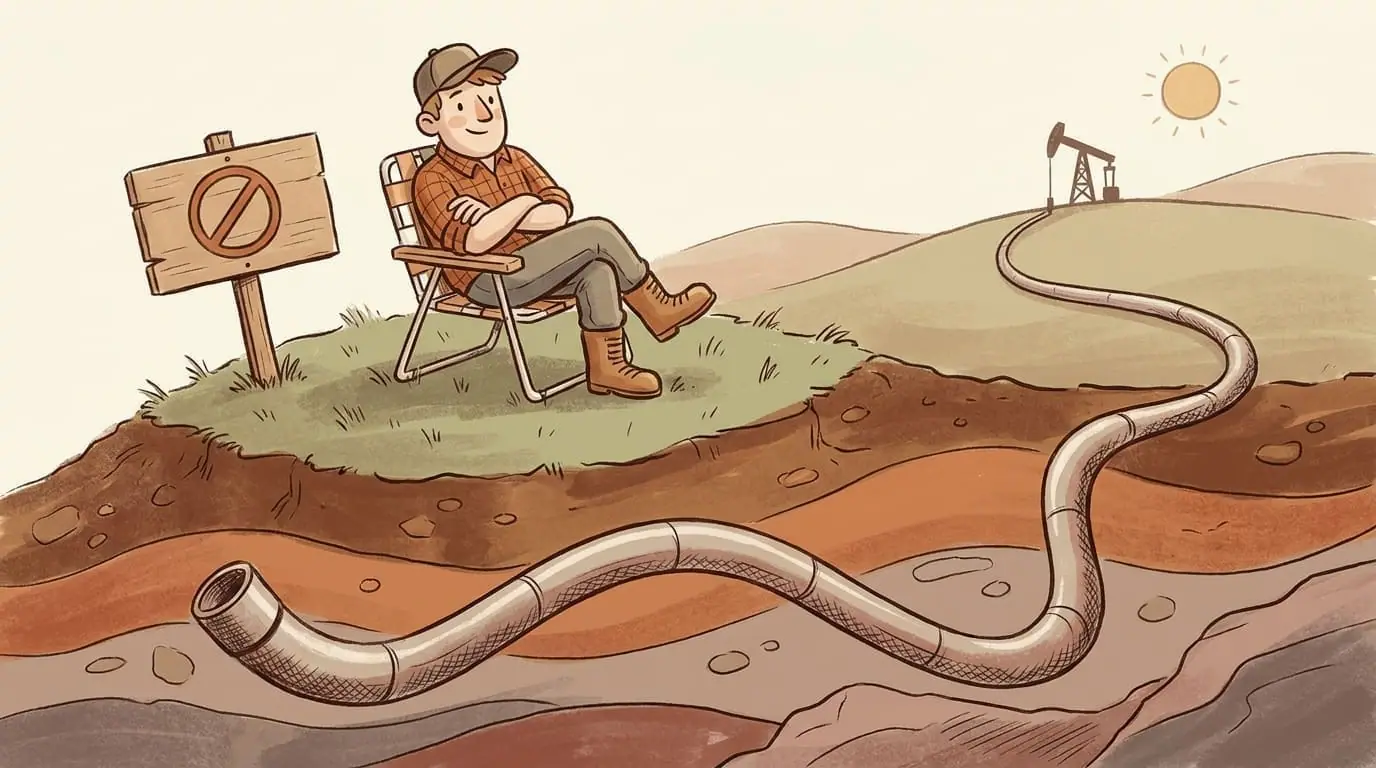
I’ve sat across the table from plenty of Louisiana families who felt they held the ultimate trump card against an aggressive oil company. The story usually goes like this: a landman sends a lease offer for their family tract in the Haynesville or Austin Chalk. The bonus is too low, the royalty fraction is insulting, or the contract is buried in heavy-handed legal language.
So the family makes a unified decision. They throw the lease in the trash.
The logic makes sense on the surface. It’s your land. If you don’t sign the contract, they can’t drill beneath your dirt. You are protected by your own refusal to play the game.
But Louisiana oil and gas law doesn’t work like real estate law. Refusing to sign a lease doesn’t make the operator pack up their rig and go home. Instead, through the power of a :compulsory drilling unit, they can drill anyway.
And if that happens, you don’t just stay a silent owner. You become an unleased mineral owner. Most folks think this means they get 100% of their share of the oil and gas without any lease strings attached. The hard truth is entirely different. Becoming a forced-in, unleased owner in Louisiana triggers a specific set of statutes that can result in massive financial penalties, aggressive deductions, and a paperwork battle that most families are entirely unprepared to fight.
Let’s look at what actually happens when you hold out.
The Commissioner’s Pen
Louisiana has a vested interest in seeing its natural resources developed. To prevent operators from drilling dozens of unnecessary wells, and to stop holdouts from blocking development for everyone else, the state gives broad powers to the Commissioner of Conservation.
When an operator wants to drill, they apply to the state to create a unit—a designated box on a map that pools together all the separate tracts of land above a reservoir. Under Louisiana R.S. 30:10, if the owners haven’t voluntarily agreed to pool their interests, the Commissioner can force them to.
Once that unit order is signed, the operator has the green light. The well gets drilled. Production begins.
If your unleased land is inside that box, your minerals are being produced. The operator is legally allowed to take your gas, sell it, and eventually pay you your share. You might think this puts you in a strong position. After all, you didn’t agree to a 20% royalty—you own 100% of your minerals, so shouldn’t you get 100% of the revenue?
Not quite. Because you didn’t sign a lease, you also didn’t contribute to the $15 million it cost to drill the well. The state legislature decided long ago that operators shouldn’t have to carry your financial weight for free.
The 200% Risk Penalty
Here is where the math gets brutal for unleased owners.
Before drilling, the operator is required to send you a formal notice by registered mail. This notice includes an Authorization for Expenditure (AFE), which outlines the estimated cost of the well, and gives you a chance to participate. Participating means writing a check for your exact percentage of that multi-million-dollar drilling cost.
Almost no family has the cash lying around to fund a deep Haynesville shale well.
If you don’t respond within 30 days, or if you simply don’t pay the invoice, Louisiana law deems you a “nonparticipating owner.” You have essentially forced the operator to take on all the financial risk of drilling a well that might turn out to be a dry hole.
To reward the operator for taking that risk, the state allows them to recover their costs out of your share of production. But they don’t just recover what they spent. Under R.S. 30:10, they get to slap you with a :risk charge.
For a standard unit well, that risk charge is 200%.
Let that sink in. The operator gets to keep your share of the production money until they have recovered their actual drilling and completion costs, plus a 200% penalty on top of it. You won’t see a dime of revenue until the well pays out at three times its initial cost. Given the rapid depletion curves of modern shale wells, it is entirely possible that a well never produces enough to clear that 200% penalty hurdle. In that scenario, your unleased minerals effectively generate nothing.
We broke down how operator debt can become your problem in a previous piece, but the R.S. 30:10 risk penalty is the most severe version of it.
The Paperwork Trap
Let’s say you accept the penalty. You know the operator is withholding your money, but you figure you’ll just wait them out. You assume they are keeping a ledger and will mail you a check once the 200% penalty is satisfied.
That assumption is dangerous.
Louisiana law does require operators to issue reports to unleased mineral owners. They have to send an initial report 90 days after the well is completed detailing the costs, followed by quarterly reports showing production volumes, prices received, and operating expenses.
But there is a massive catch buried in Louisiana R.S. 30:103.1.
The operator is only required to send these reports if you request them in writing, by certified mail.
If you just sit at home waiting for a statement to arrive, you will be waiting forever. The operator has no obligation to tell you how much gas was produced, what it sold for, or how close they are to paying off your penalty unless you trigger the statute exactly as written.
I have seen families go years without realizing this. By the time they send the certified letter, the well has been producing for half a decade. Trying to audit years of backdated drilling costs and operating expenses is a nightmare. Operators make mistakes. They overcharge for supervision. They inflate testing costs. If you aren’t actively demanding these reports from day one and scrutinizing the math, you are trusting a corporation to govern your money behind closed doors.
The Deduction Fight and the Law of Neighbors
Even if you clear the penalty hurdle and start receiving payments, a new fight begins.
A good mineral lease protects the owner from certain post-production costs—the fees charged for gathering, treating, compressing, and transporting the gas to market. When you are unleased, you don’t have a contract protecting you.
So, can the operator deduct these costs from your check?
For years, unleased owners argued that because they had no contract, the operator had no legal right to charge them for marketing the gas. The operators fought back using a deeply rooted, distinctly Louisianan legal concept called :negotiorum gestio.
It translates roughly to “management of affairs.” It’s a quasi-contract doctrine from the civil code that says if someone voluntarily manages your business for your benefit—like selling your gas for you because you didn’t make your own arrangements to sell it—they are entitled to be reimbursed for their necessary expenses.
This exact issue exploded recently in the federal courts. In Johnson v. Chesapeake Louisiana, L.P., a group of unleased mineral owners sued the operator, claiming the deduction of post-production costs was entirely illegal under the state’s conservation laws.
The federal district court initially agreed with the landowners. But Chesapeake asked for reconsideration, and the court flipped. The judge ruled that the negotiorum gestio doctrine does apply. Because the unleased owners didn’t build their own pipeline and find their own buyers, Chesapeake acted as the manager of their affairs. Therefore, Chesapeake was allowed to deduct the costs of gathering and treating that gas.
In late 2023, the Fifth Circuit Court of Appeals looked at the mess, threw its hands up, and certified the question to the Louisiana Supreme Court, basically saying, “This is your state law, you tell us if this is legal.”
While the courts argue, the reality on the ground remains harsh. Operators are deducting heavy costs from unleased owners. As we noted in our guide to the unleased owner tax, fighting these deductions requires hiring an attorney to litigate a wildly complex area of civil law. Most families simply don’t have the resources to wage that war.
Having Real Options
The psychological trap of holding out is powerful. It feels like control. It feels like you are protecting the family legacy from a bad deal.
But when you understand the mechanics of compulsory units, the 200% risk charge, the certified mail reporting requirements, and the lingering threat of post-production deductions, the reality shifts. Staying unleased is rarely a shield. It is usually just an unwritten contract where the operator holds all the leverage.
This is why understanding exactly what you own, and the laws governing it, is so critical.
If the lease offers you are receiving are terrible, going unleased is just one option. Sometimes, a firm but educated negotiation can secure a lease that waives the risk penalty entirely and limits deductions. Operators want leases—it cleans up their paperwork and makes the unit easier to administer. If they know you understand R.S. 30:10, the conversation changes.
Other times, the headache simply isn’t worth it. Dealing with statutory reports, auditing AFE costs, and fighting over negotiorum gestio is a full-time job. We buy minerals because we have the systems, the legal background, and the capital to manage those headaches. For families who just want clean resolution without the legal exposure, knowing the actual value of your rights and considering a sale is a completely valid choice.
There is no single right answer for every family. But there is a wrong answer, and that is making a decision based on the assumption that doing nothing keeps you safe.
If your land is sitting in a proposed Louisiana unit and you haven’t signed a lease, you are already in the game. It is at least worth a conversation to know what your options really look like. Knowing the math is the only way to genuinely protect what belongs to you.
:compulsory-drilling-unit
A designated area of land created by the state’s Commissioner of Conservation that pools together separate mineral tracts. Once formed, it allows an operator to drill a well that drains the entire area, even if some landowners inside the unit refused to sign a lease.
:risk-charge
A statutory penalty applied to mineral owners who do not pay their upfront share of drilling costs in a unit. In Louisiana, this allows the operator to withhold the owner’s share of production revenue until the well’s costs are recovered, plus an additional 200% penalty on those costs.
:negotiorum-gestio
A Louisiana civil law concept meaning “management of affairs.” It acts as a quasi-contract when someone voluntarily manages the business of another (like an operator selling an unleased owner’s gas). Operators use this doctrine to justify deducting post-production costs from unleased owners’ checks.