
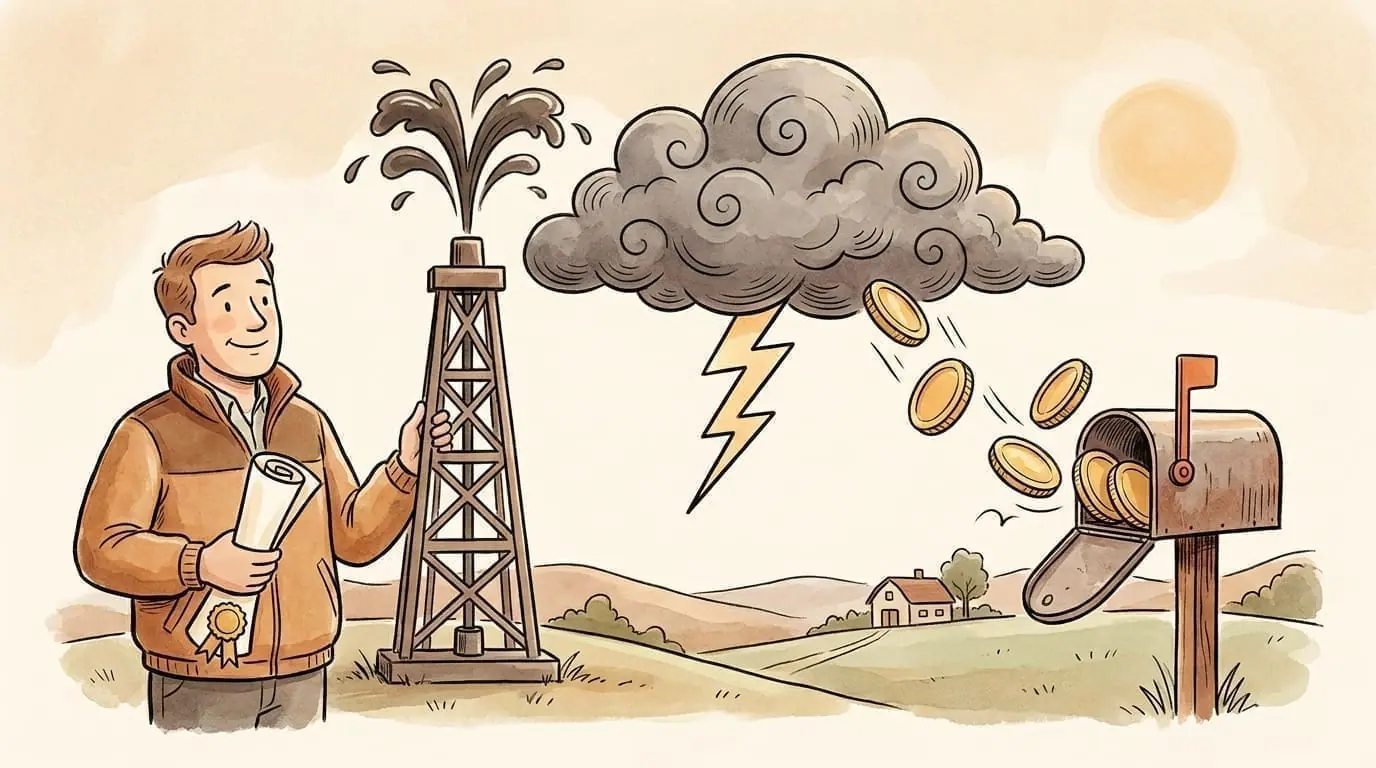
A family calls our office about once a week with the exact same story. They signed a mineral lease two years ago. The landman was friendly and paid them a nice bonus check up front. A rig moved in shortly after. The well was drilled and started producing thousands of barrels of oil.
Then the mail arrived.
Instead of a royalty check, they received a letter from the operator. The letter stated there was a “cloud” on their title. The oil company was placing their royalty money into a holding account until the family hired an attorney to fix an old probate issue from 1984.
The family is usually furious when they call us. Their argument makes complete logical sense. They say the oil company signed a contract with them. The company paid them a bonus. The company essentially agreed they owned the land when they handed over that first check. How can the operator turn around now and say they don’t own it?
Here is the hard truth about the oil and gas business. A signed lease is not proof of ownership.
When an exploration company hands you a lease bonus, they are not declaring you the rightful heir to the estate. They are buying an insurance policy. They are acquiring the right to drill just in case you actually own the minerals. That gap between getting leased and getting paid is where thousands of families get stuck.
Let’s look at how the title process actually works. We will break down exactly why an operator can legitimately have your signed lease in their filing cabinet while simultaneously telling you they need more paperwork before they can cut you a check.
The Honest Truth in Louisiana Law
Most states handle this disconnect quietly. Louisiana puts the quiet part out loud in their state statutes.
If you want to understand the true nature of a mineral lease, look at La. Mineral Code §121. This law explicitly states that a mineral lessee may take leases from persons claiming the leased land adversely to his lessor.
Read that twice. The state expressly allows an oil company to lease you and then walk next door and lease the person actively suing you for the exact same property.
Why would the law allow this? Because an oil well costs $15 million to drill. The operator cannot afford to wait five years for two families to fight out a title dispute in court. The operator just wants to drill the well. They will lease both of you. They will pay two separate lease bonuses. This is called a protection lease. They are protecting their multi-million dollar investment from future lawsuits. They do not care who actually owns the minerals at the leasing stage. They just want signatures from anyone who might conceivably own them.
The laws go even further. Under La. Mineral Code §120, the lessor impliedly warrants title to the interest leased unless that warranty is expressly excluded.
The lessor is you. The state is saying that when you sign the lease, the oil company is not guaranteeing your title. You are guaranteeing your own title to them. If it turns out your great-grandfather accidentally sold those minerals back in 1962 and you do not actually own them, your liability is usually limited to returning the bonus money they paid you. The operator takes on very little risk by handing you a lease.
The Six Stages of Title and Pay
To understand why your check is delayed, you have to understand the timeline. Leasing and paying are handled by entirely different departments inside an oil company. They operate on different timelines and with completely different levels of risk tolerance.
Here is the actual pipeline your minerals go through.
Phase 1: Lease Acquisition A land broker goes to the county courthouse. They run a quick, surface-level check of the deed records. They are looking for obvious owners. Their goal is speed. They need to secure enough acreage to form a drilling unit before a competitor does. The risk tolerance here is very high. If they accidentally pay a $3,000 bonus to someone who owns nothing, it is a minor business expense. They will lease you based on a rough guess.
Phase 2: The Drilling Title Opinion Once the company decides to actually spend millions of dollars drilling, the risk changes. They hire a specialized oil and gas attorney to write a :drilling title opinion. The attorney goes through the county records with a fine-tooth comb. They read every deed, will, and divorce decree going back to patent. This process takes months. The attorney identifies every single gap in the paperwork. We covered how secretive this process can be in our piece on the title opinion shadow market.
Phase 3: Pooling and Unit Determination The well is drilled. Now the state regulators get involved. The operator must determine exactly which tracts of land are contributing oil to this specific wellbore. They draw a box around the well. If your land falls inside the box, you get a slice of the pie. If you fall outside, you get nothing.
Phase 4: Division of Interest Calculation Now the division order analysts take over. They take the lawyer’s title opinion and the state’s unit map. They calculate out to eight decimal places exactly what percentage of the well belongs to each specific person.
Phase 5: The Division Order Months after the well is completed, you finally receive a division order in the mail. This document tells you your exact decimal interest. We have a full guide on understanding division orders if you need to know how to read yours.
Louisiana law again provides perfect clarity on where this fits in the timeline. Under La. Mineral Code §138.1, a division order is strictly defined as an instrument that is “prepared after examination of title.” The state draws a bright line. The lease comes before the title exam. The division order comes after.
Phase 6: Pay or Suspense If the title attorney gave your ownership a clean bill of health, you start getting monthly checks. If the attorney found a missing deed or an unresolved probate from decades ago, your money goes into :suspense. You do not get paid until you fix it.
The Warning from North Dakota
This is not just a Louisiana phenomenon. Every major oil-producing state operates this way.
The North Dakota Department of Mineral Resources explicitly warns residents about this reality. In their public FAQ section, the state tells owners that before a royalty check is ever issued, mineral interests must be determined and a title opinion may need to be completed.
The state advises that owners should normally receive their first check within one to two months from the time the oil is marketed. But that timeline only applies if your title is perfect. If the title opinion requires curative work, that clock stops completely. The operator is legally allowed to hold your money until you prove you are the rightful owner.
We see families trapped in this royalty black hole constantly. The operator is not trying to steal your money. They are just terrified of paying the wrong person. If they pay you $50,000 in royalties, and five years from now your long-lost cousin shows up with a valid deed proving he actually owned the land, the operator has to pay him too. They will not take that risk. They will hold the money in escrow until you resolve the family history.
The Burden of Title Curative
When you get that dreaded suspension letter, the operator will usually include a list of requirements. This is called :title curative.
The burden of fixing the title falls entirely on you. The oil company will not hire a lawyer for you. They will not track down your great-aunt’s death certificate. They just sit on the money until you do the work.
Sometimes the fix is simple. You might just need to record a death certificate in the county where the well is located.
Other times the fix is a nightmare. We frequently see situations where a family must reopen a probate case in a different state. We see fractional ownership situations where thirty different cousins need to sign an affidavit, and half of them refuse to speak to each other. You have to hire a local attorney. You have to pay court filing fees. You have to spend hours on the phone trying to explain oil and gas law to relatives who think they are being scammed.
It is exhausting. And there is no guarantee that the royalties waiting for you in suspense will actually cover the legal bills you incur trying to unlock them.
Pushing Back on the Operator
I do want to be clear about one thing. While operators have the right to suspend your pay for legitimate title defects, they sometimes use this system lazily.
Sometimes an operator will suspend an entire family because of a minor clerical error that could be resolved with a simple phone call. They put you in suspense because it is easier for them than doing the extra legwork.
States do have mechanisms to protect you if the operator is dragging their feet. In Louisiana, you cannot just sue the operator for being slow. Under La. Mineral Code §137, you must give the lessee written notice of their failure to pay as a prerequisite to filing a judicial demand. Once you send that formal notice, the operator has 30 days to either pay you or state a reasonable cause for nonpayment.
If they fail to pay you simply because you have not signed a division order, Louisiana will penalize them. Section 138.1 states that if the lessee withholds money solely for a missing division order, the court will award double the amount of royalties due, plus legal interest and attorney fees.
North Dakota has a similarly strict rule. The state mandates an 18 percent interest rate on late royalty payments. But there is a massive catch. That penalty interest does not apply if there is a legitimate dispute of title. If your title is genuinely cloudy, they can hold the money indefinitely without paying you a dime of interest.
Knowing Your Options
We understand how frustrating this system is for families. You inherit a piece of land. You sign the paperwork they put in front of you. You wait for the well to come online. You budget for the income. And then you hit a brick wall of legal jargon and suspended funds.
Fixing title defects is expensive and time-consuming. You have to decide if the juice is worth the squeeze.
This is where understanding the true value of your asset becomes critical. If you have $2,000 sitting in suspense and it will cost $5,000 in legal fees to clear the title, fighting it makes no financial sense. If you have $200,000 sitting in suspense, you absolutely hire the best attorney you can find.
Most people simply do not know what their minerals are worth. They do not know how to evaluate the reserves left in the ground or how to calculate the payout period.
Selling is ONE valid option when you hit a title wall. A good mineral buyer has in-house attorneys and landmen. When we buy a suspended interest, we take on the burden of clearing the title. We handle the probate issues. We track down the missing deeds. The family gets a lump sum payment and walks away from the headache. The legal mess becomes our problem.
I genuinely do not know if selling makes sense for your specific family. Sometimes holding the asset and paying the legal fees is the smartest wealth-building move you can make. Sometimes cashing out and investing that money elsewhere brings much-needed peace of mind.
But you cannot make a good decision without good data. Knowing what you actually own and what it is worth on the open market gives you leverage. Having options is always better than having none. If you are staring at a suspension letter and wondering what to do next, it is at least worth a conversation to see where you stand.
:drilling-title-opinion
A comprehensive legal document prepared by an oil and gas attorney before a well is drilled. The attorney reviews the entire chain of title from the original land patent to the present day to determine exactly who owns the rights to lease the minerals and receive royalties.
:suspense
A holding account where an oil and gas operator parks royalty money that they cannot legally pay out yet. Funds usually go into suspense because of a missing tax ID, a bad address, a death in the family, or an unresolved legal dispute over who actually owns the land.
:title-curative
The legal paperwork and procedures required to fix defects in a chain of title. This often involves filing death certificates, recording affidavits of heirship, resolving old probate cases, or getting quitclaim deeds from distant relatives to prove clear ownership.