
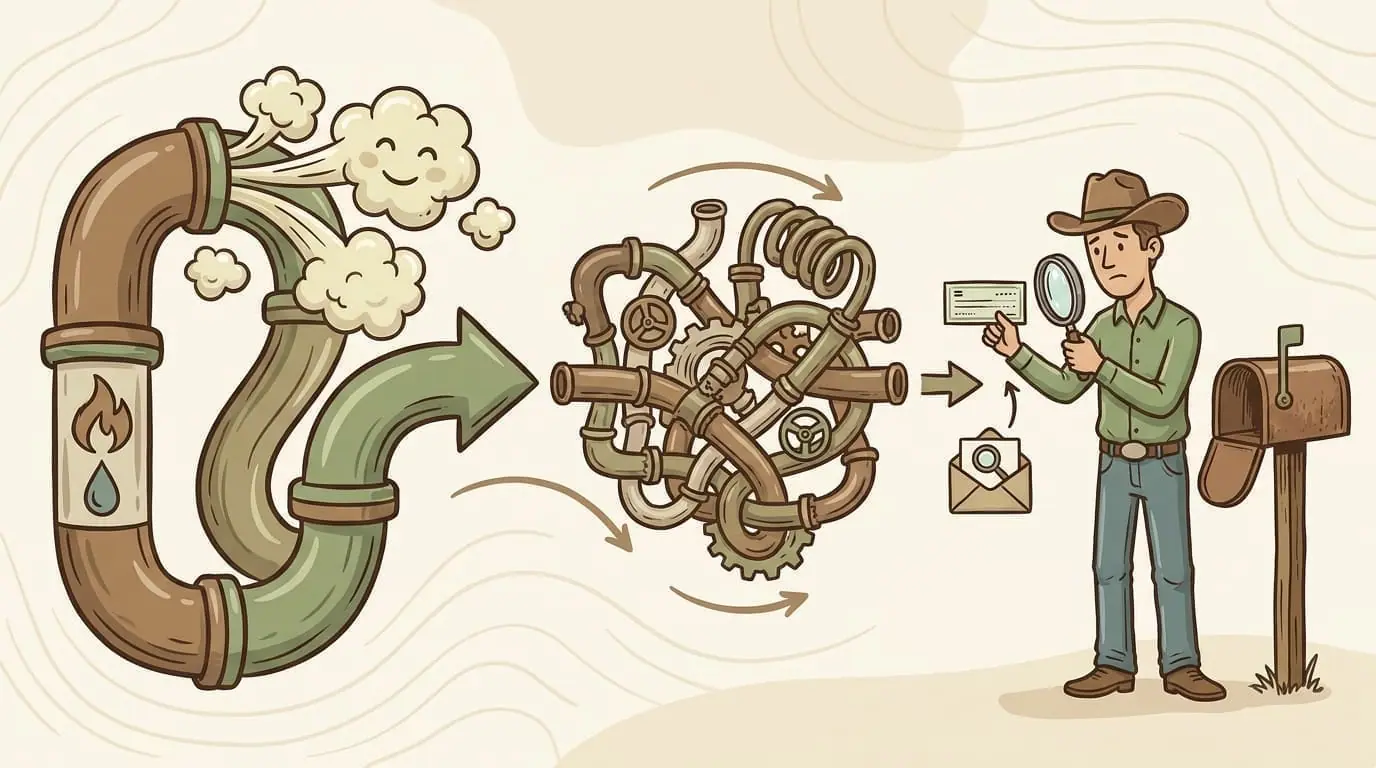
Before blaming a lower check on a regional gas-price headline, reconcile volume, realized price, taxes and deductions on the statement. The Texas mineral-rights guide identifies the public production records, and the royalty-sale guide explains the information a buyer uses to model declining cash flow.
We spend our mornings reading through dry industry data and legal briefings so our clients don’t have to. Looking at the latest dispatches from the EIA, energy analysts, and Texas courts this week, three major themes jumped out at us:
- Record-breaking natural gas output: The EIA forecasts U.S. marketed natural gas production will hit an all-time high of 122.5 billion cubic feet per day in 2026, driven heavily by the Permian and Haynesville.
- Moving bottlenecks: Permian infrastructure issues are shifting. Analysts note that constraints are moving away from the Waha hub and backing up downstream into natural gas liquid processing and fractionation.
- Legal risks for royalty owners: A recent El Paso Court of Appeals ruling (Craddick v. Cimarex Energy) affirmed that an overriding royalty can be completely “washed out” and erased if the operator releases the lease.
While all three are important, the collision of record production and shifting bottlenecks is the most critical issue for Texas mineral owners right now.
Here is why that matters for your bottom line.
More Gas Doesn’t Always Mean More Money
If you own minerals in Texas, the current market is throwing some mixed signals your way. When you see headlines about record-breaking gas production in 2026, it sounds like a windfall. But all that gas has to go somewhere.
When drillers pull more gas out of the ground than the local pipes and plants can handle, the market hits severe :midstream constraints. Right now, the pressure in the Permian is backing up into processing plants and fractionation facilities.
When infrastructure gets choked up, operators have to sell their gas at steep local discounts. Your royalty check is paid on that discounted local price—not the national benchmark you see on the evening news. If things get too backed up, operators might even shut the wells in temporarily. Your production drops to zero, and so does your monthly check, entirely outside of your control.
The Legal Rollercoaster
On top of the physical pipeline bottlenecks, holding fractional interests in oil and gas can carry surprising legal risks.
Just recently, the El Paso Court of Appeals ruled in a case where a royalty owner saw their interest completely wiped out. Because the interest in question was an :overriding royalty interest, it was tied strictly to the lease itself. When the operator released the lease, the royalty was “washed out” and vanished overnight, even though there were still producing wells on the property.
While standard mineral royalties act differently than overrides, the case is a stark reminder: lease agreements, acquisitions, and legal loopholes are heavily weighted in favor of the massive operators, not the individual families holding the rights.
Why Families Are Cashing Out
Between unpredictable local gas prices, crowded pipelines, and complex legal loopholes, holding onto mineral rights can feel like a full-time job. That is why many families eventually decide to step off the roller coaster and take a lump-sum payout.
At Double Fraction Minerals, we look at things differently. We aren’t a massive, faceless corporation flipping properties to the highest bidder. We are a Texas family office. That means when we evaluate your mineral rights, you get a fair price based on real production data, and a fast, straightforward closing process without the corporate runaround.
If you are wondering what your minerals are worth in today’s record-high production market, give us a call. We’re always happy to talk shop, look at your acreage, and give you a fair evaluation.
Check the Statement Against the Market
Use the production month—not the check date—when comparing a royalty statement with EIA prices and Railroad Commission volumes. Gas may be sold under a contract, at a regional index and after quality or transportation adjustments, so the headline Henry Hub price will not necessarily match the realized price on the statement. Flag a discrepancy only after aligning the same product, month, volume and unit.
Then compare operator-reported production with the owner’s decimal. If volume is stable but the net payment falls, focus on realized price, deductions, taxes, prior-period adjustments or a changed decimal. If both production and payment fall, normal decline or downtime may be the larger cause. Keep twelve to twenty-four months together so one volatile month does not drive a sale decision.
:midstream-constraints
The physical limits of the pipelines, processing plants, and storage facilities that move oil and gas from the wellhead to the final market. When production outpaces this infrastructure, operators are forced to accept lower local prices or shut in their wells entirely, which directly reduces royalty payments.
:overriding-royalty
A fractional interest in the production of oil and gas carved out of the lessee’s working interest. Unlike a standard mineral owner’s royalty, it is tied directly to a specific lease and typically expires completely if that specific lease is terminated or released.