Estate planning with mineral rights often starts with a very simple, very human intention. A parent wants to make sure their surviving spouse is financially secure for the rest of their days. But they also want to ensure the family land eventually passes down to their children.
The legal tool most attorneys use for this is a :life estate. The wording in the will usually says something like, “I leave my property to my wife for her natural life, and upon her death, the property shall pass to my children.”
It sounds entirely reasonable. We see this structure constantly in our office here in Texas. It is especially common in blended families or second marriages.
The trouble starts when a landman knocks on the surviving spouse’s door with a new oil and gas lease. Everyone assumes the surviving spouse gets to sign the lease, deposit the bonus check, and collect the monthly royalties. That is how a rent house works. That is how a stock portfolio works. You get the income, and the kids get the asset later.
But oil and gas do not behave like surface real estate. Because of an ancient legal concept known as the :open-mine doctrine, the surviving spouse might not be entitled to a single drop of that royalty principal.
Instead, families find themselves locked in a frustrating legal stalemate. The surviving spouse cannot develop the minerals alone. The children cannot touch the money until their stepparent passes away. And the oil company just wants clean title before they drill a five-million-dollar well.
Let’s break down exactly how this happens, why the math is so brutal, and how families can negotiate their way out of the trap.
The Problem with Oil and Gas
To understand why a life estate in minerals creates such a mess, you have to look at how the law classifies oil.
If you own a farm and leave your husband a life estate in that farm, he can grow cotton. He can sell the cotton, keep the money, and grow more cotton next year. The cotton is considered income. Growing it does not permanently destroy the farm.
Oil is different. Oil is part of the dirt itself. It is the :corpus, or the principal of the property.
Under basic property law, a person holding a life estate is not allowed to commit “waste.” Waste means permanently depleting or destroying the underlying value of the property. If you pump oil out of the ground, you are permanently removing a piece of the real estate. Once it is gone, it is gone forever. You have depleted the asset that is supposed to go to the :remaindermen after you die.
Because taking oil is considered waste, a life tenant generally has no legal right to sign a new oil and gas lease. They cannot authorize a company to drill. If they try to do it anyway, the children can sue them.
The Open-Mine Exception
There is exactly one major exception to this rule. It was developed hundreds of years ago in English common law regarding coal mines. It states that if a mine was already open and operating when the life estate was created, the life tenant is allowed to keep mining it.
The logic makes sense. If your deceased spouse was already pulling coal out of the ground while they were alive, the courts assume they intended for you to keep doing the same thing.
According to the Wex Legal Dictionary at Cornell Law, this doctrine allows the tenant to receive the full rents and royalties from the existing operations. They just cannot open any brand new mines.
In Texas, the courts have adapted this rule for the modern oil patch. They stretched it slightly to make it more practical for families. In a landmark 1956 case called Youngman v. Shular, the Texas Supreme Court looked at a situation where a husband signed an oil and gas lease, but he died before any wells were actually drilled.
His widow claimed she should get the royalties under the open-mine doctrine. The children argued that the “mine” wasn’t open because no drill bit had touched the ground before their father died.
The court sided with the widow. They ruled that the mere act of executing a valid mineral lease during the original owner’s lifetime is enough to “open” the mine. Because the husband had signed the lease before his death, the widow was entitled to receive all the royalties from wells drilled on that lease for the rest of her life.
If your family falls into this specific category, consider yourself lucky. The legal lines are clear. The surviving spouse gets the money.
But what happens when the land was unleased at the time of death?
The Brutal Math of New Wells
This is where the stalemate begins. Imagine a husband dies and leaves a life estate to his wife. The property has no active oil leases. Five years later, an operator discovers a new formation and wants to drill.
The operator cannot just lease the widow. She does not own the right to deplete the minerals. The operator must also lease the children.
If everyone gets along and agrees to sign the lease, the real shock comes when the first royalty check is cut.
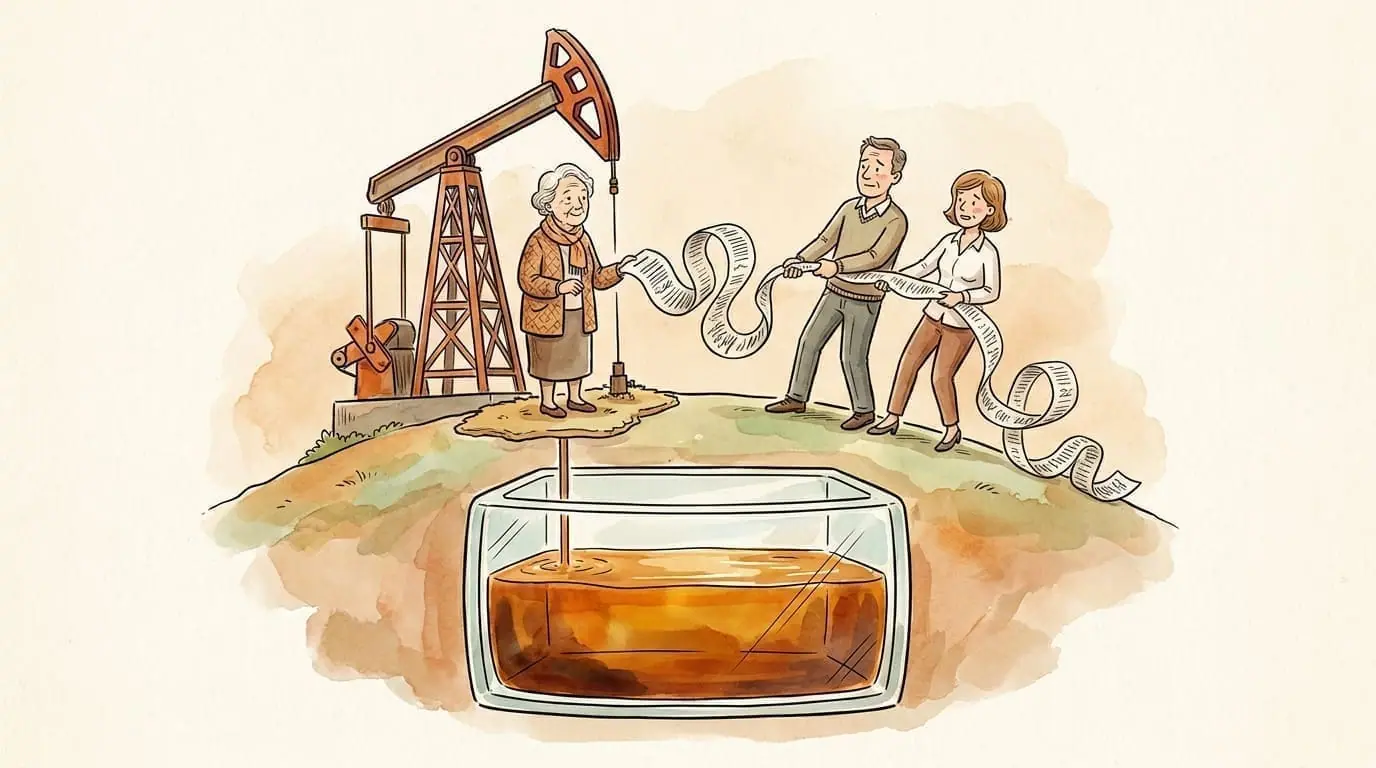
Under the law, the widow does not get the royalty principal. The children get the royalty principal. But the children do not have the right to possess it until the widow dies.
We can look at a 1936 federal case out of Texas to see exactly how courts handle this. In Davis v. Atlantic Oil Producing Co., a woman named Marilla Davis died without a will. Her husband received a statutory life estate in one-third of her property. Her children inherited the rest. After she died, the children leased the land for oil. The surviving husband sued, demanding a full cut of the oil being produced.
The Fifth Circuit Court of Appeals shut him down. They explained that because the wells were opened after his wife’s death, he had no right to the corpus of the estate. He was only entitled to the right of “user and enjoyment” of the income generated by the estate.
The court ordered a very specific remedy. The oil company had to take the royalty money, put it into a trust account at a designated bank, and pay the husband the interest earned on that account. The principal would sit untouched until he died, at which point the children would get it.
Let’s apply that math to a modern scenario.
Assume a new well generates $100,000 in royalties for the family in its first year. The money is locked in an escrow or trust account. If the bank pays 4 percent interest, the widow receives $4,000 for the year. The children technically own the $100,000, but they cannot touch a single dollar of it.
Nobody wins.
The widow might need that money for assisted living care or medical bills. Instead, she gets a microscopic interest payment. The children might have young kids going to college right now. They could desperately use their inheritance today. Instead, the money sits locked in a bank account slowly losing purchasing power to inflation.
The Family Toll
We sit across the table from families dealing with this dynamic frequently. It causes quiet tension that ruins Thanksgiving dinners.
The surviving spouse often feels shortchanged by a legal technicality. They assume their deceased partner meant for them to be comfortable. Being handed a 4 percent interest yield off a massive oil well does not feel comfortable. It feels like a mistake.
The children are in a terrible position. They want their inheritance. They might even be legally entitled to it. But enforcing that right means fighting a grieving stepparent over money.
Meanwhile, navigating The Probate Process in Texas with competing interests makes everything more expensive. Lawyers have to get involved to draft complicated trust agreements. Accountants have to figure out who owes taxes on the interest versus the principal.
The oil operators hate it too. Division order analysts loathe setting up life estate pay decks. They have to constantly monitor whether the life tenant is still alive. If they accidentally pay the principal to the widow instead of the trust, the children can sue the operator for the missing funds.
How to Break the Stalemate
You are not permanently stuck. The open-mine doctrine and the trust account requirements are default rules. They apply when a family cannot agree on anything else.
If the life tenant and the remaindermen are willing to work together, you can contract around the problem.
The most common solution is a stipulated division order or a family settlement agreement. Before anyone signs a new oil and gas lease, the surviving spouse and the children sit down and agree to a permanent percentage split.
They might agree to split every bonus and royalty dollar 50/50, paid out directly in cash right now. Or they might use an actuarial table to determine the present value of the widow’s life expectancy and assign her 30 percent while the kids take 70 percent.
Once that agreement is signed and filed in the county deed records, the oil company can pay everyone directly. No trust accounts. No interest calculations.
The second option is a joint sale of the mineral rights.
Sometimes the family history is simply too complicated for a long-term business relationship. The kids do not want to be in business with their stepmother for the next thirty years of oil production. The stepmother does not want to ask the kids for permission every time a landman wants to ratify a unit.
In these situations, converting the messy, locked-up asset into cash today is often the cleanest exit.
By selling the minerals together, the family liquidates the estate. The buyer pays a lump sum. The family uses their agreed-upon percentages to split the cash at closing. Everyone walks away whole, and the buyer takes on the headache of dealing with the operator. We discussed the mechanics of these transactions in our guide to Selling Partial Rights, but the concept applies perfectly to resolving life estates.
Knowing What You Own
Selling family land is a heavy decision. It is not something you do just because the law is confusing. But when an estate structure is actively working against your family’s financial well-being, you need to know your options.
If you are currently trapped in a life estate structure, or if you recently inherited mineral rights subject to one, the first step is getting clarity. You cannot make a good decision until you know what the asset is actually worth in the current market.
There are buyers out there who understand these complex title issues and can help families unwind them respectfully. Getting a factual, data-driven valuation gives you a baseline. It lets you sit down with your family and say, “Here is exactly what we have, and here is what it means for all of us.”
Having that information brings peace of mind. It is at least worth a conversation.
:life-estate
A legal property arrangement where one person holds the right to use and enjoy a property for the duration of their life. When they die, the property automatically transfers to a designated second party.
:open-mine-doctrine
A common law rule stating that a life tenant can continue to extract minerals and keep the full royalties if the extraction (the “mine”) was already actively operating or leased before the life estate began.
:remaindermen
The people (often the children or heirs) who are designated to receive the full ownership of a property after a life estate terminates.
:corpus
The principal or underlying capital asset of an estate, as opposed to the income generated by it. In mineral law, the oil and gas in the ground is considered the corpus.