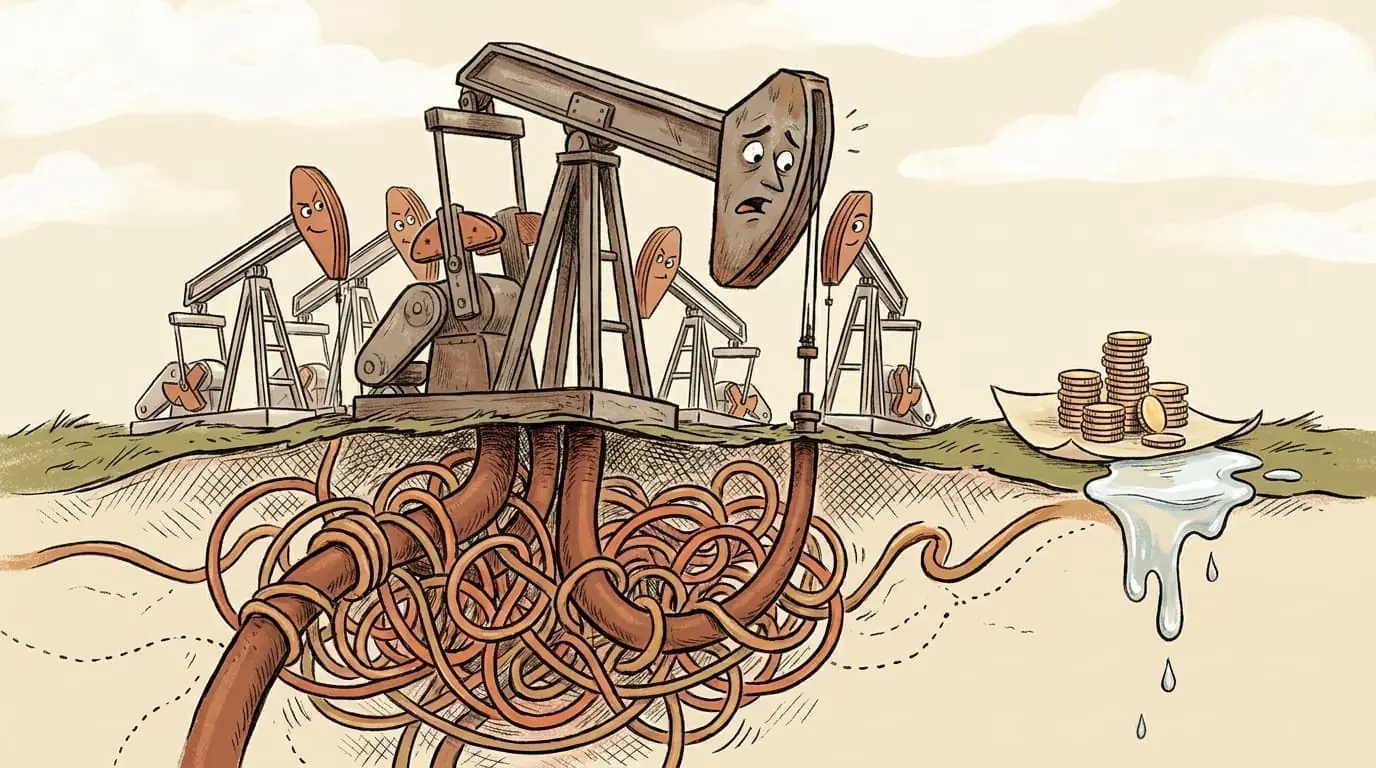
You open your mail and see an election letter or a new division order from your operator. They are coming back to your family’s land to drill four new horizontal wells right next to your older, steadily producing well.
If you are like most mineral owners, your first thought is probably about the math. If one well pays you $1,500 a month, five wells should pay you $7,500 a month. You might even start making plans for that extra income.
Then the new wells come online.
Your next few royalty checks arrive, and the numbers don’t make sense. The new wells are producing, but nowhere near what the first one did. Worse, your old reliable well—the one that had been paying a consistent monthly amount for years—has suddenly fallen off a cliff. Its production dropped by 60%, and it is pumping mostly water.
You haven’t been scammed, and there isn’t a typo on your check stub. You have just experienced the harsh engineering reality of a :frac hit.
We talk to Texas families every week who are baffled by this exact scenario. To understand why operators are willing to drill new wells that cannibalize their older ones, we need to look at the actual physics happening two miles underground, the chemical sludge ruining the rock, and the financial math that drives operator decisions.
The Physics of the Pressure Sink
To grasp why a frack hit happens, you have to understand the dynamic between a :parent well and a :child well.
When an operator drills the very first well in a unit (the parent well) and fractures the rock, they create a highly permeable pathway for oil and gas to escape. Over the next few years, as that well produces, it drains the hydrocarbons from the immediate area.
This creates a massive pressure sink. The rock directly surrounding the parent wellbore now has significantly lower pressure than the virgin rock further away.
A few years later, the operator returns to drill an infill well (the child well) just a few hundred feet away. They pump millions of gallons of water and sand into the child well under extreme pressure to crack the rock.
Fluids underground always take the path of least resistance. Instead of cracking open fresh, untouched rock, the hydraulic energy from the child well often aggressively veers toward the low-pressure void created by the parent well.
Recent studies on well interactions confirm that this pressure depletion is the primary driver of parent-child interference. The energy meant to stimulate the new well is literally lost into the depleted areas of the old well.
The result? The child well gets a terrible, inefficient fracture network and produces far less than expected. And the parent well gets slammed by a high-pressure wave of water and sand, often causing severe mechanical damage.
The Chemistry Problem: When “Shmoo” Clogs Your Well
For a long time, the industry thought frac hits were purely a pressure and mechanical problem. If you just let the parent well “recover” after the hit, it would eventually bounce back to its normal decline curve.
We now know that is often false. Many parent wells lose a massive chunk of their production and never recover. The reason is chemistry.
When the high-pressure water from a child well blasts into the parent well’s fracture network, it introduces oxygen and modern friction-reducing chemicals into an environment that has been stewing in native hydrocarbons and iron for years.
According to subsurface experts analyzing what really happens when parent and child wells interact, this chemical collision creates a disaster. The polyacrylamide friction reducers mix with the oxygen and the naturally occurring iron in the formation water to create iron oxide.
This reaction acts like cement. It binds the silica proppant and formation dirt together into a black, sticky, heavy residue. Industry engineers informally call this residue “shmoo,” “gunk,” or “gummy bears.”
This chemical sludge coats the inside of the parent well’s fractures and physically glues them shut. The parent well experiences a violent chemical shock, and suddenly, the pathways that allowed oil to flow to the surface are permanently clogged. Some parent wells lose up to 80% of their production and simply do not come back.
Putting Numbers to the Damage
Mineral owners respect math, so let’s look at the actual data.
A comprehensive analysis of over 6,000 wells in the Woodford, Meramec, and Wolfcamp formations finally put hard numbers to the frac hit phenomenon. The data is sobering.
The study found that between 60% and 67% of parent wells are negatively impacted by child well fracturing. Over a five-year period following a frac hit, an average parent well loses about 16% to 20% of its projected cumulative oil volume. In real terms, that is about 40,000 to 50,000 barrels of oil per well that simply vanish.
The child wells fare even worse. Because their hydraulic energy is wasted on the parent well’s pressure sink, up to 85% of child wells are negatively impacted compared to a standalone well. A child well can lose roughly 39% of its expected volume—meaning 80,000 to 150,000 barrels of oil are left behind in the rock.
Combined, a parent-child well pair can easily lose upwards of 200,000 barrels of recoverable oil. If oil is at $75 a barrel, that is $15,000,000 of gross revenue destroyed by poor well interaction.
This is such a massive financial drain that the Department of Energy is currently funding projects with the National Energy Technology Laboratory to use fiber-optic sensing cables in west Texas just to monitor rock deformation in real time. Operators are spending millions on fiber optics trying to figure out how to stop ruining their own wells.
Why Do Operators Do This?
If drilling a child well severely damages the parent well and results in a subpar new well, why on earth do oil and gas companies keep doing it?
We sit across the table from families who ask this exact question. It feels like terrible business. But from the operator’s perspective, the math works differently.
First, there is the issue of The “Zombie Lease” Problem: How Your Minerals Get Held Hostage by One Token Well. Operators drill the initial parent well to hold the lease by production (HBP). Once the lease is secured, they have time to secure capital and plan out the rest of the unit. They know returning later will cause a frac hit, but losing the lease entirely is a worse outcome for them.
Second, operators are looking at total unit extraction, not individual well performance.
Imagine a 640-acre unit. The parent well will recover 500,000 barrels over its life if left alone. The operator knows there is another 1,000,000 barrels of oil sitting in the rock nearby.
If they drill two child wells, the resulting frac hits might drop the parent well’s total recovery to 400,000 barrels. The child wells, crippled by the pressure sink, might only produce 350,000 barrels each instead of 500,000.
But look at the operator’s final math: 400,000 + 350,000 + 350,000 = 1,100,000 total barrels.
Yes, they cannibalized their own wells. Yes, the capital efficiency is ugly. But they successfully extracted 1.1 million barrels from the unit instead of 500,000. For a massive exploration company answering to Wall Street about total reserves, getting the maximum total oil out of a unit is often the primary goal, even if it means individual wells suffer.
What This Means for Your Royalty Checks
Understanding what happens to your royalties when the well depletes is hard enough without introducing child wells into the mix. When a frac hit happens, the impact on your monthly check is usually immediate and confusing.
First, your parent well will likely be “shut in” (temporarily turned off) while the child wells are being drilled and completed. This is a defensive measure by the operator to try and re-pressurize the parent well and protect it from the incoming water blast. For you, this means your steady royalty check suddenly drops to zero for anywhere from three to nine months.
When the parent well is finally turned back on, it rarely produces what it used to. It will likely produce a massive volume of water for weeks as it spits out the fluid that invaded it from the child well. Once the oil starts flowing again, it will likely be at a permanently reduced rate.
Meanwhile, the new child wells come online. They will generate a nice initial spike in your checks—new wells always do. But because they are often underperforming due to the pressure sink, their decline curves are typically much steeper than the parent well’s was.
The net result? The total size of your monthly checks might increase for a short period, but the long-term cash flow of your family’s mineral estate has likely been permanently reduced compared to what a perfect, theoretical layout would have generated.
Knowing Your Options Before the Hit
We have reviewed hundreds of these scenarios at our family office. We know exactly how a parent well’s decline curve looks before the offset drilling, and we know what it looks like after.
This dynamic is exactly why timing matters so much in mineral ownership.
When an operator announces plans to drill child wells, the perceived value of your minerals often skyrockets. The market sees new permits and gets excited. But as we just explored, the reality of those child wells rarely matches the theoretical hype. The child wells underperform, and the parent well is permanently damaged.
Many savvy mineral owners look at this precise window—after the permits are filed but before the child wells are actually fractured—as a strategic time to at least evaluate their estate. If a buyer is willing to value your minerals based on the optimistic assumption that the child wells will be just as good as the parent well, it might be the optimal time to take some chips off the table.
We don’t believe there is a universal right answer for every family. Selling family land is an emotional, heavy decision. You have to weigh the absolute certainty of a lump sum against the long-term, but highly unpredictable, future of those child wells.
What we do believe is that you deserve to know the actual engineering reality of what you own. You deserve to know that “four new wells” does not mean four times the money.
If you have a parent well that is about to be offset by child wells, and you want to understand how that will impact your specific valuation, we can show you exactly how we value royalties in these situations. We run the decline curves, factor in the likely frac hit interference, and show you the math.
Whether you decide to hold your minerals for the next generation or decide that removing the risk is the smartest move for your family, having real numbers makes the decision infinitely easier. It is at least worth a conversation to know what your options are.
:parent-well
A parent well is the very first well drilled and completed in a specific section of a reservoir. Because it produces for years before any other wells are drilled, it heavily depletes the pressure in the surrounding rock, creating a massive underground void that dictates how future wells in that area will behave.
:child-well
A child well, often called an infill well, is a newer well drilled immediately adjacent to an older, existing parent well. Because they are drilled into an area where the reservoir pressure has already been altered, child wells usually produce significantly less oil and gas than the original parent well did.
:frac-hit
A frac hit (or fracture-driven interaction) occurs when the high-pressure water and sand used to stimulate a new child well violently cross underground and crash into the wellbore of an older parent well. This collision often causes permanent mechanical and chemical damage, permanently reducing the older well’s ability to produce oil.