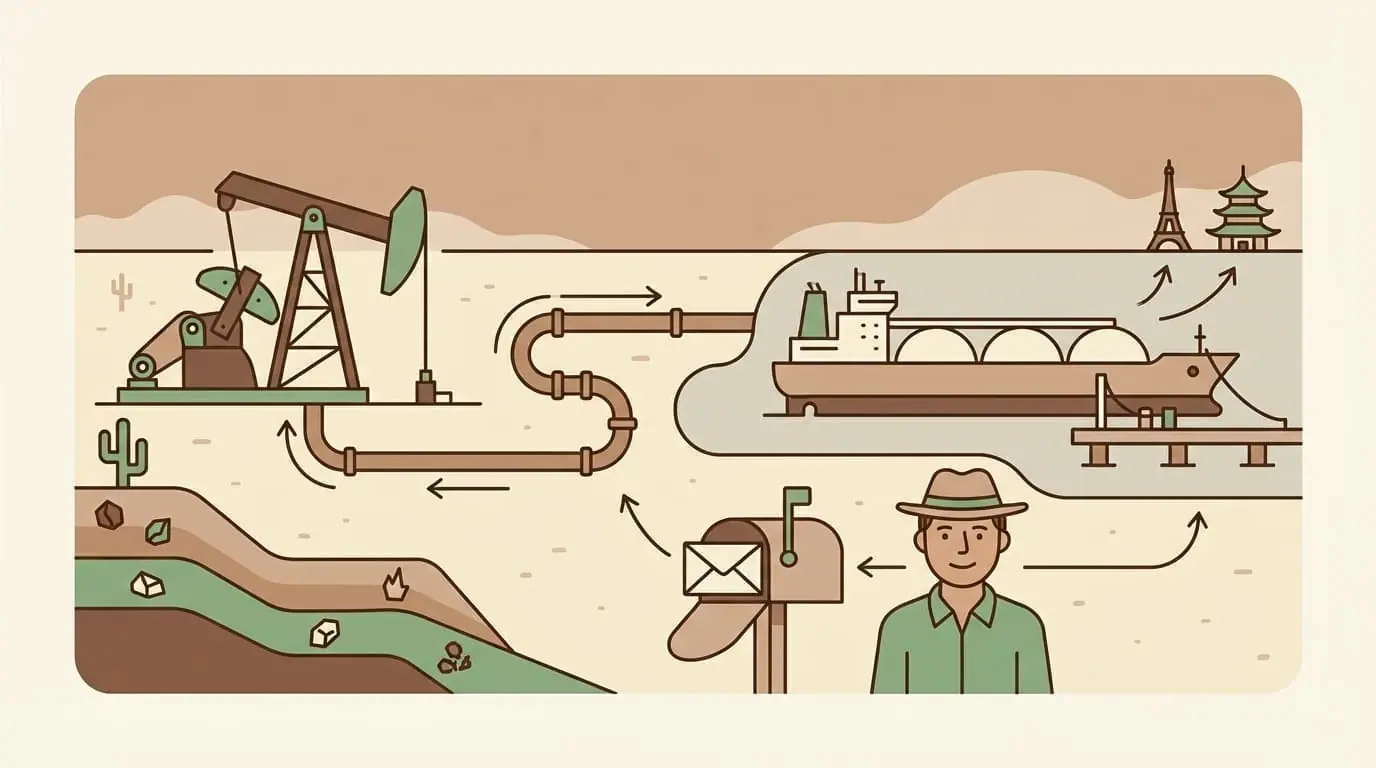
Ten years ago this winter, the first cargo of the modern U.S. :liquefied natural gas (LNG) export era left the Sabine Pass terminal. The U.S. Energy Information Administration now identifies the United States as the world’s largest LNG exporter and reported that exports averaged 15 billion cubic feet per day in 2025.
What does a ship crossing the ocean have to do with your Texas mineral rights? It can affect regional gas demand and infrastructure, but it is only one input. Your lease, location, operator, production profile, deductions and title still control the economics of a specific interest. Our Texas mineral-rights guide explains the state-specific ownership and tax checks to make first.
If you’ve been wondering why your mailbox is suddenly full of offers, or why you’re hearing about massive corporate buyouts in the news, you just have to follow the money and the pipelines. Looking at the latest industry data, three major trends are colliding right in our backyard:
- Global demand is pulling local gas: International buyers are contracting for American LNG, supporting higher utilization of Gulf Coast export terminals.
- Pipelines are pointing South: Last year, a massive 85% of all new natural gas pipeline capacity built in the United States was directed right here to the South Central region to feed Gulf Coast terminals.
- Permian gas has more potential outlets: New pipelines and LNG capacity can improve takeaway options for raw :feedgas, although local constraints and basis prices still differ across the :Permian Basin.
Export demand is directing capital toward Texas infrastructure and production. Some mineral owners may benefit through stronger regional demand or additional takeaway capacity, but that does not guarantee a higher royalty check or sale price. Basis differentials, gathering constraints, well performance, lease terms and title risk can outweigh the macro trend. If you are comparing offers, use a property-specific mineral-rights valuation rather than an LNG headline.
But this massive influx of corporate cash also changes who you are dealing with. The industry is consolidating fast. The operators drilling your land or the big aggregators trying to buy your minerals are increasingly massive, publicly traded entities answering to shareholders in New York. Dealing with them can mean navigating automated phone trees, layers of corporate lawyers, and slow, bureaucratic closing processes.
That’s where Double Fraction Minerals comes in.
We see the exact same global trends the big guys do, but we handle our business entirely differently. We’re a Texas family office. We don’t have a boardroom of folks in suits trying to hit a quarterly quota. When we buy mineral rights, we use our own family capital. That means we can move fast, cut out the red tape, and make you a fair, straightforward offer without the corporate runaround.
If you’re looking at the current market and thinking it might be the right time to cash out—whether to fund a retirement, pay off debt, or just simplify your estate—you deserve a buyer who treats you like a neighbor. We evaluate every property with Texas hospitality and respect.
Fair. Fast. Family-owned. That’s the Double Fraction way. Give us a call, and let’s talk about what your minerals are worth in today’s booming market.
Translate an Export Story to One Royalty Statement
LNG export capacity can influence Gulf Coast demand, but it does not set every Texas wellhead price. Compare the production month, gas basin and realized price on the statement with the relevant regional index. Transportation, gathering, processing, gas quality, contract terms and local constraints can create a basis difference from Henry Hub.
Then separate price exposure from volume. An owner can benefit from stronger gas pricing while receiving less money if the well is declining or down. Conversely, a new well can lift a check during a weak pricing month. Track volume, price, decimal, taxes and deductions independently before attributing the change to LNG demand.
For valuation, treat announced export projects and pipelines as dated evidence, not guaranteed cash flow. Confirm whether a facility is operating, under construction, permitted or merely proposed, and whether the tract’s production has practical access to the relevant market. Update the analysis as infrastructure and contracts change.
:lng
Liquefied natural gas (LNG) is natural gas that has been cooled to a liquid state, making it about 600 times smaller by volume. This allows it to be safely and efficiently transported across oceans on specially designed ships to international markets where pipelines can’t reach.
:feedgas
The raw natural gas that is produced at the wellhead and delivered through pipelines to export terminals, where it is then treated, chilled, and converted into LNG for global shipping.
:permian-basin
A massive sedimentary basin in West Texas and southeastern New Mexico that is the highest-producing oil and gas region in the United States. Its unique, stacked geology allows operators to drill multiple lucrative zones from a single surface location.