
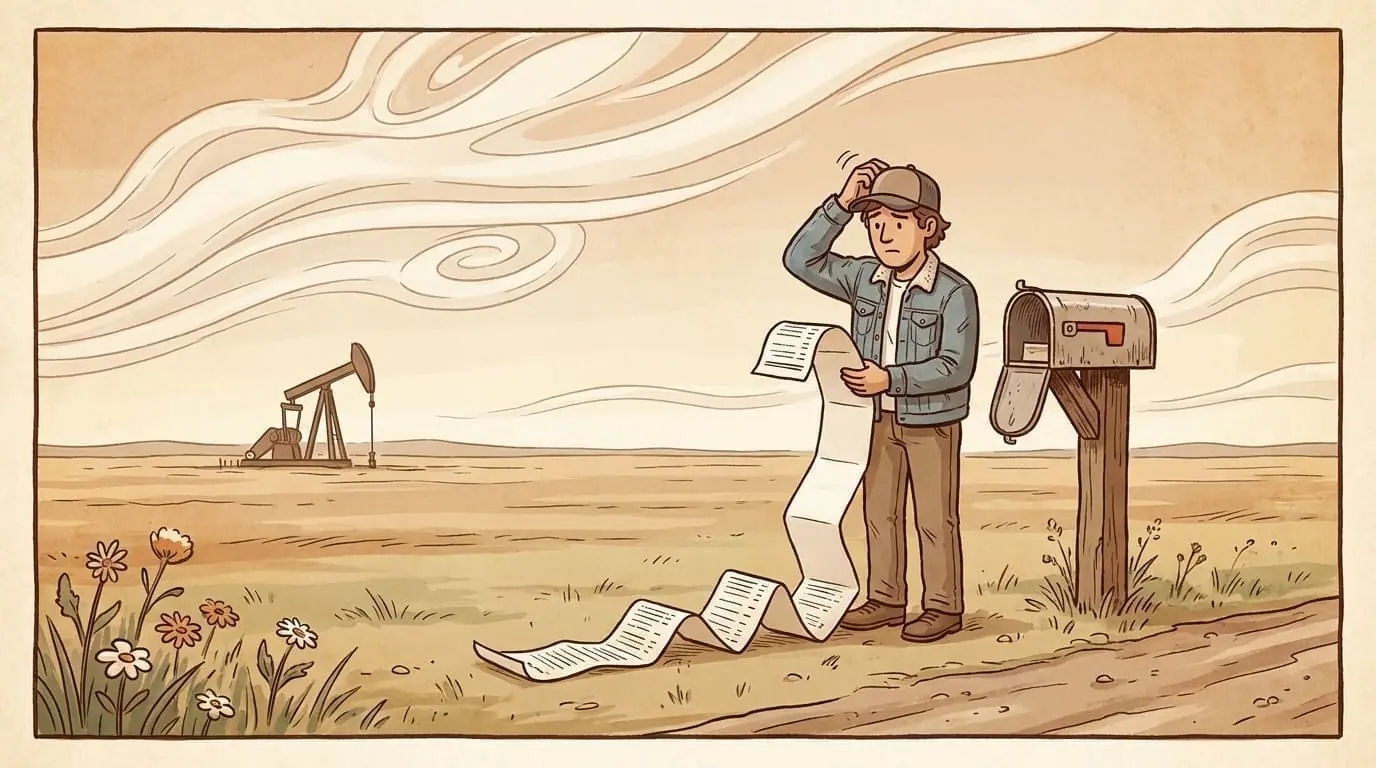
You open the mail expecting a royalty check. Your family has owned minerals in Williams County for three generations, and you recently heard an operator finally drilled a well on your section.
You tear open the envelope. There is no check. Instead, you find a dense accounting spreadsheet called a Joint Interest Billing statement (a JIB), and a demand for something like $45,000.
Panic sets in. You own the minerals. Oil companies are supposed to pay you to drill, not the other way around. Did you get scammed? Are they going to take your house if you don’t pay?
We see this exact scenario play out constantly at our family office. Families inherit North Dakota mineral rights, lose track of the paperwork, miss a few leasing offers in the mail, and suddenly find themselves staring down a five-figure invoice for a Bakken oil well.
I want to walk you through exactly what is happening here. Nobody is scamming you, but you have stumbled into a specific corner of North Dakota oil and gas law that surprises almost everyone who isn’t living and breathing this industry.
The confusion comes down to one massive misunderstanding: “mineral owner” does not necessarily mean “royalty owner.” Let’s look at how the math actually works.
The Great Divide: Mineral Estate vs. Royalty Estate
To understand why you got a bill, you have to understand what you actually own.
When you own the mineral rights under a tract of land, you own the right to extract the oil and gas. You can go out there, buy a drilling rig, bore a hole two miles into the earth, and sell the oil. That is your right.
But drilling a modern horizontal well in the Bakken costs anywhere from $8 million to $12 million. Most families don’t have that kind of cash sitting around.
That is why the oil and gas lease exists.
A lease is simply a contract where you trade your right to drill to an oil company. In exchange, the operator takes on 100% of the financial risk, 100% of the drilling costs, and 100% of the operating liabilities. You reserve a cost-free percentage of the production—your royalty.
As we explained in our guide on What is a Royalty vs. Mineral Interest, the lease is the magic document that shields you from the brutal economics of the oilfield.
But what happens if you never sign a lease?
Maybe the landman couldn’t find you. Maybe your grandmother’s estate was never probated properly, so the operator didn’t know you owned it. Or maybe you received The Dreaded Election Letter from the operator, didn’t understand what it was, and threw it in the trash.
If you don’t sign a lease, you remain an unleased mineral owner. You never transferred the risk to the operator. You never created a cost-free royalty. Legally, you are still sitting on the right to drill your own well.
Enter North Dakota’s Statutory Pooling Regime
Oil companies cannot let one holdout or missing heir stop a multi-million-dollar project. If they did, nothing would ever get drilled.
To solve this, North Dakota has a statutory mechanism called :force pooling.
Under N.D.C.C. Chapter 38-08, specifically §38-08-08, the North Dakota Industrial Commission (NDIC) has the authority to combine all the scattered mineral interests in a spacing unit into one drilling block. If the operator has secured leases for the majority of the unit, the state allows them to force the remaining unleased owners into the pool.
When you get pooled as an unleased owner, the state effectively treats you as an involuntary business partner in the well. You are now a :working interest owner.
Because you are a partner, you are responsible for your proportionate share of the costs to drill, complete, and operate the well.
Let’s do the math. Assume you own 10 net mineral acres in a standard 1,280-acre Bakken spacing unit. Your share of the unit is 0.0078 (or 0.78%).
If the operator drills a $10 million well, your proportionate share of that cost is $78,000.
That is why you are getting a JIB. The operator is sending you the bill for your 0.78% share of the project. Sometimes this comes before the well is drilled as an Authorization for Expenditure (AFE), and sometimes it comes after as a Joint Interest Billing statement detailing the exact monthly costs for water disposal, maintenance, and electricity.
The Lien and the 50% Risk Penalty
At this point, most mineral owners ask: “What if I just don’t pay it? I don’t have $78,000.”
The operator knows you don’t have the money. They don’t expect you to write a check. And no, they are not going to send a collection agency to repossess your car.
Instead, the North Dakota statute gives the operator a massive hammer.
Under §38-08-08, if an unleased owner refuses to participate and pay their share of the costs, the drilling operator is granted a lien against that owner’s share of the oil and gas production. The operator gets to keep your oil, sell it, and apply the proceeds toward your $78,000 debt until the well achieves “payout.”
But there is a catch. The operator took all the risk. They put up the $10 million. If the well was a dry hole or a poor producer, they would have lost their shirts, while you risked nothing.
To compensate the operator for taking that gamble on your behalf, North Dakota allows the operator to recover a :risk penalty from nonparticipating owners.
The penalty in North Dakota is 50% of your share of the drilling and completion costs.
So, using our previous math, the operator doesn’t just recover your $78,000 cost out of your production. They recover the $78,000 plus an additional $39,000 risk penalty. They get to keep the revenue from your share of the oil until they have recovered $117,000.
You can see this exact framework applied in the real world by reading NDIC Order No. 11347, where the Commission explicitly lays out how operators recover these costs and apply the statutory risk penalties to unleased owners who fail to make an election.
The Cost-Free Carve Out (The Silver Lining)
This sounds incredibly punitive. If the well takes three years to pay out that $117,000, do you get absolutely zero dollars for three years while the operator drains the oil from under your land?
Not quite. North Dakota law recognizes that this would be inherently unfair to a family who simply missed a piece of mail.
During the penalty recovery phase, the statute dictates that an unleased owner is still entitled to a small, cost-free royalty on their share of production. Historically, this is calculated as the weighted average lease royalty of all the signed leases in that specific spacing unit (often around 16%).
Legislative discussions, like those found in recent years surrounding North Dakota Legislature HB 1459, frequently touch on how these cost-free royalty components operate to protect the basic property rights of unleased owners while still incentivizing development. You can also read more about how the state handles title, payment mechanics, and basic owner protections on the Mineral Owner Information: ND Department of Mineral Resources page.
So, while the operator is busy paying themselves back that $117,000 out of the working interest side of your minerals, you will still receive a small monthly check for the “average royalty” portion.
You should absolutely scrutinize these checks. North Dakota takes accurate accounting very seriously. As we noted in our piece Your Check Stub Is a Crime Scene, operators who fail to provide transparent, accurate royalty statements under NDCC 38-08-06.3 can be charged with a class B misdemeanor.
What Happens After Payout?
Let’s say the well is a great producer. Four years go by, and the operator eventually recovers the full $117,000 from your share of production.
The penalty phase is over. The well has achieved payout.
Suddenly, the math flips. You are now a full working interest partner with a paid-for well. Your revenue jumps massively because you are receiving your full 0.78% share of the total well production, not just the small average royalty carve-out.
But you also now receive a JIB every single month for your 0.78% share of the operating expenses. If a pumpjack breaks, you pay for part of the repair. If a saltwater disposal line needs replacing, you pay for part of the pipe. And, crucially, you carry the liability of an operator. When the well eventually runs dry and needs to be plugged and abandoned, you are on the hook for your share of the plugging costs.
How to Handle Your Options
If you find yourself holding a JIB or an unleased mineral interest in the Bakken, you generally have a few paths forward. The “right” choice depends entirely on your family’s financial situation and risk tolerance.
1. Try to Lease (If it isn’t too late) Sometimes, if the well hasn’t been drilled yet or the pooling order hasn’t been finalized, you can still call the operator or a third-party broker and negotiate a lease. You will trade away the massive upside of being a working interest owner, but you will secure a safe, cost-free royalty and a lease bonus.
2. Participate If you have the capital and you believe in the operator’s geology, you can write the $78,000 check. You avoid the 50% risk penalty entirely. You become a true working interest partner from day one. We rarely see families do this unless they have deep industry experience, because investing in single oil wells is incredibly risky.
3. Do Nothing (Ride the Penalty) You can just let the statute do its thing. You won’t write a check. You will collect the small average statutory royalty during the payout period. Once the well pays out, you will transition into a working interest owner. It’s a passive approach, but you need to be prepared for the liability and the JIBs that will eventually arrive.
4. Consider a Sale This is often where we meet mineral owners. The complexity of tracking payout balances, reviewing JIBs, and managing forced-pooled working interests is more than most families want to handle. Many owners look at the 50% penalty, the delayed revenue, and the future plugging liabilities, and decide they would rather just walk away with clean capital today.
Selling unleased, pooled minerals is highly complex because buyers have to underwrite the penalty phase and the operator’s specific costs. But good buyers—buyers who actually understand North Dakota Century Code and Bakken economics—can calculate that value precisely.
If you are staring at a stack of JIBs and AFEs, feeling overwhelmed by the accounting, it might be worth a conversation to see what those assets are actually worth on the open market. You don’t have to sell, but knowing your options brings peace of mind. You owe it to yourself to understand exactly what you own.
:force-pooling
A state-level legal mechanism that allows an oil and gas operator to combine all mineral interests in a specific spacing unit into one drilling block, even if some owners refuse to lease or cannot be found. This prevents a single holdout from blocking development that benefits the majority.
:working-interest
An ownership type in an oil and gas leasehold that bears the actual costs of exploration, drilling, and production. Unlike a royalty interest, which is free of costs, a working interest owner must pay their proportionate share of the bills (JIBs) and assumes the operational liabilities.
:risk-penalty
A statutory financial penalty applied to unleased mineral owners who refuse to pay their share of drilling costs upfront. The operator is allowed to recover the actual drilling costs plus a set percentage (50% in North Dakota) out of the unleased owner’s share of production to compensate the operator for taking all the financial risk.