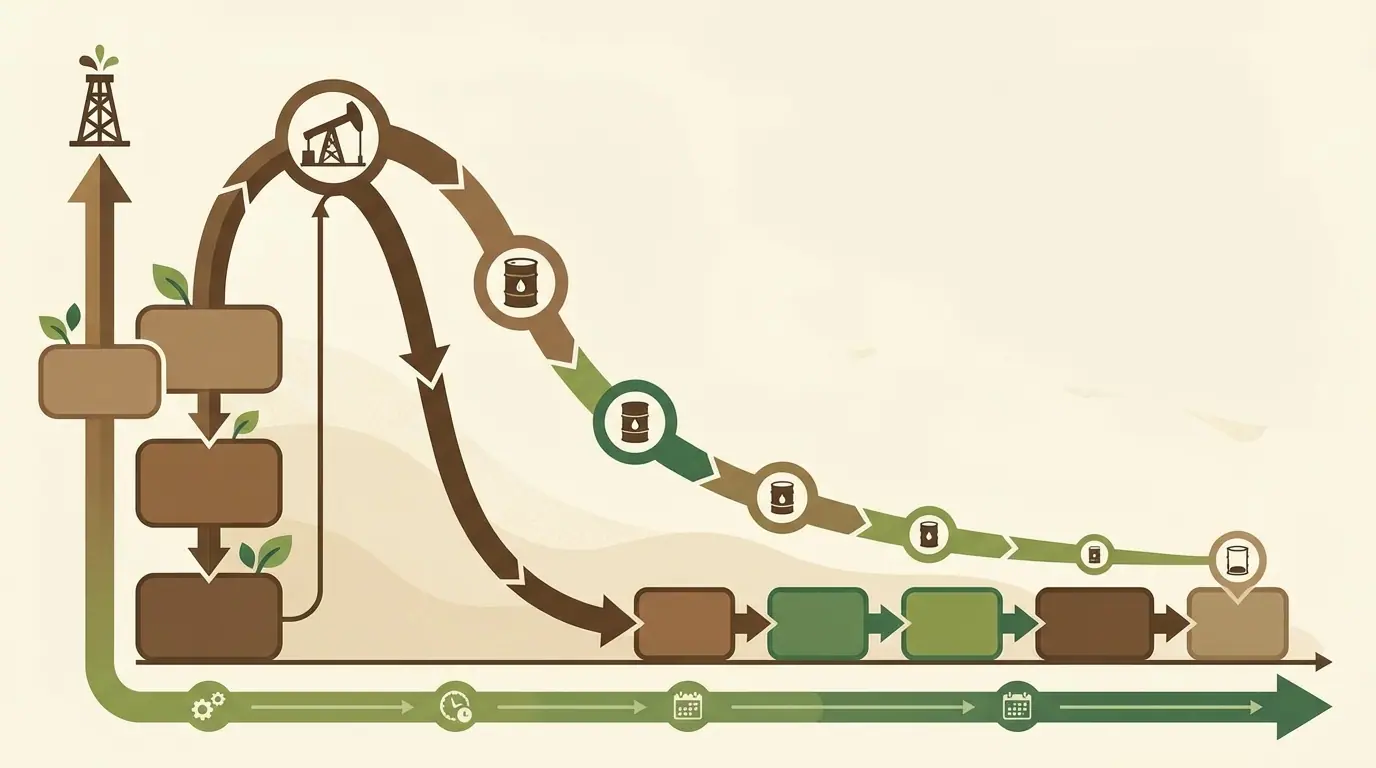
A decline curve is only one possible explanation for a smaller payment. Before making a hold-or-sell decision, verify the royalty fraction with the royalty decimal calculator and compare volume, realized price, taxes, deductions and suspense adjustments month by month.
You remember that first check after the well came online. It was substantial. Maybe enough to pay off a truck or put a serious dent in the mortgage. Naturally, you started budgeting around that number.
Then the next month came, and it was a little lighter. Six months later, you’re looking at the stub and realizing it’s half of what it used to be.
We get calls all the time from owners who are convinced the operator is skimming off the top or making accounting errors. While mistakes absolutely happen, the culprit is usually just physics. It’s called the :decline curve.
Think of a new oil well like a shaken soda can. When the operator first pops the tab, the underground pressure is immense. Production flows hard and fast. But once that initial pressure bleeds off, the flow slows down drastically. A typical horizontal well in Texas might produce 60% to 70% of its total lifetime oil in just the first few years.
After that initial flush, the well settles into a long, slow tail of production. It might pump for another twenty years, but at a fraction of that initial volume. This is known as :PDP, or Proved Developed Producing reserves. It’s steady, but it’s rarely exciting.
This matters because it changes how you look at your net worth. You aren’t necessarily losing money; you are just realizing that the “glory days” of that specific well are in the rearview mirror.
If you are holding out hoping those massive initial checks will return, you’re likely waiting for a train that already left the station. However, understanding this curve gives you clarity. You have to decide if you want the slow, predictable trickle of income over the next decade, or if it makes sense to pull that future value forward into a lump sum today. There isn’t a wrong answer, but you need the real math to make the choice.
Audit the Check Before Calling the Change Normal
Start with the sales month. Operator statements often arrive weeks after production, and adjustments may reach across earlier periods. Compare the check detail with the state regulator’s volume for the same well and month. A timing difference can explain an apparent mismatch without proving an accounting error.
Break the payment into its inputs: oil volume, gas volume, realized prices, ownership decimal, taxes, deductions and prior-period adjustments. A decline curve affects volume. Commodity markets affect price. A division-order change affects the decimal. Gathering or processing changes affect deductions. Keeping those causes separate is the fastest way to ask owner relations a precise question.
Use at least twelve months where available. New horizontal wells can decline rapidly early and then flatten, but there is no universal percentage that fits every formation or completion. Downtime, offset-fracture protection, artificial-lift changes and maintenance can interrupt the curve. Public production history is more reliable than a generic basin rule of thumb for the specific well.
Check for unit and title changes too. Amended pooling, tract participation, a transfer, estate documentation or a title requirement can move money into suspense or change the payable decimal. Preserve every division order and do not sign a replacement solely because the decimal looks familiar; compare the legal description, unit and effective date.
For budgeting, use a range. A conservative case can extend current decline without new wells, while separate scenarios can show plausible future development. Do not treat an undrilled location as certain income. If deciding whether to sell, compare written offers against the same forecast and subtract the taxes and administrative burden the owner expects to bear.
Contact the operator when the statement and public data do not reconcile, the decimal changes without explanation, deductions conflict with the lease, or a paying account enters suspense. Ask for a written owner-relations response and keep it with the monthly statements. Normal decline is common, but it should be demonstrated rather than assumed.
If the response involves title, request the specific requirement and the legal description affected. Do not send original deeds or estate papers unless a trusted professional confirms they are necessary; provide copies through a secure channel and retain the correspondence.
:decline-curve
The rate at which an oil or gas well’s production falls over time. It is almost always steepest in the first 12 to 24 months before flattening out into a slow, steady decline.
:pdp
Short for “Proved Developed Producing.” This refers to oil and gas reserves that are currently coming out of the ground from existing wells. It’s the lowest-risk part of a mineral asset because the oil is already flowing.