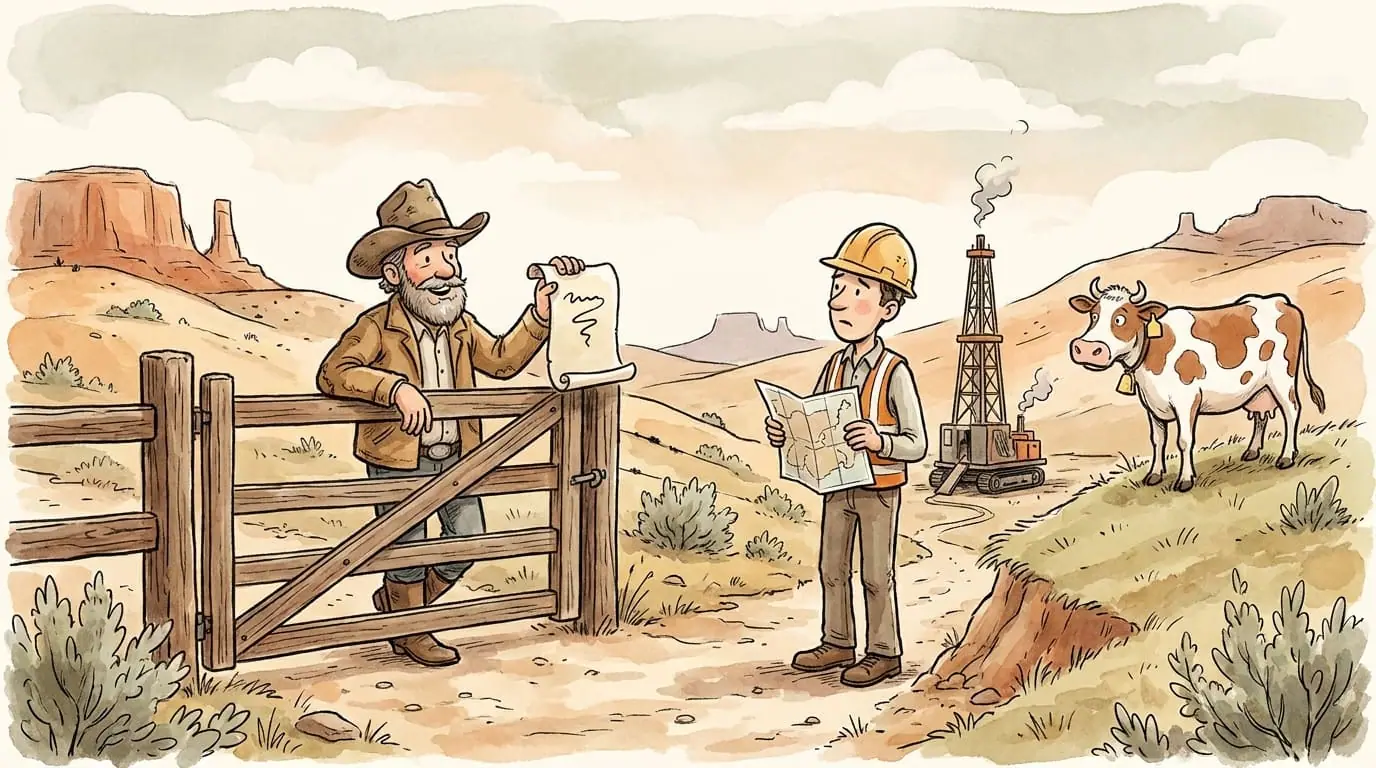
When an exploration company pools a drilling unit, secures a permit to drill from the Wyoming Oil and Gas Conservation Commission, and sends out notice to interest owners, mineral owners reasonably expect a drilling rig to follow shortly. Months pass, yet nothing happens on the ground. The state database shows an approved permit. The operator confirms the reservoir engineering looks favorable. But the spud date gets pushed from spring to autumn, and then into the following budget cycle.
In Wyoming, particularly across the Powder River Basin, the delay frequently has nothing to do with subsurface geology or market demand. It happens because of what is sitting on top of the rock.
The Powder River Basin contains some of the highest concentrations of split-estate acreage in the United States. In a split estate, one party owns the surface acreage (often a cattle rancher or farming operation), while an entirely separate party, or the federal government, owns the underlying minerals. While traditional energy law treated the :mineral estate as dominant, Wyoming statutory law modified that dynamic. Under the Wyoming Surface Owner Accommodation Act, a surface owner holds significant statutory leverage to inspect, negotiate, object, and delay operations before a single piece of heavy equipment touches the grass.
Understanding how these surface standoffs develop explains why royalty payments in Wyoming can take much longer to materialize than paper permits suggest.
The roots of the split estate in the Powder River Basin
Split estates in Wyoming are not an accident of recent development. They were created by federal public land policy more than a century ago.
Under early federal homestead laws, settlers received full fee-simple title to both surface and minerals. By the early twentieth century, Congress recognized that Western lands contained massive reserves of coal, oil, and gas. When Congress passed the Stock-Raising Homestead Act of 1916 (SRHA), it sought to encourage settlement of arid grazing lands while keeping energy reserves under federal management. The SRHA allowed ranchers to claim up to 640 acres of grazing surface, but it severed and reserved all coal and other minerals to the federal government, alongside the right to enter and use the surface for mining.
Over subsequent decades, private transactions further fractured these ownership chains. Surface acreage was sold off to ranching families, while mineral rights were retained, leased, or divided among heirs across multiple generations. As described in guidance published by the Powder River Basin Resource Council, this history left Wyoming with three common ownership configurations:
- Federal minerals under private surface.
- Private minerals under private surface owned by an unrelated third party.
- State minerals under private surface.
When a mineral owner holds rights under a private tract in Campbell, Converse, Johnson, or Sheridan County, that owner almost never owns the ranch sitting above it.
For many years, common law gave mineral developers broad leeway. The common-law doctrine of mineral dominance held that because mineral rights would be useless without access to the surface, the mineral owner (and their lessee) held an implied easement to enter the land and use as much of the surface as reasonably necessary to extract the hydrocarbons. Surface owners received compensation only if the operator caused unreasonable or negligent damage. In practical terms, an operator could build access roads, dig pits, and clear a pad with minimal rancher input.
How the Wyoming Surface Owner Accommodation Act changed the rules
The imbalance between ranching operations and energy developers led the Wyoming legislature to intervene. In 2005, Wyoming passed the Surface Owner Accommodation Act (codified at Wyoming Statutes § 30-5-401 through § 30-5-410).
The statute formally departed from unconstrained mineral dominance. It established that an operator cannot enter private land to drill without first meeting explicit statutory obligations designed to protect the rancher’s agricultural livelihood.
Under the Act, an operator cannot simply show up with a bulldozer because they hold a valid state drilling permit. The law requires four distinct steps before entry:
- Written notice: The operator must provide the surface owner with at least thirty days written notice before starting any surface-disturbing activities. This notice must describe the proposed operations, including the general location of well pads, access roads, pipelines, and power lines.
- Good-faith negotiations: The operator must attempt to negotiate a :surface use agreement in good faith. This agreement covers the practical footprint of the operation and monetary compensation for surface damages, loss of agricultural production, and lost land value.
- Financial assurance (bonding): If the rancher and the operator cannot reach an agreement, the operator cannot enter until it posts a surety bond or letter of credit with the Wyoming Oil and Gas Conservation Commission to secure payment for damages.
- Opportunity to object: The surface owner has thirty days to challenge the proposed bond amount as insufficient to cover the true damage to the surface estate.
The legal scholarship on accommodation doctrines in Western energy states shows that while these laws do not give surface owners an absolute, permanent veto over development, they provide procedural mechanisms that can tie up operations for extended periods.
Points of contention during surface access talks
To someone holding an unproduced mineral interest, it might seem simple: the operator pays the rancher a fair dollar amount per acre, agrees to reseed the disturbed grass, and begins drilling.
On the ground, negotiations are rarely that simple. A working ranch in the Powder River Basin is a delicate business. An industrial drilling site introduces high-traffic roads, noise, dust, heavy machinery, and potential environmental hazards. When negotiations stall, the friction typically centers on several specific operational disputes:
Pad placement and directional drilling
A rancher may object to a pad located near a calving pasture, a natural spring, an irrigation ditch, or an existing home site. The rancher will demand that the operator move the pad to a remote corner of the section or drill from an off-site multi-well pad. The operator, however, must design its wellbore trajectory within mechanical limits and within the legal boundaries of its spacing unit. If moving the pad adds two million dollars in extended-reach directional drilling expenses or forces the operator to cross other lease boundaries, talks hit an impasse.
Road access and livestock management
Industrial oilfield traffic involves hundreds of semi-truck trips during construction, drilling, and hydraulic fracturing. Dust can coat surrounding forage, making it unpalatable for cattle. Ranchers frequently demand speed restrictions, daily watering of gravel roads for dust suppression, cattle guards at every fence intersection, and automatic gates. Who pays to maintain the road when spring runoff turns bentonite clay roads into impassable mud is often a contentious negotiation item.
Fresh water sourcing and disposal
Drilling and completing a modern horizontal well in formations like the Turner, Parkman, Niobrara, or Mowry requires substantial volumes of water. Operators often seek to purchase water from on-ranch reservoirs or drill deep water-supply wells on the property. Surface owners may refuse to sell water or demand strict protections for shallow aquifers that supply their stock wells. Disputes over water pipelines, temporary storage pits, and produced water disposal can halt negotiations entirely.
Timing and seasonal restrictions
Ranching operates on strict biological calendars. A rancher may insist on zero heavy traffic during the spring calving window (typically March through May) to avoid stressing pregnant cows or newborn calves. The operator, meanwhile, has booked a drilling rig six months in advance at a cost of tens of thousands of dollars per day. If the operator misses its designated drilling window, it cannot simply wait thirty days; it may have to release the rig to another operator, delaying the well by a year or more.
The detailed operational guides on managing ranching and energy operations show that these disagreements involve real operational conflicts, not mere stubbornness. When both sides dig in, the timeline stretches out.
What happens when negotiations fail: The bonding route
If the operator and the surface owner cannot agree on terms, the operator has the statutory right to enter the property by posting a bond with the Wyoming Oil and Gas Conservation Commission under Wyo. Stat. § 30-5-404.
This process is not instantaneous:
- 30-day notice of proposed operations
- Good-faith negotiation period (30+ days)
- Agreement reachedDrilling proceeds
- Impasse / breakdown
- Operator files surface bond
- Surface owner receives notice
- No objection within 30 daysOperator allowed entry
- Surface owner files objection
- Informal Commission hearing
- Formal WOGCC order on bond
- Possible state district court appeal
Read downward through the process; each fork shows an alternative outcome. A possible appeal follows the formal bond order.
First, the operator must determine the required bond amount. The statutory minimum blanket bond or individual well bond may not satisfy the specific conditions of a large multi-well horizontal pad.
Once the operator submits its proposed bond to the Commission, the surface owner receives notice and has thirty days to file an objection. If the rancher objects, arguing that the proposed financial assurance fails to cover likely damages to grazing, fences, timber, and land value, the Commission must hold a hearing.
During this hearing, both sides present testimony, agricultural valuations, and engineering estimates. If either side is dissatisfied with the Commission’s decision, the ruling can be appealed to Wyoming state district court.
While this process ensures that surface owners are not trampled by industrial development, it creates an administrative delay that can consume six to eighteen months.
The consequences for mineral and royalty owners
For the surface owner, fighting for favorable terms is a direct defense of their property value and livelihood. For the operator, fighting over access fees is a cost management calculation.
For the mineral owner waiting for development, however, the split-estate standoff creates substantial, uncompensated risks:
Capital budget reallocations
Exploration companies do not leave idle capital parked waiting for a dispute to resolve. If an operator faces a difficult surface owner on Section 14, it will often pull its drilling rig and move it to Section 32, where the surface is federally owned or where a cooperative landowner has already executed an agreement. Once an operator shifts its drilling program to another portion of the basin, the stalled unit may lose its spot in the capital queue for several budgeting cycles.
Lease expiration risk
If your mineral rights are leased under a three-year primary term without production, the clock runs continuously. An operator facing surface access litigation may run out of time on its primary term. If the lease expires before the operator can spud the well, you might receive the chance to lease again, but market conditions may have shifted. If leasing activity in that part of the basin has cooled, the acreage may simply sit undrilled and unleased.
We have addressed how administrative hurdles and inactive periods affect lease economics in our guide on producing versus non-producing mineral assets.
Regulatory permit expirations
An approved permit to drill (APD) issued by the Wyoming Oil and Gas Conservation Commission does not remain valid indefinitely. In Wyoming, an approved APD generally expires after two years if operations have not commenced. If surface disputes delay entry past the expiration date, the operator must re-apply, subjecting the permit to new regulatory reviews, updated spacing requirements, or changed environmental restrictions.
Commodity price exposure
A well planned when West Texas Intermediate crude trades at $80 per barrel may generate attractive returns for both the operator and royalty owners. If a twelve-month surface dispute delays drilling until oil drops to $55, the operator may shelve the project entirely. Timing risk is one of the most underappreciated risks in mineral ownership. When drilling is deferred, the delay alters the financial outcome of the asset.
In our analysis of Wyoming nonconsent elections and statutory penalties, we highlighted how operational delays and regulatory timing influence whether an interest owner ever sees commercial payouts.
Evaluating certainty versus indefinite waiting
When mineral owners discover that their interest is tied up in a surface accommodation dispute, their standard impulse is to wait it out. The common assumption is that because the minerals exist underground and a permit has been filed, development is inevitable.
Development in the oilfield is never inevitable until the drill bit is turning in the ground.
Holding a mineral interest means accepting all the risks that sit between an approved permit and an actual royalty check:
- You bear the risk that the rancher and the operator never come to terms.
- You bear the risk that the operator posts a bond, enters litigation, and eventually walks away from the project.
- You bear the risk of corporate acquisitions, where a new operator buys the asset and decides the Powder River Basin is no longer a core focus area.
- You bear the risk of crude oil and natural gas price declines during the months or years the tract sits idle.
Selling some or all of an interest trades that compounding uncertainty for liquid capital today. When a buyer evaluates a mineral tract, they price the asset by analyzing the subsurface potential, the operator profile, the title chain, and the surface complexity. A dedicated mineral buyer can absorb the delay because they manage a diversified portfolio across dozens of townships. They can afford to wait three years for a surface dispute in Converse County to clear because they have active wells paying royalties in Campbell County or Texas.
An individual family holding ten or twenty net mineral acres does not have that portfolio buffer. A standoff on their single tract freezes one hundred percent of their expected mineral revenue.
Consider the math. Suppose an owner holds an interest that would generate roughly $4,000 per year if drilled, and a buyer offers $35,000 upfront. That purchase price represents nearly nine years of future royalty checks paid immediately. If the surface accommodation process delays drilling by three years, and commodity prices drop twenty percent in the interim, the present value of waiting diminishes rapidly.
Taking capital off the table does not have to be an all-or-nothing proposition. Many owners choose to sell a fraction of their acreage while retaining the rest. A partial sale provides immediate cash that can be used to retire personal debt, diversify into other investments, or handle family expenses, while preserving future upside if the operator finally resolves its surface access dispute and brings high-volume wells online. We explored this balance in our discussion of whether to sell all or part of your mineral rights.
Moving from passive waiting to concrete information
If your minerals sit inside an approved unit in Wyoming but no drilling activity is occurring, discovering the cause requires looking beyond the drilling permit. It requires understanding whether the surface is private, who owns it, whether a surface use agreement has been recorded, and whether the operator is actively negotiating or moving capital elsewhere.
Every tract carries unique mechanics:
- The exact legal description and township location.
- The ratio of net mineral acres to gross unit acres.
- The depth severed by historical patents or deeds.
- The specific operator assigned to the unit and their historical track record of working with local surface owners.
- The presence of existing wells holding the lease versus expiration deadlines.
General county-wide estimates cannot tell an owner what their specific tract is worth, nor can they tell an owner whether their minerals are likely to be drilled this year or stalled behind an administrative hearing.
Getting a clear, professional valuation on your interest does not obligate you to sell. It gives you a verified baseline. Putting a real dollar figure next to an asset that has existed as an abstract legal description on an old deed helps you make an objective financial choice.
You may review an offer, examine the status of the surface discussions, and conclude that holding for future royalties is worth the wait. Or you may look at the offer and realize that converting an uncertain, delayed prospect into guaranteed funds today serves your family far better than waiting on a standoff you cannot control.
Either choice is entirely valid. The only mistake is assuming that a paper permit guarantees a quick royalty check while the legal machinery of the surface estate quietly grinds operations to a halt.
:mineral-estate
The ownership rights to the oil, gas, coal, and other minerals found beneath the surface of a property, which can be owned, leased, or sold separately from the surface land above it.
:surface-use-agreement
A legally binding contract between a surface owner and an energy developer establishing conditions, pad locations, road routes, water protections, and financial compensation for oil and gas operations on the land.